UK Dog Racing Results Today: Form, Odds and Betting Guide
How to read greyhound results, decode racecards, compare odds and place smarter bets
across every active UK track.
Updated October 2026
Licensed
Available in US
Fast payouts
18+ Only
UK Dog Racing Results Today: Form, Odds and Betting Guide
The trap opens, the hare bolts, and six seconds later a 14/1 outsider crosses the line first at Romford's 8pm
card. Somewhere in East London, a punter who backed Trap 6 has turned a tenner into a hundred and fifty quid.
Somewhere else, a thousand casual bettors are staring at the same result on their phones and wondering what they
missed. The answer, almost always, is the same: they read the winner's name but not the data that predicted it.
UK dog racing results today are not just finishing positions. They are compressed packets of information that
tell you how a race unfolded, which dogs ran to form, which fell apart early, and where the value sat in the
market before the traps opened. Every column in a greyhound result card serves a purpose, from the finishing
time that reveals whether the track was running fast or heavy, to the Starting Price that tells you what the
market thought of each runner.
SP (Starting Price) — the final odds assigned to a greyhound at the moment the traps open.
In UK greyhound racing, the SP is determined by on-course bookmakers and represents the official price at
which most bets are settled.
This guide exists for a specific kind of reader: the punter who checks greyhound racing results daily and wants
to extract more from them. Whether you follow the dogs at Romford, Nottingham, Towcester or any of the eighteen GBGB-licensed tracks running in Britain, the
result is only the starting point. What matters is what you do with it.
There is no sport in Britain that generates data as fast as greyhound racing. Six dogs per race, results
landing across multiple tracks from lunchtime into the late evening. Horse racing moves slower. Football gives
you ninety minutes and a single scoreline. Greyhound racing gives you a wall of numbers every night, and if you
know how to read them, those numbers tell you where the money is.
What follows is the complete framework: how UK greyhound results work, what every column means, how to read a
racecard, every bet type available to British punters, how to analyse form, where to find the best odds, and how
to watch live. If you have ever looked at a greyhound result and thought there must be more to it than the
winning name and time — there is.
What Makes UK Greyhound Racing Results Different From Every Other Sport
Eighteen tracks, over a hundred races a day, results landing every eight minutes — greyhound racing generates
data faster than almost any other UK sport. A typical evening card at a single track runs twelve races between
7pm and 10pm. Multiply that across five or six tracks broadcasting simultaneously, and you begin to understand
the volume of form data accumulating every night.
The average favourite win rate in UK graded greyhound racing sits around 35% — considerably lower than most
casual bettors assume. Nearly two-thirds of the time, something other than the market leader crosses the line
first.
A standard 480-metre sprint takes less than thirty seconds. The result is immediate, the data is instant, and
the next race is eight minutes away. Unlike horse racing, with its seasonal calendar, greyhound racing runs
year-round with evening-dominated scheduling. Most results land after 7pm, fitting neatly around working hours —
one reason the sport generates an estimated annual turnover exceeding one billion pounds through off-course and
remote channels.
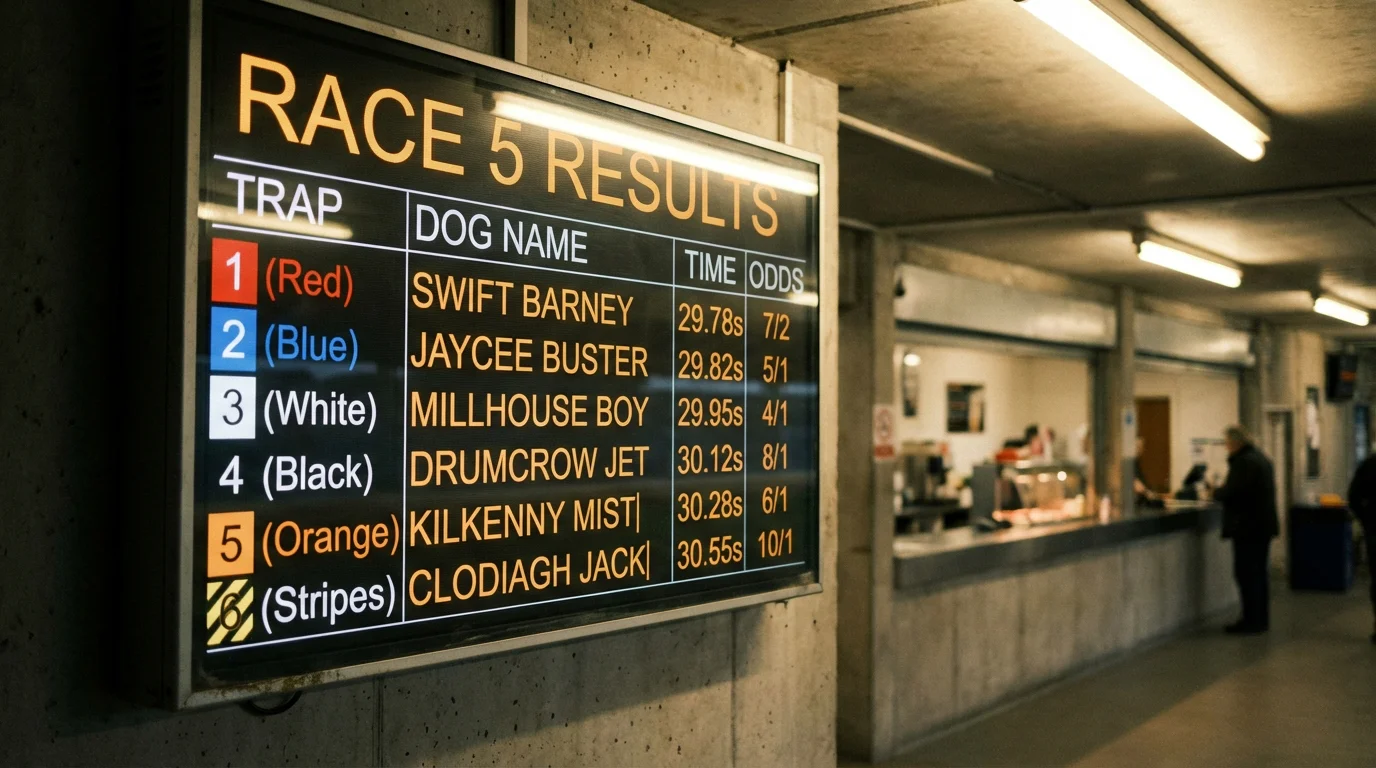
A results board at a UK greyhound stadium displays finishing positions, times and starting prices
after an evening race.
How UK Greyhound Racing Is Regulated
All licensed greyhound racing in Great Britain falls under the authority of the Greyhound Board of Great Britain. The GBGB sets the Rules
of Racing, oversees track licensing, manages welfare standards, and conducts anti-doping testing. Updated rules effective from 1
January 2026 require racecourses to maintain published homing policies for retired greyhounds and injury
retirement protocols. The Board is UKAS-accredited, and every racing greyhound must be microchipped, vaccinated,
and covered by a retirement bond before racing. The sport also falls within the regulatory scope of the UK Gambling
Commission, which licenses all bookmakers offering greyhound markets.
Graded Races vs Open Races: What the Result
Actually Tells You
Graded races are the bread and butter of the sport. Dogs are grouped by ability — typically A1 through A10 —
and move up after winning or down after a series of poor results. The system ensures competitive balance: an A6
dog racing other A6 dogs should produce a close contest. Open races have no grade restriction. The best dogs
from any level can enter, and the field is assembled by invitation or qualification. The Greyhound Derby, the
sport's flagship event, is an open competition.
For bettors, this distinction is critical. A dog's graded form tells you how it performs against dogs of
similar ability. Its open race form tells you how it copes with elite competition. Comparing the two reveals a
runner's true ceiling — something that neither dataset provides alone.
Active UK Tracks in 2026: The Full List
As of early 2026, eighteen GBGB-licensed greyhound stadiums operate across England and Wales. The last
independent track closed in March 2025, consolidating all licensed racing under a single regulatory
framework. This is also the centenary year of British greyhound racing — a hundred years since the first modern
race at Belle Vue in Manchester on 24 July 1926 — and the GBGB has scheduled 50 category one and 27
category two open competitions to mark the occasion.
The tracks span from Brighton and Hove on the south coast to Newcastle and Star Pelaw in the north-east. London
is served by Romford. The Midlands has Nottingham, Monmore Green, and Dunstall Park. Yorkshire and the north are
covered by Doncaster, Owlerton, Kinsley, Newcastle, Star Pelaw, and Sunderland. East Anglia has Harlow,
Mildenhall, and Great Yarmouth. Oxford and Towcester serve the Thames Valley and south-central England, Central
Park covers Kent, and Valley in Wales remains the sole Welsh venue — though its future is uncertain after the Welsh Government's 2025 announcement of a
planned ban on greyhound racing.
How to Read UK Greyhound Race Results (And What Every Column Means)
Most punters read the winner. Sharp punters read the splits, the margin, and the trap — then they read who
finished second. A standard result row includes: finishing position, trap number, dog name, finishing time,
distance beaten in lengths, SP, BSP, forecast and tricast dividends, trainer name, grade, and distance. Some
services add sectional times. Each column serves a purpose.
Step 1 — Time (29.62s): Compare to the track average for this grade. If the average is
29.80, this dog ran 0.18s faster — strong individual form or fast conditions on the night.
Step 2 — Trap 4: A middle-box winner needs early pace or the speed to run wide through the
first bend. Winning from here signals genuine ability, not a favourable draw.
Step 3 — SP 7/2 vs BSP 4.80: BSP backers received a better return. This divergence is common
in greyhound racing and one reason exchange users often outperform SP-only punters.
Step 4 — Trainer: Patrick Janssens is among the UK's most successful trainers. Top kennels
place dogs in the right races at the right time.
Understanding SP vs BSP in Greyhound Results
The Starting Price is the final price offered by on-course bookmakers when the traps open — the traditional
settlement mechanism for most UK greyhound bets. The Betfair Starting Price is an exchange-derived price
calculated from all unmatched back and lay bets at race time. Because BSP reflects a wider pool of money than
the handful of on-course bookmakers who set the SP, it often diverges from the traditional price. In many cases
BSP pays more, particularly on outsiders where on-course liquidity is thin.
If you habitually back at SP and the BSP consistently pays 10-15% more, you are leaving money on the table over
hundreds of bets. Checking both columns in the result card after every race is the simplest way to identify
which route works better for your selections.
Finishing Times and What They Tell You About Form
Finishing times are measured electronically to hundredths of a second. Unlike horse racing, greyhound times at
the same track and distance are broadly comparable. A dog that runs 29.50 at Nottingham over 480 metres and
clocks 29.85 two weeks later at the same venue — something has changed: fitness, weight, track conditions, or
early position.
Track conditions are the main variable. Sand-based surfaces slow down in wet weather and speed up when firm.
Experienced punters track not just individual times but the difference between a dog's time and the card
average. If the average winning time is 0.3 seconds slower than usual, the surface was running heavy, and every
individual time needs adjusting. Sectional times — the split from trap to the first bend — add further insight.
A dog reaching the first bend in 5.20 seconds is a pace runner; one posting 5.45 but still finishing in 29.50 is
a closer. Each style has different implications for trap draw and selection.
Forecast and Tricast Returns Explained
Every UK greyhound result includes forecast and tricast dividend figures — returns for bets that correctly
predicted the first two or first three finishers in exact order. Unlike fixed-odds bets, these are pool-derived:
the total amount bet on all combinations, minus the operator's deduction, distributed among winning tickets.
A forecast dividend of 24.50 means a one-pound straight forecast returned twenty-four pounds fifty. Tricast
dividends are typically much larger because there are 120 possible outcomes in a six-dog race versus 30 for the
forecast. Returns of 100/1 or more are not unusual.
The dividend figures also reveal how predictable a race was. A forecast paying 5.00 means the market got it
right. A forecast paying 150.00 means the favourites bombed. A dog that repeatedly appears in the first two of
high-paying forecasts is producing results the market is not pricing correctly — potential value for those
paying attention.
UK Greyhound Tracks: Every Active Venue, Race Schedule and Quirks
Not all tracks are created equal — a dog with a 30.1-second personal best at Romford may struggle at Towcester,
and the results do not lie about it. Each of Britain's eighteen GBGB-licensed tracks has its own geometry,
surface characteristics, and race-night schedule. Track circumference ranges from under 400 metres to nearly
500. Bend radii differ enormously, and directional preference — clockwise or anticlockwise — affects trap bias
in measurable ways.
Romford
London (Essex) — 400m, tight circuit, strong Trap 1 bias. Evening racing Mon/Wed/Fri/Sat.
Suffolk — 400m (Suffolk Downs), compact track in East Anglia.
Yarmouth
Norfolk — 462m, home of the East Anglian Cup.
Brighton and Hove
Sussex — 515m, historic south coast venue, home of the Regency.
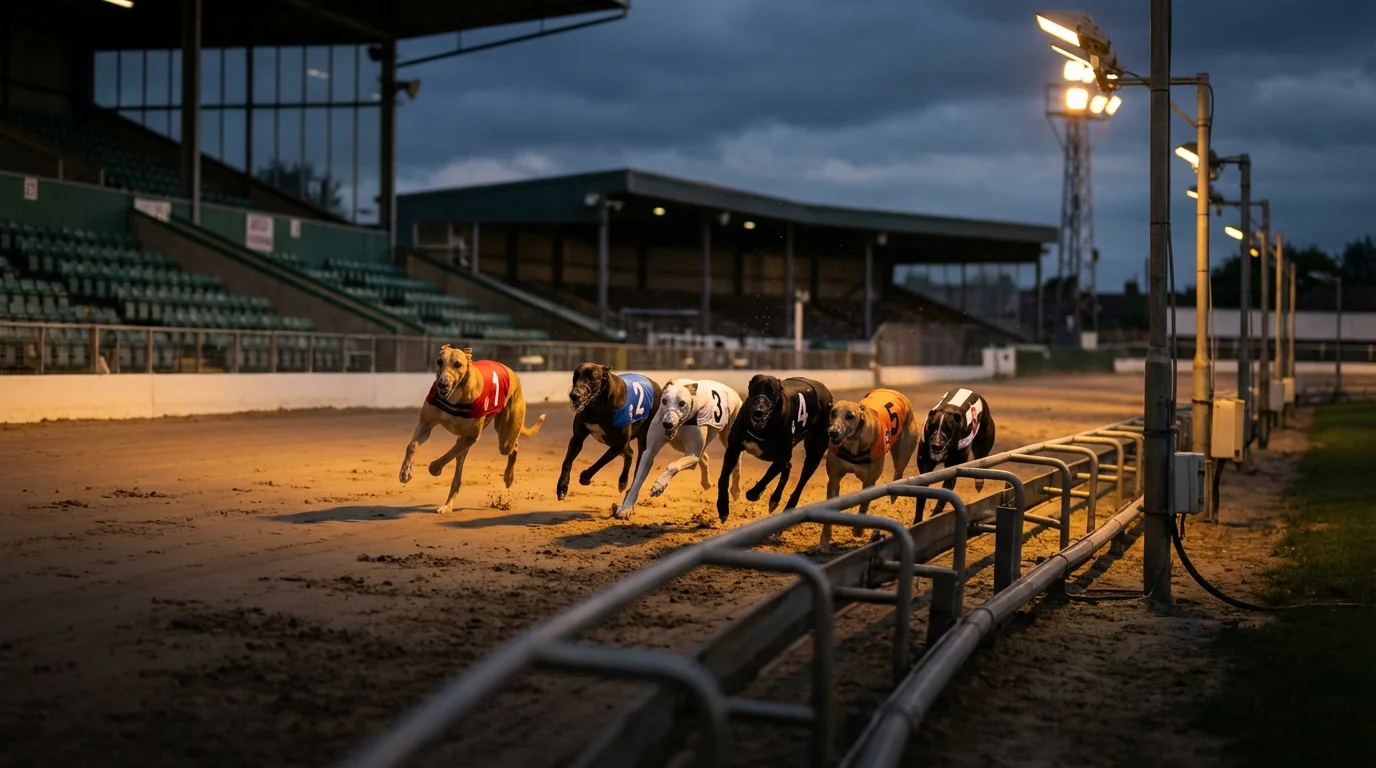
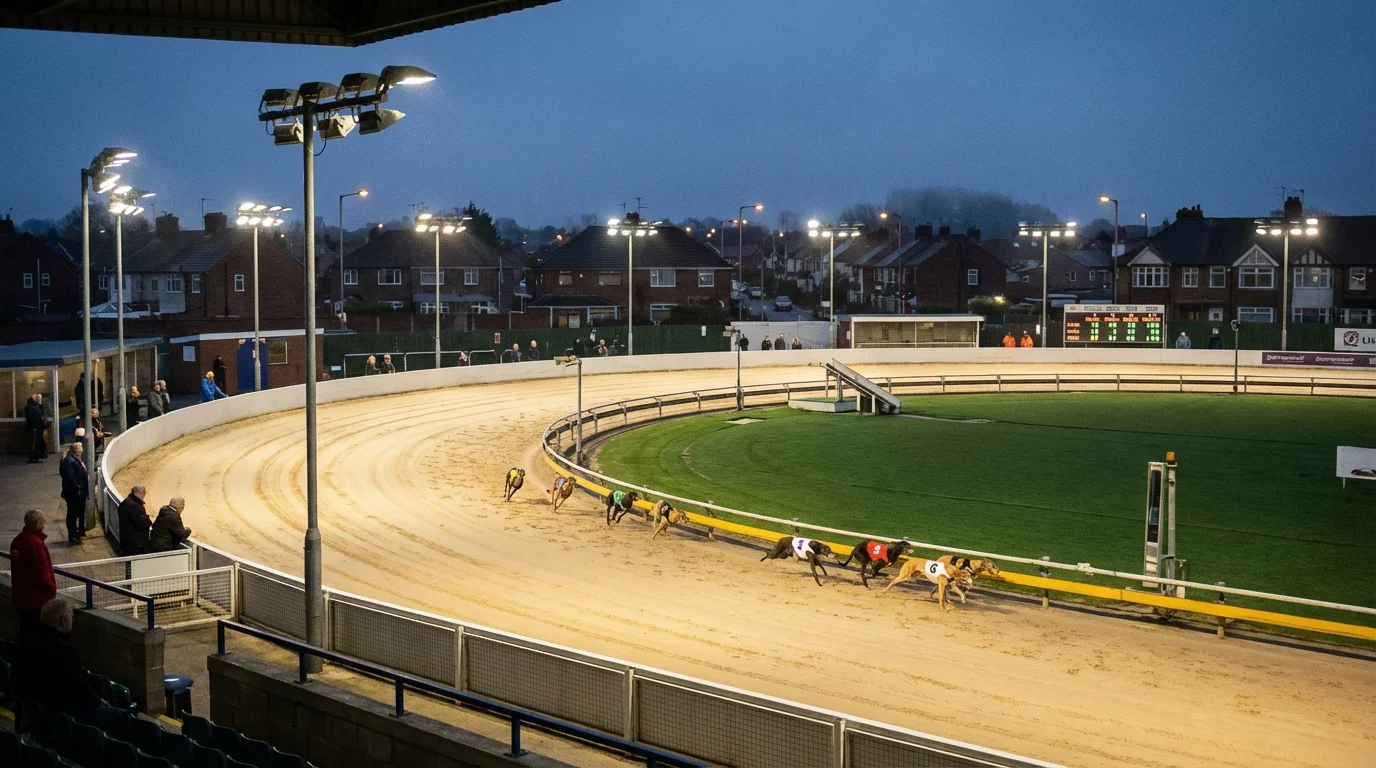
An evening meeting at a GBGB-licensed UK greyhound stadium, with floodlights illuminating the sand
track.
London and South East Tracks
The south-east remains the heartland of UK greyhound racing by volume. Romford is the flagship venue, running
four evening cards per week and hosting some of the best-attended meetings in the country. Its compact 400-metre
circuit produces fast, tight racing where trap position is king — Trap 1 has a documented win rate well above
the statistical average. Crayford, which had been just south of the Thames and was known for its extreme
inside-trap bias, closed
in January 2025 — one of three GBGB track closures during the year.
Central Park at Sittingbourne offers a more balanced layout. Further south, Brighton and Hove provides the
south coast's greyhound racing, with a larger 515-metre circuit that suits stayers and middle-distance runners.
Oxford, in the Thames Valley, has been revitalised under new management and will host eight Category One
events in 2026. For punters following results from London and the south, the key lesson is that form
rarely transfers cleanly between these tracks — a dog that wins from Trap 5 at Brighton may struggle from Trap 5
at Romford because the geometry is completely different.
Midlands and Northern Tracks
The Midlands belt hosts significant venues at Wolverhampton: Monmore Green and the newly opened Dunstall Park.
Monmore Green has arguably the best surface in the Midlands — consistent, well-drained, and producing reliable
times that make form comparison straightforward. Perry Barr, the traditional Birmingham powerhouse, closed in
August 2025, but Arena Racing Company replaced it with Dunstall
Park, which opened in September 2025. Dunstall Park's Arena Racing Company Scurry
was upgraded to Category One status for 2026, marking the venue's growing significance in the open race
calendar.
Moving north, Nottingham acts as a critical mid-country hub and hosts the Select Stakes, one of the sport's
premier open competitions. Doncaster, Owlerton in Sheffield, and Kinsley serve Yorkshire, while Newcastle, Star
Pelaw, and Sunderland cover the north-east. Sunderland runs a strong evening schedule that attracts a dedicated
local following. Star Pelaw (formerly Pelaw Grange), purchased by
Star Sports Bookmakers, has seen serious investment, and its Untold Racing Stewards Cup has been upgraded
to Category One for the first time in 2026 — a signal that the northern circuit is gaining prestige.
Key Venues for Major Events
Towcester is the single most important track in UK greyhound racing for one reason: it hosts the English
Greyhound Derby, the sport's most valuable and prestigious event. The Derby takes place in May and June,
running over six rounds from first heats to the final, with a winner's prize of 175,000 pounds. Towcester's
wide, sweeping layout favours strong gallopers over pure railers, making it a true test of ability rather than
trap draw.
Beyond the Derby, the major event calendar spans the full year. Nottingham's Select Stakes, Brighton's Regency,
and Great Yarmouth's East Anglian Cup are all category one fixtures. The GBGB's 2026 centenary
calendar is the most extensive open race programme in recent memory, with 50 category one and 27 category
two events distributed across multiple tracks. For bettors, major event results carry disproportionate weight in
form analysis — a dog that runs well in open company against the best is a different proposition from one that
dominates a local A5 grade.
How to Read a Greyhound Racecard Before the Results Come In
The racecard is the result before the race — every number in those tiny columns is a forecast waiting to be
read. A standard UK racecard lists six runners and provides: trap number, dog name, form figures, grade of
previous races, trainer, previous finishing times, and weight. Some services also include a synthesised rating
figure.
Trap 1 and Trap 2 railers win disproportionately at clockwise tracks with tight first bends. At Romford and
Harlow, inside-box runners produce a large share of all winners at sprint distances — a statistical edge that
casual punters routinely underestimate.
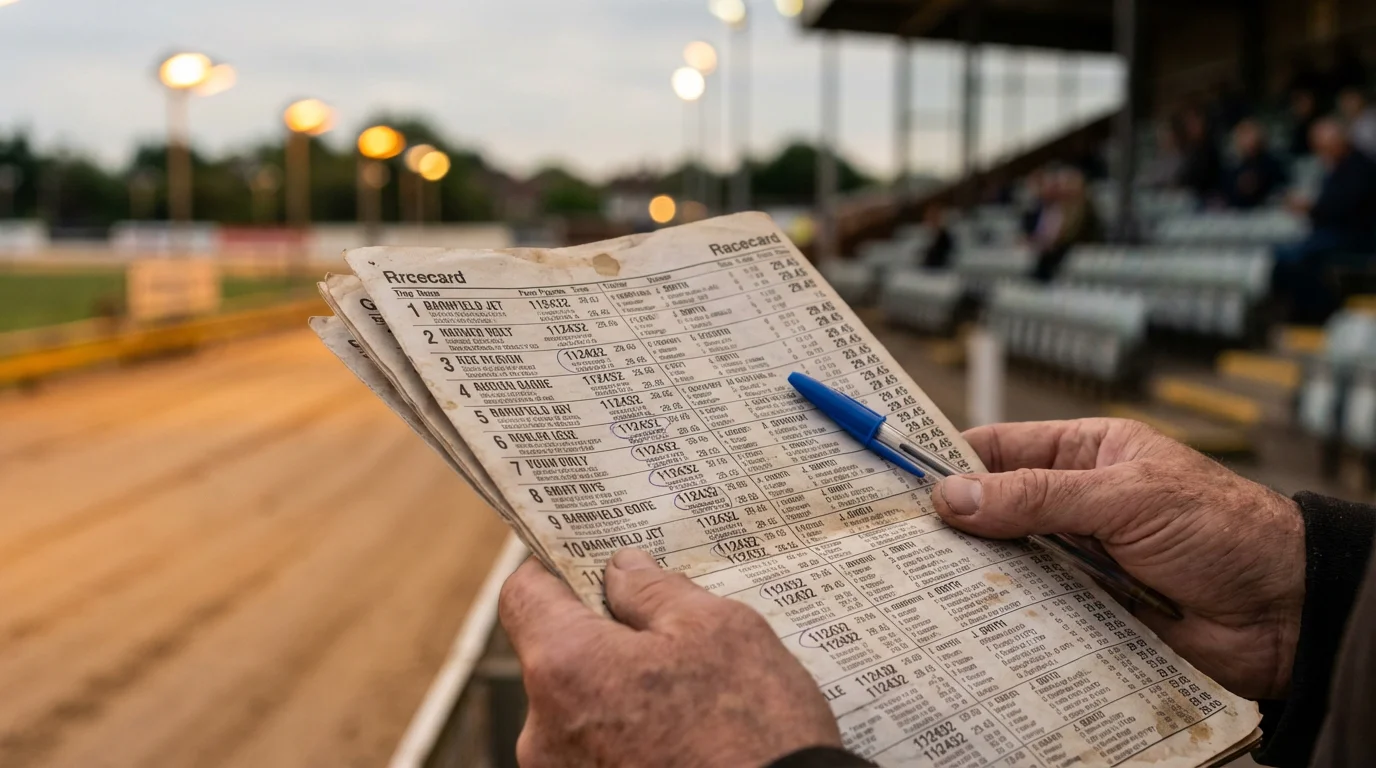
A punter reviews form figures and trap draw information on a greyhound racecard before the next
race.
Form Figures Decoded: What 1-6, F, W, R Really Mean
The form string is the most information-dense element on any racecard — a sequence of numbers and letters
representing a dog's finishing positions in its most recent races, typically the last six. A string of 211432
means the dog finished second, first, first, fourth, third, second in its last six runs, with the most recent
run on the right.
Letter codes carry specific meaning. F means the dog fell — a fall often affects the next two or three runs. W
indicates a walkover with no real competition. R means the dog refused to chase or was pulled up. D indicates
disqualification, usually for interference. The most recent two figures carry the most weight, but always check
the grade column alongside them: 66 in A3 company is very different from 66 in open races.
How Grade Changes Signal Value Bets
A dog dropping a grade is often a gift. A dog going up a grade is a warning. The grade column shows the class
of each dog's recent races. If a dog ran in A4 last week and enters A5 tonight, it has dropped — and its
previous times against better dogs become even more valuable as a prediction tool.
Grade drops happen when a dog finishes outside the places, or when a trainer enters it at a different track
with a more favourable grading structure. The reverse matters equally: a dog rising from A6 to A5 after
consecutive wins faces harder company, and its winning form may not translate. Smart bettors track grade changes
across multiple runs, looking for dogs that have been dropping steadily and are now well below their natural
level — these runners are undervalued by the market more often than any other category.
Trap Draw Bias: Which Box Wins Most at Each Track
At certain UK tracks, trap draw is one of the strongest predictive factors. At Romford and Harlow — tracks with
tight first bends — inside traps produce statistically more winners. A dog from Trap 1 has the shortest run to
the rail and the tightest line through the bend. At tracks with wider geometry like Nottingham and Towcester,
outside runners compete more effectively because there is room to run wide without losing critical lengths.
Track direction matters too. At clockwise tracks, Trap 1 is naturally on the inside. You need external trap
statistics — available from Timeform and other data services — to quantify the bias at each venue. The racecard
gives you the starting point: the trap number itself. Matching that to track-specific data gives you a genuine
analytical edge.
Reading Trainer Form and Kennel Data
A trainer in form is a multiplier. In UK greyhound racing, the trainer makes almost every meaningful decision:
when a dog runs, at which track, over which distance, and after how much rest. A sharp trainer places dogs where
they have the best chance. Mark
Wallis, confirmed as GBGB
Trainer of the Year for 2025 for a record sixteenth time, exemplifies consistent kennel form — his runners
win at a rate that significantly exceeds the baseline.
Trainer strike rates are available through Timeform and the Racing Post. Look also for trainer patterns at
specific tracks: some kennels have higher strike rates at certain venues because they have learned the track's
quirks over years of entries. If a trainer sends a dog to a track where they rarely compete, it is worth asking
why — the answer can signal intent.
Graded racing · A1–A10 · six-runner fields
Up one, down three
One win moves a dog up a grade. Three unplaced runs move it down. Neither trigger is worth a full grade of evidence — so the grade column always trails the dog, and the gap has a price you can read off the card.
Dropped a grade last time out
—
—
—
Any dog in the grade
16.7%
5/1
the six-runner baseline
Moved up a grade last time out
—
—
—
Same track, same trip, same six traps. The only thing that differs is which way the grade column moved last week. These are fair prices from the grade signal alone, before any margin and before the market makes its own adjustment.
Conditions
The two gates
True ability of every dog in one grade, measured against the average dog in that grade. The grey field is the whole grade. The two coloured fields are the dogs that walked through each gate last week — and the brackets below show how much evidence each gate actually collected before moving a dog a full grade.
Everyone in the gradeCame down a gradeWent up a grade
What the gate knew
Evidence behind each move, priced in grades.
The step the ladder takes1.00 grade
Evidence in one win—
Evidence in the losing run—
Ladder climbed vs descended—
—
Price check
Put the price you are actually being offered against the fair price above.
—
How long the error lasts
Win chance over the ten runs that follow a grade change, against the 16.7% baseline. The ladder cannot correct a bad promotion until the dog has run up the required losing sequence — which is why the promoted line keeps falling before it turns.
—
—
is the spread of true ability inside a single grade — a grade is about as wide as the gap to the next one.
—
of the time a dog taken at random from the grade below beats one taken at random from the grade above.
—
of the field is more than half a grade away from where the grade column says it belongs.
Method, and what this does not do
Every dog carries a true ability expressed as a time over the trip. A grade is a rung on a ladder, and the rungs are one class gap apart. What matters is not the dog’s absolute ability but its mismatch: how far it sits from the average dog in the grade it currently races in.
In a race, each of the six runners posts its true time plus an independent random error — the run-to-run scatter that the trap draw, the first bend and the going all feed into. The fastest of the six wins. Win and place chances are integrated exactly over that error, with the five opponents drawn from the same grade population as the dog itself.
The grading rule is the one described on this page: a win moves the dog up one grade; the required run of unplaced finishes moves it down one; any placed finish resets the count. Between runs the dog’s own ability drifts a little. The tool then solves for the equilibrium of that whole machine — the distribution of mismatch that reproduces itself race after race — and reads the two conditional populations off it: the dogs that have just been promoted, and the dogs that have just been dropped.
Field size: 6
Mismatch grid: 97 bins, ±6 grades
Equilibrium: fixed point, opponents drawn from the solved population
Identity check: — (target 16.667%)
That last line is the model marking its own homework. If the dog and its five opponents all come from the same grade, every one of them must win one race in six. The number above is what the engine actually computes. It should land on 16.667% to within grid error — the small residual you can see is discretisation, not a shortcut.
Because a win is more common than a losing sequence, the rule pushes dogs up the ladder faster than it lets them back down. In a real racing population that pressure is absorbed by young dogs improving, older dogs retiring and new dogs entering at the bottom, so the tool measures every dog against the current average of its own grade rather than against a fixed absolute standard.
What this does not do. It carries no trap draw, no track bias, no trainer strike rate, no sectional times and no going allowance. It prices one column of the racecard — the grade, and the direction it last moved — on the assumption that everything else in the race is even. In a real card it never is. Treat the output as the size of the grade signal, not as a selection.
Educational tool. It produces fair prices with no bookmaker margin in them, and no bet is a good bet at the wrong price. 18+. If gambling is causing you problems, the National Gambling Helpline is free and confidential on 0808 8020 133.
Every Greyhound Bet Type Available in the UK: From Win Singles to Tricasts
The win single is the entry point. But the punters who consistently extract value from dog racing results are
the ones who understand what a combination forecast does — and when to use it. What follows is a complete
breakdown of every bet type available to UK greyhound punters.
Worked Example: Each-Way Bet on a Greyhound
You back Trap 3 at 4/1 each-way. The each-way terms are 1/4 odds for two places.
If Trap 3 wins: Win part pays 4/1 = 4.00 profit on a 1.00 stake. Place part pays 1/1 (4/1
divided by 4) = 1.00 profit on a 1.00 stake. Total return on a 2.00 total stake (1.00 win + 1.00 place) = 7.00
(5.00 profit).
If Trap 3 finishes second: Win part loses (minus 1.00). Place part pays 1/1 = 1.00 profit.
Total return = 2.00 on a 2.00 stake (break-even).
If Trap 3 finishes third or worse: Both parts lose. Total loss = 2.00.
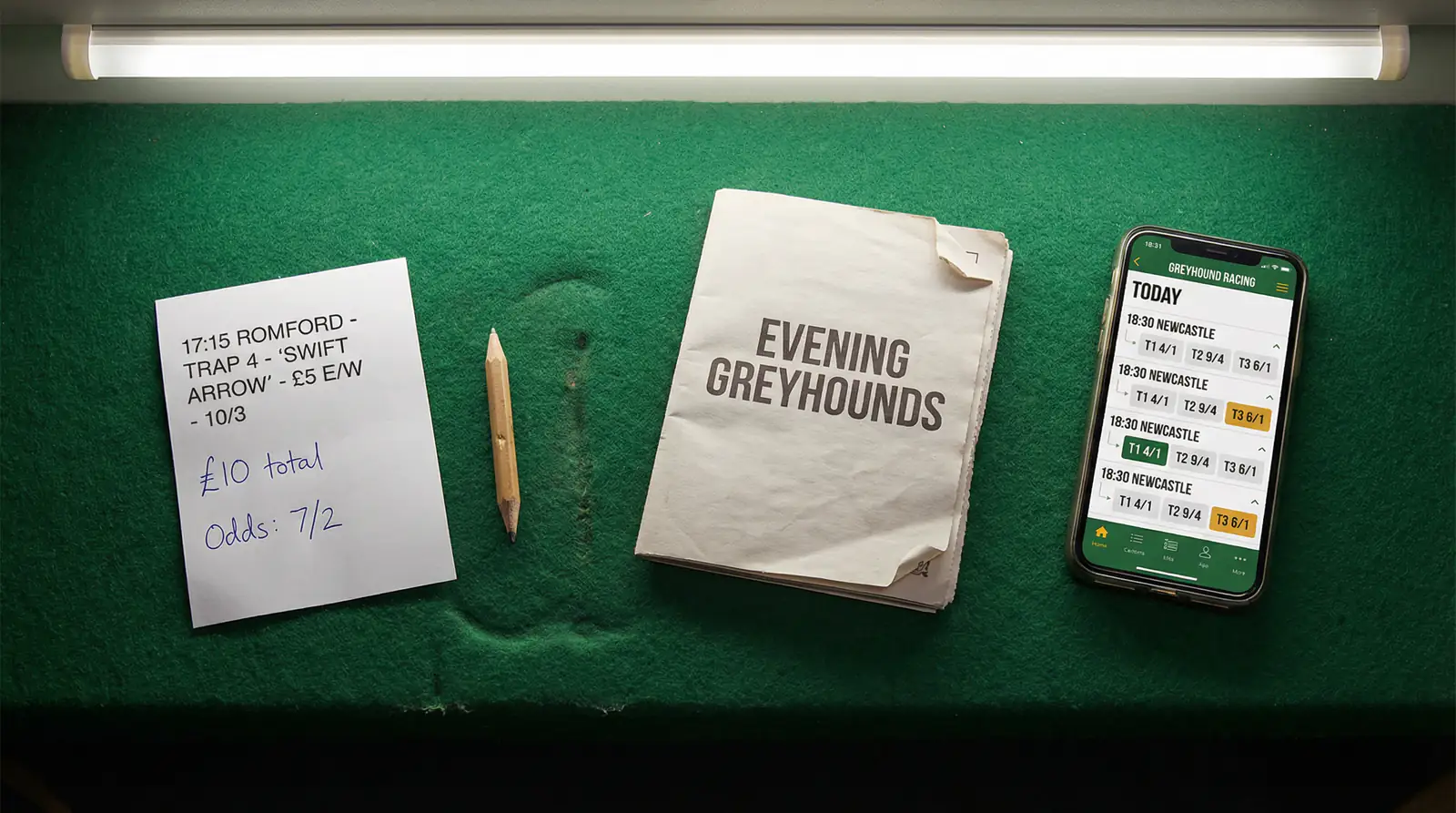
An each-way betting slip next to a phone displaying live greyhound odds from a UK bookmaker app.
Win and Each-Way Bets on Greyhounds
The win single is the simplest bet: pick a dog, it wins, you collect. In a six-runner field, the probability
baseline is inherently higher than in larger horse racing fields. The each-way bet adds a safety margin — two
bets in one, covering the win and a place (typically first or second). The place part pays at a fraction of the
win odds, usually one-quarter for greyhounds.
Each-way value depends heavily on price. At short odds the place return barely covers the stake. At 5/1 and
above, the place part starts generating meaningful returns. Experienced punters use win singles on strong
fancies and each-way for medium-confidence selections at bigger prices.
Forecast and Tricast Bets: How They Work and Pay Out
A straight forecast requires you to predict the first and second finisher in exact order. A reverse forecast
covers both orders but costs double. A combination forecast lets you select three or more dogs and covers all
first-second permutations. Returns are pool-derived, calculated by the totalisator. Straight forecasts regularly
pay between 10/1 and 50/1, with occasional returns exceeding 100/1.
Tricast betting extends the logic to three places. A straight tricast predicts first, second, and third in
exact order. With 120 possible outcomes in a six-dog race, even relatively predictable races produce substantial
dividends. Tricasts are best reserved for races where you have strong form convictions about multiple runners.
Accumulator and System Bets on the Dogs
Greyhound accumulators chain two or more win selections, with returns rolling from each leg into the next. A
four-fold at 3/1, 2/1, 5/1, and 4/1 produces a combined return of 359/1. The appeal is obvious. The risk is that
one loser kills the bet.
Do
Limit accumulators to three or four legs for greyhounds.
Use races from different tracks to avoid correlated form.
Back dogs at genuine value prices, not short-priced favourites.
Treat accumulators as small-stake additions to your main betting.
Check each leg's racecard independently before adding it.
Don't
Build six-plus-leg accumulators where probability approaches zero.
Use accumulators as your primary greyhound strategy.
Add unanalysed races just to boost the odds.
Chase accumulator losses by increasing stake or legs.
Ignore the each-way accumulator option where bookmakers offer it.
System bets — Trixie, Patent, Yankee — offer partial insurance. A Trixie covers three selections in four bets
(three doubles and a treble), so you collect even if one leg loses. For greyhound betting, where short fields
make upsets frequent, system bets often represent better value than straight accumulators.
Ante-Post Greyhound Betting
Ante-post markets exist for the sport's major events. The English
Greyhound Derby at Towcester, running in May and June, is the prime market. Bookmakers open Derby betting
months in advance, with prices based on form, trainer connections, and qualifying performance. A dog at 33/1
ante-post may shorten to 8/1 by the semi-finals if it wins early rounds impressively. The risk is clear: if your
selection is withdrawn or fails to qualify, the stake is lost.
The centenary 2026
calendar, with its expanded roster of 50 category one events, offers more ante-post opportunities than any
recent season. The market is thinner than horse racing, less informed by widespread analysis, and slower to
react — all of which work in favour of the prepared bettor who studies form early and backs dogs before the
market catches up.
How to Use Greyhound Form to Interpret Results and Back Winners
Form is not history — it is a map of trajectory. The last six results tell you where a dog has been; the
sectional splits tell you where it is going. You are never evaluating a dog in isolation: you compare its
performance against the dogs it faced, the track, the grade, and the conditions. A first-place finish in a slow
A8 race is not the same as third in a fast A3 — the numbers look worse for the second dog, but the performance
may have been stronger.
Dog in Good Form
Form: 112211. Consistent top-two finishes. Times improving or stable. Weight steady. Same track and
distance. Sectional time to first bend in the top two of each field.
Dog Returning From a Break
Form: 3---1146 (dashes for missed weeks). Gap of three-plus weeks. Weight may have shifted. Different track
or distance. Grade unchanged but now facing race-fit opponents. Current sectional time unknown.
Sectional Times: The Metric Most Casual Bettors
Ignore
The most common sectional split is trap to first bend — around five seconds in a standard sprint. A dog
reaching the bend in 5.15 seconds is a pace dog: it leads from the front and controls the rail. A dog posting
5.40 but finishing in the same overall time is a closer, relying on late acceleration. Neither style is
inherently better, but each has different implications for trap draw and race dynamics.
A pace dog from Trap 1 at a tight track is a strong proposition. The same dog from Trap 6 faces a much harder
task. Sectional times expose this dynamic and are freely available from Timeform for most GBGB tracks.
Weight Fluctuations and What They Signal
Greyhounds are weighed before every race. Typical racing weights range from 26 to 36 kilograms. What matters is
the change: a half-kilogram increase might mean muscle gain, rest-related weight, or reduced exercise from a
minor injury. A decrease might signal peak training fitness or, less positively, stress or illness. A dog whose
weight has been stable across five runs and suddenly shifts a kilogram deserves closer scrutiny. The change does
not give you the answer, but it tells you to ask the question.
Using Free and Paid Form Databases in the UK
The GBGB publishes official results and basic form data. Timeform provides detailed analysis, ratings, and
sectional times through free and subscription services. The Racing Post covers greyhounds with racecards, form
figures, and tips. Sporting Life aggregates results with quick form snapshots and odds comparison.
Paid services offer more granular data: speed ratings, track-adjusted times, and historical databases going
back years. For casual bettors, the free resources from GBGB and Sporting Life provide a solid foundation —
enough to make informed selections rather than guessing from trap numbers alone.
How to Track a Dog's Form Over a Season
Greyhounds race far more frequently than horses — a busy dog might run once or twice a week, accumulating 50 to
80 races per year. This creates an opportunity: form patterns become visible quickly. It also creates a
challenge: dogs decline quickly, and a January flyer may be past peak by April.
Tracking seasonal form means noting times, weights, grades, and rest intervals. A dog that ran six times in
three weeks then rested may come back sharper. One that has raced weekly for two months without a break is more
likely to show fatigue — slower sectionals, wider running lines, finishing positions slipping from second to
fourth to sixth. The form database tells this story if you read it as a sequence rather than isolated snapshots.
Greyhound Odds Explained: SP, BSP, BOG and How to Find Value
The same result, the same dog, the same race — but four different bookmakers just paid out four different
amounts. Understanding how odds work is essential because they are a product of the bookmaker's margin, the
weight of money, and specific pricing mechanisms.
Bookmaker margins on UK greyhound racing typically run at around 20%, significantly higher than the 5-10% on
Premier League football or major horse racing. This makes odds comparison and value identification even more
critical for greyhound punters.
UK greyhound odds are quoted in fractional format — 3/1, 7/2, 11/4 — with decimal equivalents available on most
platforms. The number reflects each dog's implied probability of winning, inflated by the bookmaker's margin.
SP vs BSP: Which Pays Better and When
Over large samples, BSP tends to pay more than SP on outsiders and roughly the same on short-priced favourites.
The reason is structural: on-course bookmakers set the SP from relatively small amounts of money. The Betfair
exchange aggregates wider liquidity and typically produces a more efficient price.
The practical question: take an early fixed price or wait? If you spot value — a price longer than the true
probability suggests — take it before the market corrects. If you are not confident in early prices, BSP is a
reliable fallback that outperforms SP on longer-priced selections over time.
Best Odds Guaranteed: What It Means for
Greyhound Punters
BOG means that if you take a fixed price and the SP is higher, the bookmaker pays at the SP instead. You get
whichever is better. Not all bookmakers offer BOG on greyhounds, and terms vary — some restrict it to specific
tracks or cap the maximum payout. When BOG is available, the strategy is clear: take early prices without fear.
If the dog shortens, you keep your longer price. If it drifts, you get paid more. BOG is the single most
punter-friendly promotion in UK greyhound betting.
How to Compare Odds Across UK Bookmakers for Dog
Racing
Fewer comparison services cover greyhounds in detail, but options exist. Oddschecker includes greyhound markets
from major bookmakers. The Racing Post racecard displays prices from multiple operators. Betfair's exchange
provides a benchmark against which bookmaker prices can be assessed.
The margins matter enormously. A bookmaker at 20% margin systematically offers worse prices than one at 15%.
Over hundreds of bets, this compounds into hundreds of pounds of difference. The simplest strategy: hold
accounts with three or four bookmakers, check prices before every bet, and combine this with BOG where
available. It takes thirty seconds and pays for itself many times over.
How to Watch UK Greyhound Racing Live: Streams, TV and Free Access
You can read ten results on your phone, or you can watch three races and learn more in real time — both
approaches have their place. Watching greyhound racing live adds a dimension that results alone cannot provide:
you see how a dog breaks from the trap, whether it crowded at the first bend, how it responds under pressure in
the final straight. These are the details that separate a form reader from a race analyst.
The primary broadcast routes for UK greyhound racing are Sky Sports Racing and SIS (Satellite Information
Services). Sky Sports Racing covers selected meetings from major tracks and is available through Sky TV
subscriptions and some streaming packages. SIS provides the wider coverage network, broadcasting races from the
majority of GBGB-licensed tracks to licensed betting offices and bookmaker streaming platforms. Between them,
they cover the bulk of the daily racing programme.
For punters at home, the most accessible route to live greyhound racing is through bookmaker apps. Most major
UK bookmakers — including Bet365, William Hill, Paddy Power, Coral, Ladbrokes, and Betfair — offer live
streaming of greyhound races through their mobile apps and websites. The model is bet-to-watch: you need either
a funded account or a recently placed bet on the relevant meeting to access the stream. The quality varies, but
the coverage is comprehensive.
Important: Most bookmaker streams require a funded account or a recently placed bet to
access. Check the specific terms of your bookmaker before relying on a particular stream — requirements
differ, and some restrict access to customers who have bet on that specific race meeting.
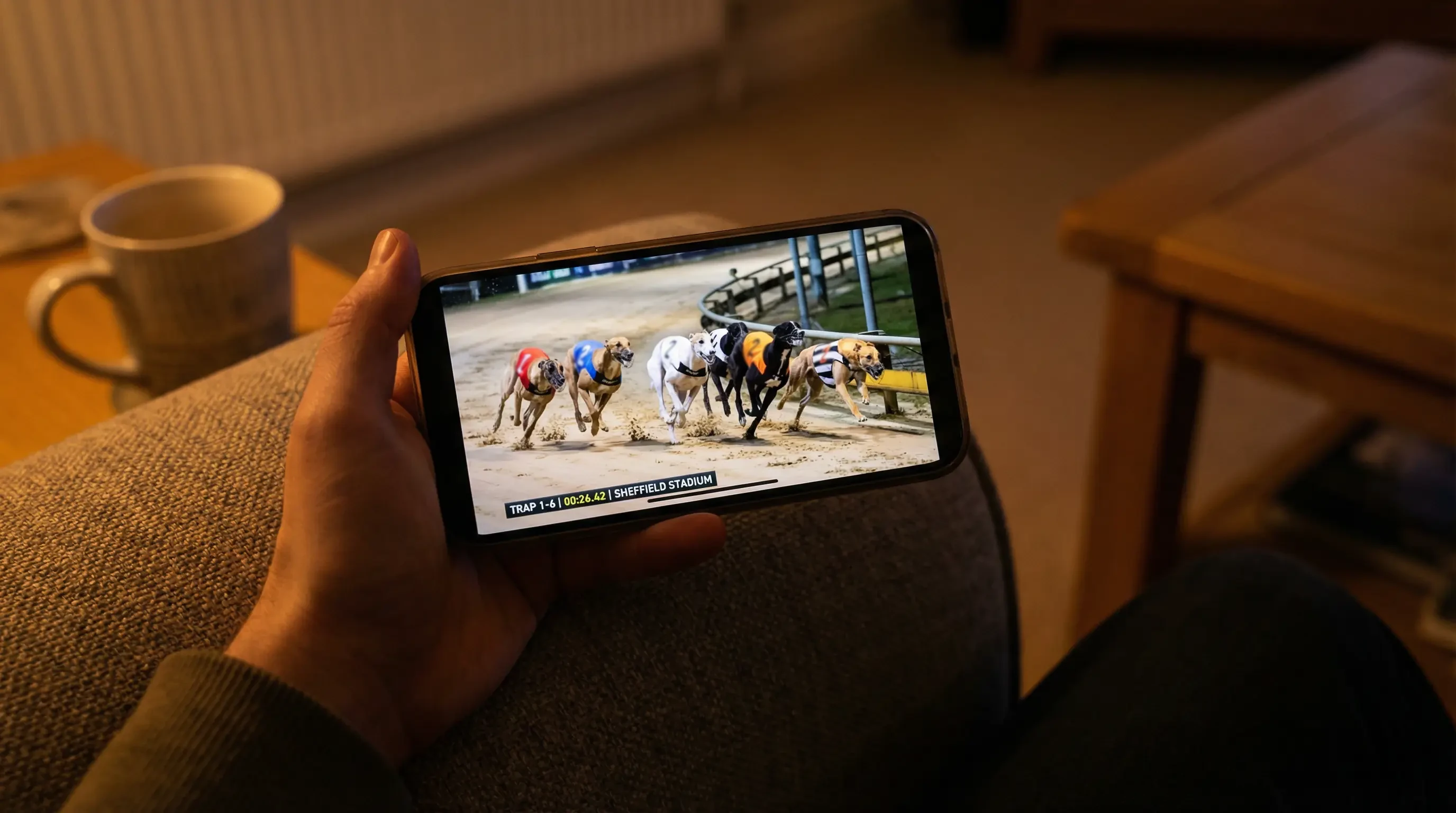
Watching a live UK greyhound race via a bookmaker streaming app on a smartphone.
Free alternatives exist but are more limited. Some tracks offer their own streaming services for selected
meetings. The GBGB and racing media sites occasionally provide live coverage of major events. For regular daily
racing, however, the bookmaker stream is the most reliable and widely available option.
Mobile viewing now dominates greyhound streaming. The bookmaker apps are optimised for phone screens, and the
short race duration makes greyhound racing uniquely suited to mobile. You can check the racecard, watch the
race, and review the result in under three minutes.
For form analysis, watching live adds three things results alone do not capture. First, early pace: which dogs
break fastest and which get crowded. Second, bend running: how dogs handle the turns, whether they drift wide or
hold the rail. Third, finish effort: a dog that closes strongly but runs out of track may be one to back at a
longer distance next time.
Responsible Gambling on Greyhound Racing: UK Rules and Tools
Greyhound racing is one of the UK's most accessible betting sports — and that accessibility carries a
responsibility to know your own limits. With over a hundred races every day, evening schedules that coincide
with peak leisure hours, and mobile apps that put the next bet thirty seconds away at all times, the temptation
to overextend is structural. This section is not a disclaimer. It is practical guidance on how to use the tools
available to keep your betting within boundaries that work for you.
All licensed bookmakers are regulated by the UK Gambling
Commission under the Gambling Act 2005. Every operator must hold an active UKGC licence, implement age
verification (18+), and provide responsible gambling tools. The most important tool is deposit limits — daily,
weekly, or monthly caps on what you can deposit. Once set, limits cannot be increased immediately; most
operators impose a 24-to-72-hour cooling-off period.
Beyond deposit limits, bookmakers offer loss limits, session time reminders, and temporary account breaks. For
a more comprehensive solution, GamStop is the national self-exclusion
scheme, blocking you from all UKGC-licensed sites for a minimum of six months. Disputes with bookmakers can be
escalated to IBAS, the industry's independent adjudication service.
If gambling is causing problems, visit GambleAware.org or
call the National Gambling Helpline: 0808 8020 133. The helpline is free, confidential, and
available 24 hours a day.
Everything in this guide is designed to make betting more informed and more disciplined. But informed betting
only works within limits you have consciously set. The results will still be there tomorrow. Bet what you can
afford to lose, and treat the rest as research.
Frequently Asked Questions
What is the difference between a graded race and an open race in UK greyhound racing?
In UK greyhound racing, graded races group dogs by ability into categories ranging from
A1 (highest) through A10 (lowest), with separate grades for sprint and stayer distances. Dogs move up a
grade after winning and drop down after a series of poor results, ensuring competitive balance within each
race. Open races have no grade restriction — the best dogs from any level can enter, and the field is
assembled by invitation or qualification. Open races carry higher prize money and attract the strongest
runners in the sport. The English Greyhound Derby at Towcester is the most famous open competition. For
bettors, the distinction is critical: a dog's graded form tells you how it performs against peers of
similar ability, while its open race form reveals how it copes with elite competition. Comparing the two
gives you a much clearer picture of a runner's true ability ceiling than either dataset alone.
Which trap number wins most often at UK greyhound tracks?
Across UK greyhound racing as a whole, Trap 1 has the highest overall win rate, primarily
because inside-box runners have the shortest route to the rail on the first bend. However, the extent of
this advantage varies enormously between tracks. At venues with tight first bends — Romford and Harlow are
prominent examples — Trap 1 and Trap 2 produce significantly more winners than the outside boxes. At
tracks with wider, more sweeping bends, such as Nottingham and Towcester, the trap bias is far less
pronounced, and middle or outside traps can win at near-average rates. Track direction also matters: at
clockwise tracks, Trap 1 sits on the inside and has the strongest advantage. The key lesson for bettors is
that trap statistics must always be assessed on a track-by-track basis. A blanket rule such as always
backing Trap 1 would be misleading — at some venues the advantage is marginal, while at others it is
substantial.
What does BSP mean and how does it differ from the SP?
BSP stands for Betfair Starting Price. It is the price calculated by Betfair's exchange
algorithm at the moment a greyhound race begins, based on all unmatched back and lay bets in the exchange
market. The SP, or Starting Price, is the traditional mechanism: the final odds set by on-course
bookmakers at the track when the traps open. The main practical difference for punters is that BSP often
pays more than SP, particularly on outsiders and longer-priced selections. This is because the Betfair
exchange aggregates a larger and more diverse pool of money than the small number of on-course bookmakers
who determine the SP. Over a large sample of bets, punters who settle at BSP on dogs at odds of 5/1 and
above tend to achieve better long-term returns than those who settle at SP. However, for short-priced
favourites, the difference is typically minimal and occasionally favours the SP. Many experienced
greyhound bettors use BSP as their default settlement option unless they can lock in an early fixed price
that is clearly better.
After the Wire: What Every Result Leaves Behind
A greyhound race lasts less than thirty seconds. The result appears on your screen within minutes. And then it
is over — or it appears to be. In reality, every result sets something in motion. The winning dog's time becomes
the benchmark its next opponents will be measured against. The second-placed dog's form string shifts, and the
market will price it differently next time. The losing favourite drifts in the ante-post markets. The trainer
notes which trap caused problems. The punter who backed the outsider is already looking at the next racecard.
This is what makes UK greyhound racing results different from a football score or a cricket total. A football
result is an endpoint. A greyhound result is a data point in a sequence that stretches forward into the next
race, the next card, the next week. The dogs run again in days, not months. The form evolves fast, the grades
shift, and the data accumulates at a pace that no other UK sport matches. The punter who treats each result as a
finished story is missing the point. The punter who treats it as a chapter in an ongoing form narrative is
starting to see the sport clearly.
Everything in this guide — the racecard analysis, the trap statistics, the bet types, the odds mechanisms, the
form databases — is a tool for extracting meaning from that sequence. You do not need to use all of them at
once. Start with the results. Learn what the columns tell you. Then add the racecard. Then the form. Then the
odds comparison. Build the practice gradually, and the results stop being surprises. They start being
confirmations of what the data already suggested.
The hare has already disappeared around the bend. What you do with the number in the results column is entirely
up to you.