
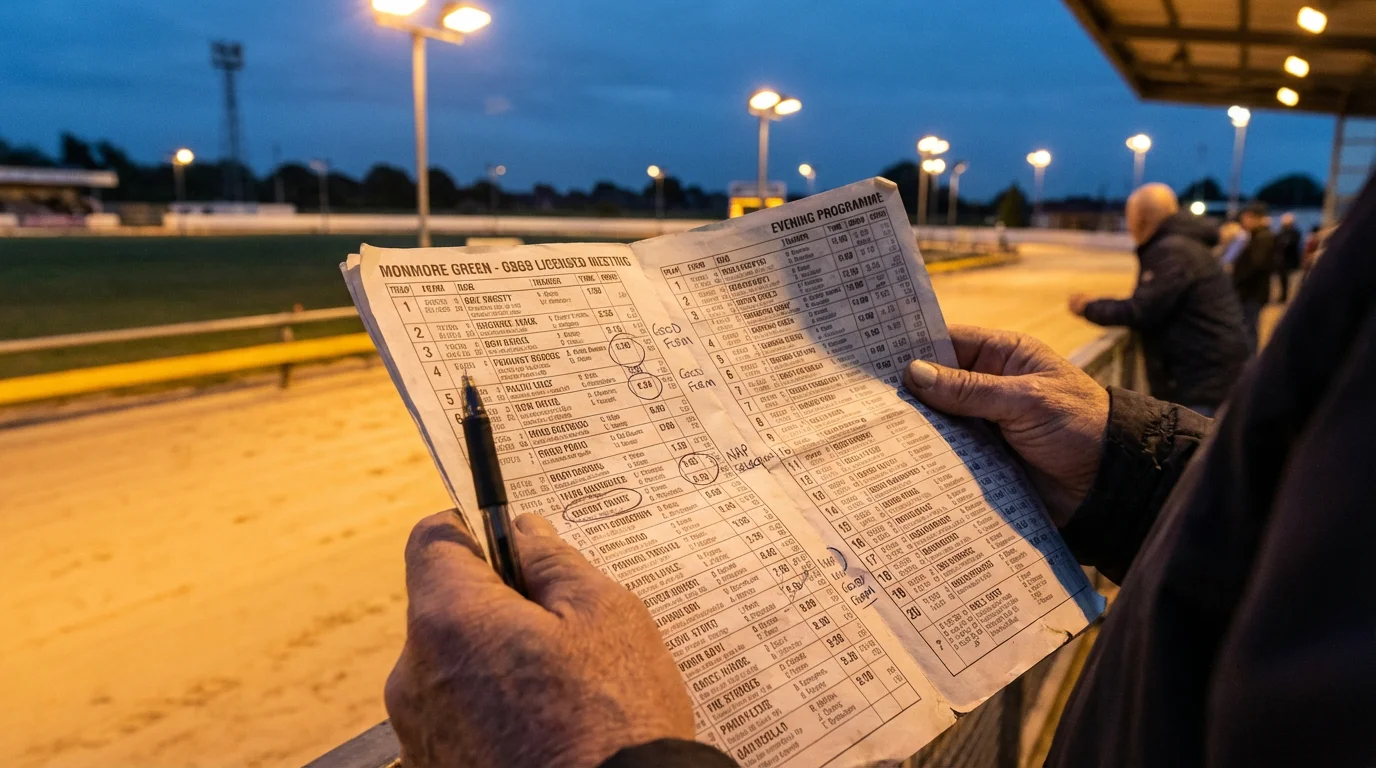
Every number and letter in a greyhound’s form string exists for a reason. Together they form a compressed performance biography — six recent runs condensed into a handful of characters that tell you, if you can read them, exactly where the dog stands in its current campaign. Most punters read the most recent digit and move on. The ones who read the whole string, in sequence, with the context of distance and grade and track and time, are operating with a fundamentally different quality of information. Form is a language, and this guide teaches the vocabulary.
UK greyhound form is structured differently from horse racing form, and the comparison is worth making because punters who migrate from one sport to the other often bring assumptions that do not transfer cleanly. In greyhound racing, there are typically six dogs per race rather than a field of fifteen to thirty. The grade structure means each dog is theoretically competing against opponents of equivalent ability. And the volume of racing — a dog can run every ten to fourteen days, sometimes more frequently — means form strings update quickly enough to be genuinely current. A greyhound’s form string from six months ago is almost entirely irrelevant. Its form from the last four weeks is the live analytical document.
How to Read UK Greyhound Form Figures
The standard UK greyhound form string consists of the six most recent finishing positions, reading right to left from oldest to most recent. A form string of 321412, reading left to right as the most recent entry last, shows a dog that has recently won, placed, and generally competed — but reading the sequence directionally reveals whether the dog is improving or declining through that run of form. Three second places followed by a win followed by two wins is a dog on a rising trajectory. One win followed by three second places and two thirds is a dog that may have peaked and is being overtaken.
The key codes beyond the numbered finishing positions are:
- F — Fell. The dog went down during the race, almost always at or through a bend. A fall is excluded from form assessment as a performance indicator — it says nothing about the dog’s ability and almost everything about an isolated incident of contact or track.
- W — Walked over. The dog won uncontested because all other runners were withdrawn. This is not a form performance. Treat it as a blank rather than a win when assessing trajectory.
- R — Refused to race. The dog did not participate in the race after entering the trap. Often associated with a dog that is unhappy with conditions, nervous, or in physical discomfort. A single R in a form string is a flag; multiple Rs are a serious concern about the dog’s current temperament or welfare.
- D — Disqualified. The dog crossed the line but was removed from the result by the stewards, typically for serious interference causing another runner to fall. The disqualification applies to the result, not the performance — the dog ran, its time can be noted, but the position is not part of the form record.
- 0 — Finishing sixth. In UK form notation, sixth position is typically recorded as 0 rather than 6 to distinguish it from the digit and keep the string compact. A 0 is the worst result in a six-dog race and should be read as exactly that — the dog was last.
The form string on its own is incomplete without the grade and track codes that accompany each entry. A string reading 112 looks exceptional until the grade codes reveal that the three wins were in A6 and A5 company. Whether that trajectory continues upward depends on how fast the dog has been running relative to A4 par times, not on the position sequence alone. The digit is the headline; the grade is the context.
Graded Form vs Open Race Form: Not the Same Scale
Graded racing and open racing in UK greyhound competition are not points on the same ability scale — they are different competitions with different selection criteria, different field quality controls, and different analytical implications. Understanding this distinction is one of the most important conceptual divides between a casual greyhound form reader and a serious one.
In graded racing, each dog is assigned to a grade by the track grader based on its recent performance. The grader’s job is to place the dog in the grade where it competes against others of equivalent ability, with the expectation that races will be competitive. This means that a dog’s form in A-grade competition — regardless of whether it is winning or losing — tells you something about its ability relative to its own grade level, but nothing definitive about its ability in absolute terms without the time data to anchor it.
Open races are invitational. The track or event organiser selects the entrants based on their form and the narrative of the competition. The field is therefore not grade-controlled — it is ability-curated. An open race at Towcester during the Derby draws the best greyhounds available from a national pool. An open race at a regional venue might draw the best available dogs from a regional pool that is meaningfully narrower in absolute ability terms. The form a dog shows in either open race context is calibrated against the specific quality of the field in that event, not against a graded average.
The practical implication for form reading is that a dog with a history of competitive open race performances is demonstrating measured quality against known opponents. A dog with only graded form is demonstrating quality relative to a grade level that is internally calibrated but only approximately related to the national ability distribution. When these two types of dogs meet in an open event, the dog with open race form experience typically carries a more legible form profile — the punter has more direct evidence of how it performs when the competition is defined by ability rather than grade assignment.
Seasonal calibration differs between the two formats. Graded form compresses naturally — dogs improve, get graded up, and their win rate falls as competition stiffens. A win in A4 last month is not the same quality statement as a win in A2 this month. Reading a long form string that moves through grade changes requires accounting for this shift — the grade code, not just the position digit, carries the meaning.
Track and Distance Changes in Form: What They Signal
The track code and distance that accompany each entry in a dog’s form guide are not footnotes — they are essential context for every single performance in the string. A dog’s best time at Romford over 400 metres is not directly comparable to its best time at Towcester over 480 metres. The tracks are different sizes, the surfaces are maintained to different conditions, the going varies, and the competition field within each grade is calibrated locally. Treating times across venues as directly comparable without any correction is the form equivalent of converting miles to kilometres by assuming they are the same unit.
Track changes in a dog’s form string signal several different things depending on the direction and reason. A dog that moves from a tight-circuit venue to a wide-circuit venue for the first time will typically run below its expected time on the first appearance, as it adjusts to the different bend geometry and wider racing line. This first-run-at-a-new-track discount is real and documented across the UK greyhound form record. A punter who applies it correctly will not dismiss the dog’s poor debut at Towcester as evidence of decline — they will wait for the second or third run at the venue before revising the dog’s Towcester form assessment downward.
Distance changes carry their own signal. A dog moving from 400 metres to 480 metres for the first time is testing sustained pace rather than explosive early speed. Some improve significantly at the longer trip — particularly those who finish well in 400-metre races after a slow start. Others decline, especially front-runners who cannot maintain pace for an extra eighty metres. The form guide reveals which type a dog is: look at how its positions and margins distribute between the early and closing stages of recent races.
Going changes also require explicit treatment. A dog whose best times cluster on firm summer surfaces and runs noticeably slower on soft winter going is surface-dependent. Its form from wet-ground outings should not be treated as representing its current level on fast going — a consistent error in the autumn-to-spring transition period that produces mispricings the careful form reader can identify.
Free and Paid Form Databases for UK Greyhound Punters
The public availability of UK greyhound form data is substantially better than most punters realise. Several high-quality sources provide free access to form records, and the paid services — while more comprehensive — are not necessarily required for a productive form analysis practice at the level most punters operate.
The GBGB at gbgb.org.uk is the authoritative source for official results and basic form records. It covers all GBGB-licensed meetings with finishing positions, times, and SP data. The interface is functional rather than elegant, but the data is complete and reliable. For historical form research — tracking a specific dog’s full record across venues and distances over a season — the GBGB archive is the correct starting point.
Timeform provides form data, race ratings, and trainer records for UK greyhound racing. Its free tier covers basic results and form figures; the paid subscription adds ratings, sectional data, and predictive tools that are genuinely useful for serious form analysts. Timeform’s greyhound ratings — which attempt to convert performance into a standardised numerical scale — are particularly useful for cross-track and cross-grade comparisons of the kind that raw form figures alone cannot support.
The Racing Post’s greyhound section at racingpost.com/greyhounds carries racecards, full form guides, and results with trainer and kennel data. The free tier is comprehensive enough for most purposes; the paid subscription adds predictive ratings and detailed sectional information. The Racing Post’s editorial commentary on major events is available without subscription and provides valuable qualitative context alongside the quantitative form data.
OLBG at olbg.com publishes annual and seasonal track statistics including favourite win rates, trap bias data, and tipster performance records. This is not a form database in the traditional sense but it is a useful statistical reference for the structural analysis layer that sits above individual form reading.
Building a Form Model: Where to Start
A form model is not necessarily a spreadsheet or a statistical algorithm. For most greyhound punters, it is a set of consistent analytical practices applied to the same set of data in the same order before every betting decision. The discipline of consistency matters more than the sophistication of the method, because the principal failure mode in greyhound form analysis is not complexity — it is inconsistency, cherry-picking, and post-hoc rationalisation of selections that were made on impulse and justified with form data afterwards.
The simplest effective approach to building a form model begins with a single track and a single grade. Pick a venue you will follow consistently — Romford, Crayford, Nottingham, or any track where the evening cards are regular and accessible — and focus on one or two grades within the graded structure at that venue. Read every result from those grades, noting the finishing times, margins, trap numbers, and running conditions. After four weeks, you will have a picture of the active dogs in those grades, their form trajectories, their running style preferences, and their typical time ranges. That picture is more valuable than any general guide to greyhound form analysis could provide, because it is specific to the dogs and conditions you are actually betting on.
From that foundation, add layers incrementally. After time comes grade comparison: are any dogs running times that suggest they belong in the grade above? After grade comparison comes trainer form: which kennels are producing a disproportionate share of winners from your tracked grades over the last four to six weeks? After trainer form comes the draw modifier: which dogs have running style preferences that create predictable mispricings when the draw goes against them? Each layer added to the base time analysis makes the model more precise — and each layer is built from publicly available data that most punters are not using systematically.
Building this model takes weeks, not hours. It requires watching races alongside reading results, because the visual information from a replay — how a dog moves through the bends, where it accelerates — supplements the numbers in ways the form string alone cannot convey. The number is the outcome. The visual is the explanation. Both are part of the complete form picture.