
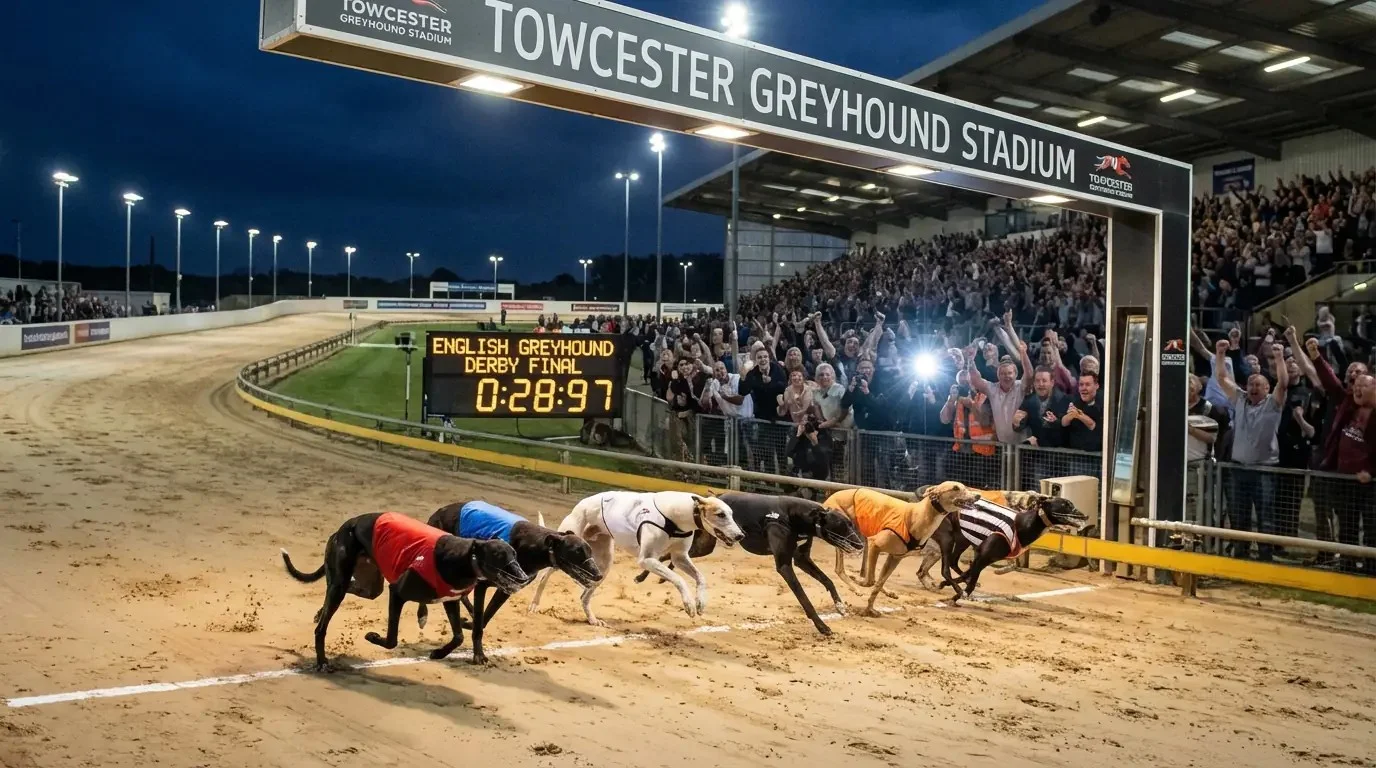
Every sport has its defining event, and in UK greyhound racing that event is the English Greyhound Derby. It is the race that trainers build entire campaigns around, the competition that turns fast dogs into household names within the sport, and the one set of results that the wider betting public actually pays attention to. The Derby does not operate like a standard Tuesday evening card at Romford or Sunderland. It runs across multiple rounds over several weeks, demands sustained form rather than a single flash of speed, and generates ante-post markets that open months before the first heat. If you follow UK dog racing results at any depth, the Derby is the point where everything converges: form analysis, track knowledge, market reading, and timing. Find more race guides at dogracingresultstoday.
The competition has been held in various formats and at various venues since 1927, but its modern incarnation at Towcester has given it a distinct character. Towcester’s wide, galloping track rewards a different kind of runner than the tight London circuits, and the results from each round carry weight far beyond the event itself. A dog that reaches the Derby final is a dog whose form data becomes a reference point for graders, bettors, and rival trainers for months afterwards. Understanding how Derby results work, what they reveal, and how to bet on them is not optional knowledge for serious UK greyhound punters — it is foundational.
English Greyhound Derby: Format, Rounds and How Results Work
The English Greyhound Derby is a knockout competition run over 500 metres at Towcester. It typically begins in late May or early June with first-round heats and concludes with the final in late June or early July. The field starts large — often 192 dogs entered across 32 first-round heats of six — and is progressively reduced through second-round heats, quarter-finals, and semi-finals until six dogs contest the final.
Each round is a standard six-dog race. The key difference from regular graded racing is that results carry elimination consequences. In a standard A2 race at Monmore, a third-place finish is a moderate result that adjusts form and possibly triggers a grade change. In a Derby heat, a third-place finish might end a dog’s entire campaign. Typically the first two finishers in each heat advance, with some fastest losers also progressing depending on the round structure. The exact qualification criteria can vary slightly between years, but the principle remains consistent: only winning and close-second performances survive.
Results from Derby rounds are published through the same channels as regular GBGB racing — Timeform, Racing Post, GBGB’s own results service — but they attract significantly more attention. Sectional times from heats are scrutinised by ante-post bettors looking for signals about which dogs are improving through the competition and which are peaking too early. The time recorded in a first-round heat at Towcester in early June often becomes the benchmark against which semi-final performances are measured three weeks later.
One structural detail that matters for bettors: the draw for each round is typically made after the previous round concludes, which means trap positions are not known in advance. This removes one layer of predictability that punters rely on in regular graded racing, where a dog’s trap assignment is published on the racecard hours before the race. In the Derby, draw announcements become market-moving events in themselves.
Historical Derby Results and What They Reveal About Form
The Derby archive is one of the richest datasets in UK greyhound racing. Results stretch back nearly a century, but for practical betting purposes the relevant history begins with the competition’s move to Towcester. The Derby was originally held at White City (1927–1984), then Wimbledon (1985–2016) — a tighter, faster track where early pace from traps one and two carried a premium. After a brief period at Nottingham (2019–2020) following Towcester’s temporary closure, the event returned to Towcester in 2021. Towcester’s wider circuit and longer run to the first bend shifted the advantage towards dogs with strong middle-running pace and the stamina to sustain it over 500 metres on a galloping surface.
What the historical results consistently show is that Derby winners tend to share a cluster of form traits. They almost always arrive at the competition with recent form that includes at least one open-race win or a top-two finish in a Category One event. Dogs promoted rapidly through the grades without open-race exposure rarely survive beyond the quarter-finals. The data also reveals a strong bias towards dogs that have raced at Towcester before the Derby heats begin — familiarity with the track’s dimensions appears in the results as a measurable advantage.
Another pattern visible in the historical record is the correlation between heat performance and final success. Dogs that win their first-round heat comfortably — by two lengths or more — and record a fast time relative to the round tend to maintain that trajectory. Conversely, dogs that qualify as fastest losers or scrape through in second place by a narrow margin have a significantly lower conversion rate in later rounds. The Derby rewards consistency across multiple races, which is precisely what makes it different from a single open race where one brilliant performance is enough.
For bettors, the historical archive also exposes trainer dominance patterns. Certain kennels have produced a disproportionate number of Derby finalists over the past decade, and tracking which trainers consistently place dogs in the later rounds provides a useful filter when assessing early-round entries.
Betting on the Greyhound Derby: Ante-Post and Race-Day Markets
The Derby generates betting markets that are structurally different from everyday greyhound racing. Ante-post markets open weeks before the first heat, and prices fluctuate based on trial times, trainer signals, and entry confirmations. This is one of the few greyhound events where ante-post betting carries genuine strategic value, because the information asymmetry between early-bird bettors and the general market is wider than in standard nightly racing.
Ante-post prices on Derby contenders can shift dramatically between the announcement of entries and the first round. A dog that posts a fast trial time at Towcester in the weeks before the competition may see its price halve overnight. Conversely, a late withdrawal due to injury or a poor trial can cause other dogs’ prices to drift in unexpected directions. The key risk in ante-post Derby betting is the same as in any ante-post market: if your selection does not run, your stake is lost. Most major UK bookmakers do not offer non-runner, no-bet terms on Derby ante-post wagers, so the decision to bet early is a calculated trade-off between price and certainty.
Race-day markets for individual Derby rounds function more like standard greyhound betting, with win, forecast, and tricast options available. The difference is liquidity: Derby heats attract significantly more money than a regular Tuesday evening race, which means the Betfair exchange market is deeper and BSP prices tend to be more reliable as a reflection of true probability. For punters who prefer exchange betting, Derby rounds are among the best opportunities in the UK greyhound calendar to find genuine value at BSP.
The final itself is the single most heavily bet greyhound race of the year. Bookmaker margins on the Derby final tend to be tighter than on standard racing — closer to horse racing levels — because the volume of money forces competitive pricing. Best Odds Guaranteed is generally available on the Derby final at most major bookmakers, making it one of the rare greyhound races where taking an early price carries minimal downside.
Towcester’s Role as Derby Venue and Its Effect on Running Style
Towcester is not a neutral venue. Its track dimensions — a wide first bend, long straights, and a circumference that favours galloping dogs over sharp railers — impose a specific selection filter on the Derby field. Dogs that dominate at tight London tracks like Romford, where early pace from inside traps is decisive, often find Towcester’s geometry working against them. The run to the first bend is longer, which reduces the advantage of a fast break, and the wide bends allow middle runners to maintain position without being squeezed into the rail.
For bettors analysing Derby form, this means that sectional times from other tracks do not translate directly. A dog posting 4.50 to the first bend at Romford is doing something entirely different from a dog posting 4.50 at Towcester. The Towcester split reflects a longer run on a wider track, which tests sustained early speed rather than explosive trap speed. The second split — from the first bend to the third bend — is often more revealing at Towcester, because it shows whether a dog can maintain pace on the long back straight where many Derby races are effectively decided.
The track’s surface and conditions also play a role. Towcester’s sand track can run differently depending on weather and maintenance, and Derby results occasionally reflect track conditions as much as dog form. Experienced Derby bettors pay attention to the going reports and to how times compare across heats run on the same evening — if all six heats produce times within a narrow band, the track is running consistently and the times are reliable for comparison. If there is significant variation, the track conditions may be shifting between races.
Using Derby Form to Evaluate Dogs for the Rest of the Season
The Derby does not exist in isolation. Dogs that compete in it return to regular graded and open racing afterwards, and their Derby form becomes a permanent part of their profile. A dog that reached the semi-finals of the Derby carries that credential into every subsequent race, and graders, bettors, and bookmakers all factor it into their assessments. This is where Derby results become a practical tool for the rest of the season. Also read our UK greyhound Derby guide.
The most useful signal from Derby form is not whether a dog won, but how it performed relative to the round. A dog eliminated in the quarter-finals after running a fast time in a strong heat may actually be a better prospect for regular open racing than the dog that scraped into the semi-final from a weak heat with a slow time. The context around the result matters as much as the finishing position, and punters who dig into the sectional data from each round often find value in dogs whose Derby campaign looked disappointing on paper but was competitive in substance. When a former Derby quarter-finalist turns up in an A1 race at Monmore three weeks later, the market sometimes undervalues the quality of opposition that dog has already faced — and the results tend to correct that undervaluation fairly quickly.