
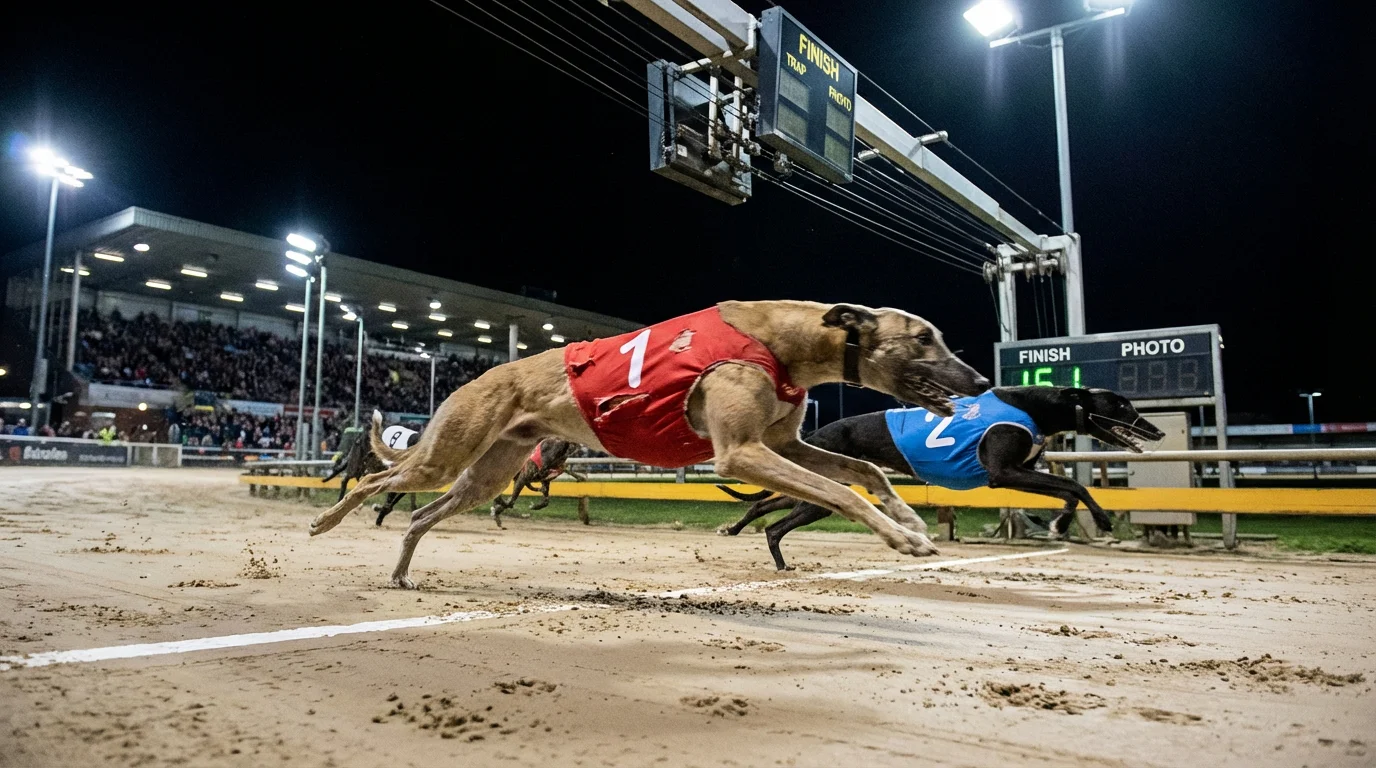
A forecast bet asks you to predict which dog will finish first and which will finish second in a single race. It pays more than a win single because you are predicting two outcomes rather than one, and the returns can be substantial — a correctly predicted forecast in a competitive six-dog race routinely pays between ten and forty times the stake, sometimes considerably more. For UK greyhound punters who have moved beyond basic win betting and want to extract more value from their race analysis, the forecast is the natural next step. Find more bet type guides at dogracingresultstoday.
The appeal of forecast betting lies in its relationship to form reading. If you can identify the most likely winner of a race, you already have half the forecast. The second half — identifying the most likely runner-up — is where deeper form analysis pays off. Factors like trap draw, running style, early pace, and track bias all influence which dogs are likely to fill the first two positions, and punters who pay attention to these details have a genuine edge in forecast markets. The bookmaker’s margin on forecast dividends is built into the calculation method, but the returns are high enough that a disciplined approach to selection can overcome it.
Straight Forecast vs Reverse Forecast: The Key Difference
A straight forecast requires your two selected dogs to finish in the exact order you specify. If you back Dog A first and Dog B second, the bet wins only if Dog A wins the race and Dog B finishes second. If Dog B wins and Dog A finishes second, the bet loses. The precision of this requirement is what drives the higher returns — you are not just identifying the two best dogs, you are predicting the order in which they will cross the line.
A reverse forecast covers both possible finishing orders between your two selections. It is effectively two straight forecasts in one: Dog A first and Dog B second, or Dog B first and Dog A second. The trade-off is obvious — you double your chances of winning, but you also double your stake. A one-pound reverse forecast costs two pounds. If one of the two permutations comes in, you are paid the straight forecast dividend for that specific combination, minus the cost of the losing permutation.
The decision between straight and reverse comes down to how confident you are in the finishing order. If your form analysis strongly suggests that Dog A has the early pace to lead and Dog B is a consistent second-place finisher that runs on in the closing stages, a straight forecast is the higher-value play. If both dogs have similar running styles and either could plausibly win, the reverse forecast is the safer option at the cost of halving your effective return on the winning permutation.
In practice, most experienced greyhound forecast bettors use straights more often than reverses. The reason is that trap draw and running style usually give a strong indication of which dog is more likely to lead. A dog breaking from trap one at a tight-bend track with a rail-running style is more likely to lead than a wide runner from trap six, even if both dogs are of similar ability. That positional analysis is what makes straight forecasts viable rather than speculative — you are not guessing the order, you are deducing it from the available data.
Combination Forecast: How It Works and What It Costs
A combination forecast extends the forecast concept to three or more selections. Instead of picking two dogs, you pick three (or more) and the bet covers every possible first-and-second combination among them. With three selections, there are six possible straight forecast permutations: A-B, A-C, B-A, B-C, C-A, C-B. A one-pound combination forecast on three dogs therefore costs six pounds. With four selections, the number of permutations rises to twelve, costing twelve pounds at a one-pound unit stake.
The advantage of a combination forecast is coverage — you do not need to predict the exact first two; you only need two of your selected dogs to fill the first two places in any order. This is particularly useful in competitive races where form analysis identifies three strong contenders but cannot separate them with confidence. Rather than agonising over which two to include in a straight or reverse forecast, you cover all possibilities and accept the higher outlay.
The disadvantage is cost, and this is where many punters miscalculate. A combination forecast on three dogs at a one-pound unit feels modest — six pounds — but the return is a single straight forecast dividend, which must be large enough to cover the five losing permutations and still generate a profit. If the winning combination returns fifteen pounds on a one-pound straight, your net profit on a six-pound combination is nine pounds. Respectable. But if the return is only eight pounds, you have lost money despite correctly identifying two of the top three finishers.
The practical rule for combination forecasts is that they work best in races with one clear contender and two or three plausible challengers for second place. In this scenario, you can often use a straight forecast with the clear contender as your first selection and then combine two or three dogs for the second position — sometimes called a forecast with a banker — which reduces the number of permutations and the total cost while still covering the uncertainty around the runner-up position.
How Forecast Returns Are Calculated in UK Racing
Forecast returns in UK greyhound racing are determined by a Computer Straight Forecast calculation, commonly abbreviated as CSF. The CSF is not a fixed-odds price — it is calculated after the race based on the Starting Prices of all runners. This means you do not know the exact return when you place the bet; you know only that the return will reflect the SPs of the first and second finishers relative to the rest of the field.
The CSF formula takes into account the win odds of both the first and second-placed dogs and applies a mathematical model that produces a forecast dividend. In general terms, the return increases as the SPs of the placed dogs increase. A forecast involving a 6/1 winner and a 5/1 second pays substantially more than one involving a 2/1 winner and a 3/1 second, because the former result was less probable according to the market. The formula also factors in the implied probability of each dog finishing second given that a specific dog has won — a subtlety that means forecast returns are not simply the product of the two dogs’ win odds.
For punters, the practical implication is that forecast value is highest in competitive, open races where the SPs are spread across the field rather than concentrated on one short-priced favourite. In a race where the favourite is 4/6 and the rest of the field is 5/1 or longer, the forecast returns involving the favourite tend to be compressed because the calculation heavily weights the favourite’s dominance. In a race where the market is split between three dogs at 2/1, 3/1, and 7/2, the forecast returns across combinations tend to be higher and more varied, creating more opportunities for value.
Some bookmakers also offer fixed-odds forecasts on selected races, where the return is quoted in advance as a specific price. These fixed-odds forecasts can occasionally offer better value than the CSF, particularly when the bookmaker has misjudged the relative chances of two dogs. Comparing the fixed-odds forecast price against the likely CSF range — which experienced punters can estimate roughly from the win odds — is a useful habit.
When to Use a Forecast Bet vs a Win Single
The forecast is not always the right bet. It is the right bet when your analysis produces a strong view on two dogs rather than one. If you have identified a single standout selection and the rest of the field looks evenly matched, a win single gives you the best return relative to risk. Adding a forecast means you need to correctly predict the second-place finisher from a group you consider undifferentiated, which reduces your edge without proportionally increasing your expected return.
Forecasts become the better option when your form work highlights two dogs that stand out from the field for specific, identifiable reasons. Perhaps one is a strong early-pace dog drawn in trap one at a rail-biased track, and the other is a proven closer that consistently finishes in the first two. Or perhaps the field contains one class dropper that is clearly the best dog on ratings and one improving dog whose recent sectional times suggest it will be competitive. When your reasons for selecting two dogs are distinct and evidence-based, the forecast captures that analysis in a way a win single cannot.
The other situation where forecasts offer structural value is in races with short-priced favourites. When a dog is 4/6 or shorter to win, the win single return is thin — you risk six pounds to profit four. If you have a strong view on which dog will finish second behind the favourite, a straight forecast involving the favourite typically returns between five and fifteen times the stake, which represents a significantly better reward-to-risk ratio than the win single. The trade-off is the added requirement of predicting the runner-up, but in races dominated by a clear favourite, the second-place market is often where the real value sits.
Forecast Value: Finding the Right Races to Combine
Not every race is a good forecast race. The best forecast opportunities share a set of characteristics: a competitive but not chaotic field, at least two dogs with clear form advantages over the remainder, and a race structure (distance, track, grade) that supports a predictable running pattern. Races where all six dogs have similar form, or where recent results are inconsistent across the field, are poor forecast candidates because the probability of any specific first-second combination is low. Also see our UK greyhound bet types.
Graded races at A2-A4 level tend to produce more forecastable outcomes than open races or the very lowest grades. The dogs at these levels are experienced enough to run to their form but not so closely matched that the result is a coin toss. Track familiarity also helps — a dog returning to a track where it has previously posted strong results is a more reliable forecast leg than a dog racing at a new venue for the first time. The data is there in the racecard. The forecast just asks you to read it one position deeper than a win single does.