
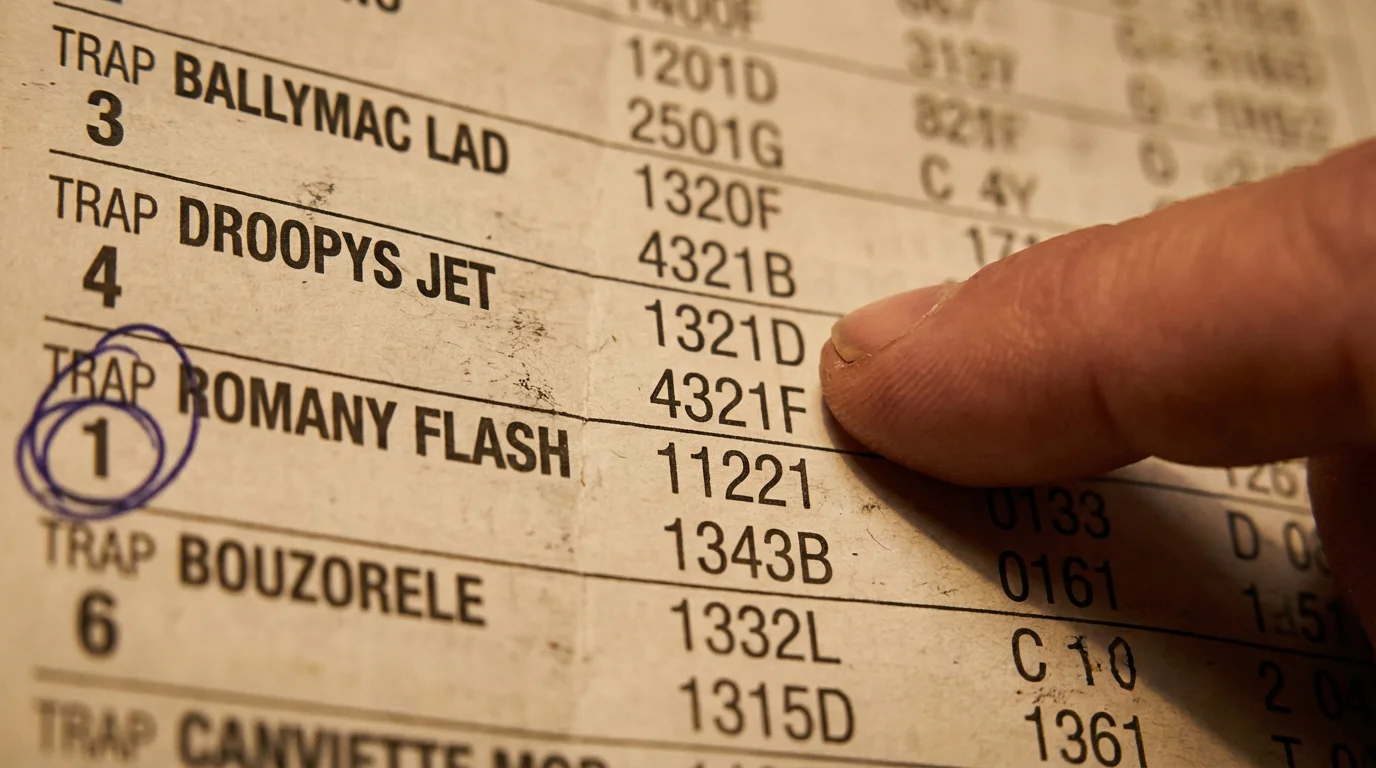
Those six digits next to each dog’s name on the racecard are the most condensed performance data in sport. A string like 2-1-3-1-4-2 tells you, in six characters, where this dog finished in each of its last six races — most recent on the right. No other sport packs that much competitive history into so small a space. Football does not do it. Horse racing comes close but uses a longer string with more variables. Greyhound form figures are pure positional data, stripped of context, and that compression is both their strength and their weakness. The strength is speed: you can scan a six-dog racecard in thirty seconds and get a rough picture of the field. The weakness is that the numbers hide as much as they reveal, and reading them without understanding what sits behind each digit is a reliable route to bad bets. Find more form guides at dogracingresultstoday.
This guide decodes every element of the greyhound form string — the position numbers, the letter codes, the way recency affects weight, and the patterns that experienced punters look for before the traps open.
What Each Position Number Means: 1st to 6th
The numbers 1 through 6 in a form string represent the dog’s finishing position in each race. A “1” means the dog won. A “6” means it finished last in a six-runner field. The numbers are listed in chronological order with the most recent run on the right, so a string of 4-3-2-1 shows a dog whose finishing positions have been improving over its last four races — fourth, then third, then second, then a win.
What the number does not tell you is the context. A “3” could mean the dog finished a length behind the winner in a competitive A1 race, or it could mean the dog trailed in twenty lengths behind the winner in a weak A6 race. Both appear as “3” in the form string. This is why form figures should never be read in isolation. The grade, the track, the time, and the winning margin all modify the meaning of the raw position number. A dog showing 3-3-3-3 in A2 races is a significantly better animal than a dog showing 3-3-3-3 in A6 races, even though the form strings look identical.
For quick assessment, the key threshold is the top three. Dogs that consistently finish in positions one through three are competitive in their current grade. Dogs that regularly finish fourth to sixth are either outclassed at their current level or have issues — trap draw problems, running style mismatches, or declining ability — that prevent them from being competitive. A dog that has not finished in the top three in its last four runs is, statistically, a poor prospect for the next race unless something material has changed: a grade drop, a trap switch, or a return to a preferred track.
One subtlety: in races with fewer than six runners (which occur occasionally due to withdrawals), the positions still reflect the actual finishing order. A “4” in a four-runner race means last. A “4” in a six-runner race means fourth of six. The racecard typically shows the number of runners alongside the form, but not all displays make this obvious. Checking the field size for each historical run adds precision to your reading.
Special Form Codes: F, W, R, D, Disq and What They Indicate
Not every run produces a clean finishing position. The letter codes in a form string indicate non-standard outcomes, and each carries different implications for future performance. F means the dog fell during the race. This is relatively rare in greyhound racing but does occur, particularly on tight-bend tracks where dogs become crowded at the first turn. A fall tells you nothing about the dog’s ability — it may have been in a winning position before the incident — but it does indicate that the dog experienced physical disruption, and some dogs take a run or two to recover their confidence after a fall.
R indicates that the dog refused to race. The dog was loaded into the trap but did not participate when the traps opened. This is often associated with a dog that is nervous, unsettled, or in physical discomfort. A single R in a form string is a flag worth noting; repeated Rs are a serious concern about the dog’s current temperament or welfare.
W stands for walkover — the dog was the only runner and was awarded the race without competition. A walkover tells you nothing useful about form. The dog did not race against opponents, so the result cannot be used to assess relative ability. Treat it as a blank entry.
D can indicate different things depending on the context. In some form displays, D means the dog was disqualified — typically for interference with another runner. In others, it may denote a specific grade designation. The racecard provider’s key will clarify which meaning applies. A disqualification for interference is worth noting because it often means the dog was competitive (it was close enough to other runners to cause interference) but ran an undisciplined race. Repeated disqualifications suggest a running style problem that may recur.
Disq (or DQ in some formats) is an explicit disqualification marker. The distinction from D depends on the data source, but the implication is the same: the dog was removed from the finishing order after the race for a rules violation. When you see any disqualification code, check the race details to understand why — the reason matters more than the code itself.
How Recent Form Weighs Against Older Runs
The standard racecard shows six form figures, but not all six carry equal weight. The most recent two or three runs are the strongest indicators of current ability and condition. A dog showing 6-5-4-3-2-1 is clearly improving, but the trajectory from the last three runs (3-2-1) matters more than the trajectory from six runs ago. Conditions change — the dog may have been recovering from injury in its earlier runs, or racing in an unsuitable grade, or adjusting to a new track. The recent form reflects the dog’s current state; the older form reflects its history.
A practical rule of thumb: weight the last two runs at roughly 50% of your overall form assessment, the third and fourth most recent runs at 30%, and the fifth and sixth at 20%. This is not a mathematical formula to apply rigidly — it is a mental model that prevents you from over-weighting stale data. A dog whose last two runs show 1-1 is a stronger prospect than its form string of 5-6-4-5-1-1 might suggest at first glance, because the early poor runs may reflect conditions that no longer apply.
The exception is when a dog’s recent form departs sharply from its longer-term pattern. A dog showing 1-1-2-1-5-6 has two recent poor runs that contradict a strong underlying record. This is a red flag — something has changed. It could be a temporary issue (bad draw, interference, track condition) or it could be the start of a decline. Investigating the reasons behind the recent poor runs, using the detailed result data rather than just the form string, is essential before deciding whether to back or oppose.
Distance and Track Changes in the Form String
The form string does not always refer to the same distance or the same track. A dog may have run its last six races across two different tracks at three different distances, and the form figures blend all of those runs into a single string. This mixing is one of the form string’s biggest limitations, because a dog’s ability can vary significantly between distances and between tracks.
Detailed form displays — the kind available on Timeform, Racing Post, and GBGB — show the track and distance for each run alongside the finishing position. When you see a form string on a basic racecard display, the first step in deeper analysis is to check which of those runs were at the same track and distance as the upcoming race. A dog with a form string of 3-2-5-1-4-2 looks mixed, but if the two wins were at the track where it is racing today and the poor runs were at different venues, the picture is more positive than the raw string suggests.
Distance changes are particularly important. A dog that has been running over 480 metres with a form string of 1-1-2 and is now entered over 640 metres is stepping into different territory. Its sprint form may not translate to a staying trip. The reverse also applies — a dog moving from a longer distance to a shorter one may lack the early pace to compete against specialists. The form string treats all runs equally regardless of distance. Your analysis should not.
Track transfers carry the same caveat. A dog that has moved from Romford to Monmore brings its form figures with it, but those figures were earned on a different track with different dimensions, a different surface, and different competition. The first one or two runs at a new track are essentially trials — the dog is adapting to unfamiliar conditions, and its form at the previous venue is an imperfect guide to how it will perform.
Red Flags and Green Lights in Greyhound Form Sequences
Certain form patterns appear frequently enough to function as reliable signals. A green light — a pattern that suggests a positive outcome — includes a sequence of improving positions (4-3-2-1 or similar), a return to a preferred track or distance after poor runs elsewhere, or a grade drop following a run of mid-field finishes that suggests the dog has been outclassed rather than declining. These patterns indicate a dog that is likely to be competitive in its next race and is worth including in your selection process.
Red flags include a sequence of deteriorating positions (1-2-3-4-5), repeated falls or disqualifications that suggest a handling or running style problem, and a pattern of poor finishes at a track where the dog has no prior winning form. A dog showing F-5-6-4-5 has had a fall followed by a string of poor results — the fall may have affected its confidence, or it may be masking an underlying fitness issue. Either way, this is not a dog to back until the form shows signs of recovery.
The most dangerous form pattern for bettors is the single recent win surrounded by poor runs — something like 5-4-6-1-5-4. The win catches the eye. The surrounding form suggests it was an outlier rather than a turning point. Dogs with this profile are often backed at shorter prices than their overall record justifies, because the market overweights the visible win and underweights the persistent mediocrity around it. Opposing these dogs, or at least not backing them, is one of the simplest and most effective disciplines in greyhound form reading. Also explore our how to read a UK greyhound racecard.
Conversely, the most undervalued pattern is the consistent placer — a dog showing 2-3-2-3-2-3 that never wins but always finishes in the frame. These dogs are poor win single prospects but outstanding forecast and tricast components. The market prices them for win probability, which is low, but their probability of finishing in the top three is high. Building forecasts and tricasts around reliable placers, combined with a more volatile selection for the win, is a form-reading strategy that the raw numbers support and the market frequently underprices.