
Consistency is the rarest attribute in greyhound punting. Most bettors have none. They back favourites one evening, try long-priced outsiders the next, switch between win singles and accumulators depending on their mood, and adjust their stakes based on how the session is going rather than on any predetermined plan. The result, predictably, is a slow and steady erosion of bankroll disguised by occasional wins that feel like progress but are not. Find more strategy guides at dogracingresultstoday.
Building a consistent approach to greyhound betting does not require genius. It requires structure: a definition of value, a method for selecting races and dogs, a staking plan that survives losing runs, and a record-keeping system that tells you whether your approach is working. None of these elements is complicated individually. The difficulty is maintaining all of them simultaneously, race after race, evening after evening, through the inevitable periods when results do not cooperate. This guide covers each element in practical terms.
The Foundation: Understanding Value Before Results
Value is the concept that separates betting as a serious activity from betting as entertainment. A value bet is one where the odds offered by the bookmaker exceed the dog’s true probability of winning. If you believe a dog has a 33% chance of winning (roughly 2/1 in fair odds) and the bookmaker offers 3/1, that is a value bet — regardless of whether the dog actually wins that race. The dog will still lose two out of three times. But over a large sample of bets where you consistently identify this kind of discrepancy, the cumulative returns are positive.
Understanding value requires two skills. The first is the ability to estimate a dog’s true probability of winning based on form, grade, trap draw, running style, and track characteristics. This estimate will never be precise — greyhound racing has too many variables for exact probability calculations — but it can be approximately right, and approximately right is enough. The second skill is the discipline to compare your estimate against the available price and to bet only when the price exceeds your estimate. This sounds obvious. In practice, it means walking away from the majority of races because the price does not offer value, even when you have an opinion on the winner.
The hardest part of value betting is emotional. Passing on a race you have analysed because the price is not right feels like wasted effort. Backing a dog at a value price and watching it lose feels like a bad decision. Neither feeling is accurate. The wasted effort was the analysis, which informed a correct decision not to bet. The losing bet was correct at the time of placement because the price exceeded the probability. Training yourself to evaluate decisions by process rather than outcome is the foundational shift that makes profitable greyhound betting possible.
Building a Selection System Using Form and Track Data
A selection system is a defined set of criteria that a race and a dog must meet before you place a bet. The criteria can be as simple or as complex as your experience and data access allow, but the key principle is that they exist in advance of the race, not after you have already decided who you want to back.
A basic system for graded greyhound racing might include the following filters: the dog must have finished in the top three in at least two of its last four runs; it must be running at the same track where those results were achieved; it must not be stepping up more than one grade from its last run; and the available price must exceed your estimated probability of winning by at least 20%. Any dog that passes all four filters is a qualifying selection. Any dog that fails one or more is not bet, regardless of how appealing it looks.
The power of a system is not that it picks the most winners. It is that it enforces discipline by removing subjective judgment from the final decision. You will miss winners that your intuition would have identified. You will also avoid a larger number of losers that your intuition would have backed. Over a meaningful sample, the net effect is positive — not because the system is perfect, but because it is applied without exception. Uniformity of method is what produces reliability of results.
Refining the system is an ongoing process. After a hundred bets, review the results. Are there filters that are too loose (allowing too many losers) or too tight (screening out winners unnecessarily)? Are there race types or tracks where the system performs well and others where it performs poorly? Adjust based on evidence, not feeling, and document every change so you can evaluate its effect on subsequent results.
Bankroll Management for Greyhound Bettors
Your bankroll is the fixed sum you allocate to greyhound betting. It is not your current account balance, not your disposable income, and not the amount you deposited last time you ran out. It is a defined, ring-fenced amount that you can afford to lose entirely without affecting your life. Setting this number honestly is the first act of strategic betting.
Once the bankroll is set, staking follows a simple formula: each bet should represent between 1% and 3% of the current bankroll. At a one-hundred-pound bankroll and a 2% stake, each bet is two pounds. If the bankroll grows to one hundred and fifty, the stake rises to three pounds. If it drops to seventy, the stake falls to one pound forty. This proportional staking adjusts automatically to your fortunes — you bet more when winning and less when losing — without requiring any active decision-making during a session.
The temptation to override the staking plan is strongest after losses. You have lost four bets in a row, you are confident in your fifth selection, and you want to stake more to recover. This impulse must be resisted every time. The staking plan exists precisely for these moments. It is your bankroll’s immune system — it limits the damage from losing runs and preserves the capital that allows you to continue betting when the results improve. Overriding it for one bet might work. Overriding it habitually will destroy the bankroll. The maths is unambiguous on this point.
Tracking Your Own Results: A Simple P&L Method
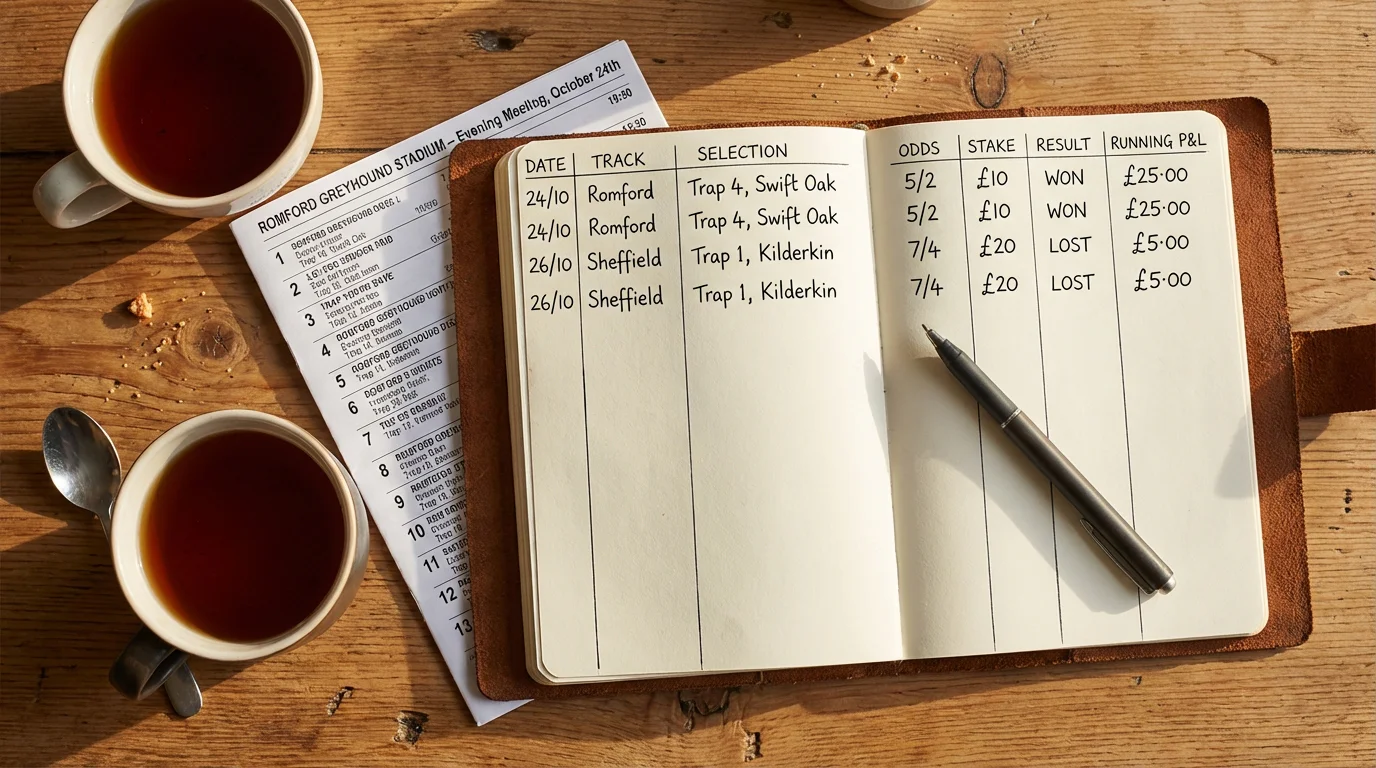
You cannot improve what you do not measure. Tracking your greyhound betting results is not optional — it is the feedback mechanism that tells you whether your approach is working, where it is working, and where it is failing. The method does not need to be sophisticated. A spreadsheet with columns for date, track, race time, selection, trap, grade, odds taken, stake, and result (win/loss) is sufficient. After each bet, log the details. At the end of each week or month, calculate total stakes, total returns, and net profit or loss.
The aggregate P&L number is important but not sufficient. The value of tracking lies in the breakdowns. Filter your results by track: are you profitable at Romford but losing at Monmore? Filter by grade: are your A2 selections outperforming your A5 selections? Filter by price range: are you finding more value at 3/1 to 5/1 than at evens to 2/1? Each breakdown reveals something actionable. If you are steadily losing on BAGS afternoon racing but profitable on evening cards, the correct response is to stop betting on BAGS — not to try harder.
Track your results from the first bet. The temptation to start tracking once you think you have found your method is strong, but it defeats the purpose. The early data — including the losing phase while you are still learning — is the most valuable, because it shows you where you started and how far your adjustments have taken you. A P&L record that begins on day one is an honest document. One that begins after a good week is a flattering one.
When to Walk Away: The Most Important Decision in Betting
Walking away — from a session, from a track, from a strategy that is not working — is the most important and most difficult decision in greyhound betting. The difficulty is not intellectual. Everyone knows they should stop when they are chasing losses or when their analysis has stopped producing results. The difficulty is emotional, because stopping feels like quitting, and quitting feels like admitting failure.
Reframe it. Walking away from a losing session after hitting your pre-set loss limit is not failure. It is the execution of a plan you made when your judgement was clear, enforced at the moment when your judgement is compromised. Walking away from a track where your record shows persistent losses is not quitting. It is reallocating your time and capital to an area where your edge is stronger. Walking away from the dogs entirely for a week or a month because the results are not there is not giving up. It is protecting your bankroll so that it still exists when conditions improve. Also read our greyhound racing tips UK.
Set session limits before you start betting each evening. Define a loss limit (the maximum you will lose before stopping), a time limit (the latest you will bet until), and a win target (a profit level at which you will consider closing the session). These are not rigid rules — a strong selection late in the evening may justify staying — but they provide structure. Without them, sessions expand to fill the time available, stakes creep upward, and discipline erodes one race at a time. The punters who last in greyhound betting are not the ones who win the most. They are the ones who know when to stop.