
UK greyhound racing is one of the country’s oldest and most accessible spectator sports, and it generates more betting activity per hour of competition than almost any other sport in Britain. Races last under thirty seconds. They happen every eight to ten minutes at each track. There are roughly eighteen active tracks running on any given evening, producing over a hundred races per day. For newcomers, this volume can be overwhelming — the sport does not pause to explain itself. The dogs race, the results post, the next race loads, and the cycle repeats. Find more beginner guides at dogracingresultstoday.
This guide is the starting point. It covers what greyhound racing is, how a race works from trap to finish, where in the UK it takes place, how to access results and racecards, and how to place your first bet. The aim is not to make you an expert. It is to give you the foundation that prevents the first few weeks from being an expensive exercise in confusion.
What Is UK Greyhound Racing? A One-Stop Explainer
Greyhound racing is a sport in which six dogs — greyhounds, bred and trained for speed — chase a mechanical lure (the hare) around an oval track. The dog that reaches the finish line first wins the race. In the UK, the sport is regulated by the Greyhound Board of Great Britain, which licenses tracks, registers dogs, employs racing managers, and enforces the rules of racing. All licensed tracks operate under GBGB rules, which cover everything from the welfare of the dogs to the integrity of the betting markets.
The sport has deep roots in British culture. Commercial greyhound racing began in the UK in 1926, and at its peak in the mid-twentieth century, greyhound stadiums attracted tens of millions of spectators per year. The scale has contracted since then — several dozen tracks have closed over the decades — but the sport remains active and popular with a dedicated following. The roughly eighteen GBGB-licensed tracks that operate today run structured evening and afternoon cards throughout the year, producing a volume of racing that dwarfs the UK horse racing schedule.
From a betting perspective, greyhound racing offers a distinctive product. The fields are small (six dogs per race), the races are frequent, and the form data is compact and accessible. These characteristics make the sport both attractive to bettors — there is always a race to bet on — and risky, because the frequency and ease of access can encourage impulsive betting. Understanding the sport before engaging with the betting is the first step towards a sustainable relationship with the dogs.
How a Greyhound Race Works: From Trap to Finish
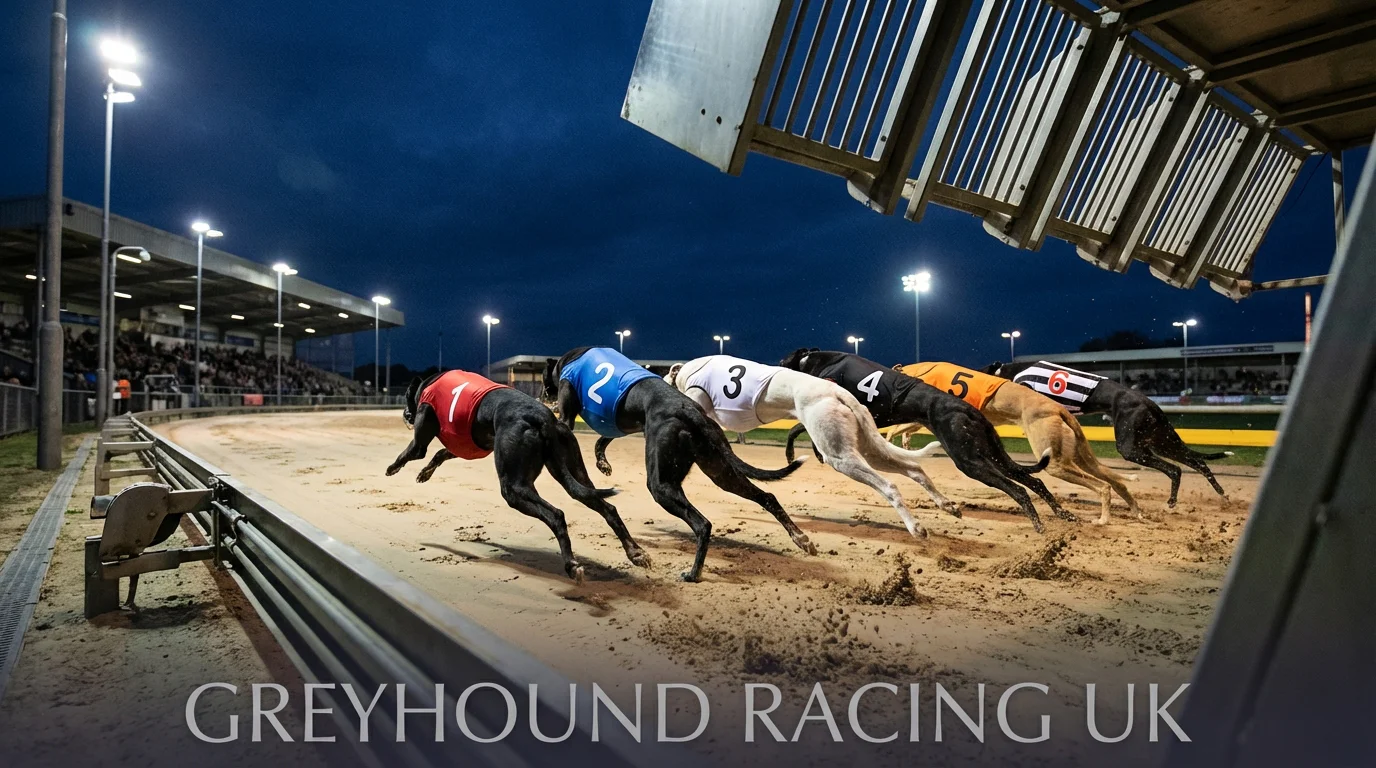
A greyhound race begins with six dogs loaded into numbered traps — metal starting boxes arranged side by side on the track. Trap one is on the inside rail and trap six is on the outside. Each trap is coloured according to a standard code: red for trap one, blue for two, white for three, black for four, orange for five, and black and white stripes for six. The colours help spectators and commentators identify the dogs during the race, which happens too fast for reading names on jackets.
When the starter signals, the mechanical hare begins moving around the track and the traps open simultaneously. The dogs break and sprint towards the first bend, reaching speeds of up to 45 miles per hour within a few strides. The first bend is often where the race is shaped — dogs on the inside have a shorter path, while dogs on the outside must cover more ground. Crowding, bumping, and checking (a dog being forced to slow by another dog’s movement) are common at the first bend, and the result is often influenced by how cleanly each dog navigates this phase.
From the first bend, the race follows the track’s contours — typically two bends and two straights for standard sprint distances of 450 to 500 metres, or four bends for longer staying distances of 600 metres and above. The dogs run in the order established at the first bend unless a closer (a dog with strong finishing pace) makes ground on the straights. The entire race lasts between 25 and 35 seconds for standard distances, making greyhound racing one of the shortest-duration sporting events in the world.
The finish is determined by photo-finish technology. The first dog’s nose to cross the finish line wins. Margins are measured in lengths (one length equals approximately 0.08 seconds) and can range from a short head to ten lengths or more in one-sided races. The official result, including finishing positions, times, and SPs, is published within seconds of the race ending.
UK Greyhound Tracks: The 18 Active Venues in Brief
The UK’s active GBGB-licensed tracks are spread across England, with a concentration in London and the South East and a secondary cluster in the Midlands and North. There are no licensed greyhound tracks in Scotland, Wales, or Northern Ireland at present, though the sport has historically operated in all three nations.
London and the South East are served by Romford, Harlow, and Central Park in Sittingbourne — three tracks that run frequent evening cards and produce the highest volume of BAGS afternoon racing. Romford is the largest and most well-known, hosting major open races and attracting the deepest betting markets. Central Park runs five meetings per week and has seen significant recent investment. Harlow runs a regular schedule of graded racing at a slightly lower level than Romford.
The Midlands are anchored by Monmore Green in Wolverhampton, Dunstall Park — also in Wolverhampton, opened in September 2025 as a purpose-built replacement for Perry Barr — and Nottingham. Monmore is one of the busiest tracks nationally, running multiple evenings per week. Nottingham hosts the Select Stakes and other major events. Dunstall Park, situated inside Wolverhampton Racecourse, runs four meetings per week.
The North is represented by Sunderland, Sheffield, and Newcastle. Sunderland is the primary northern venue, hosting regular evening racing and open events. Towcester in Northamptonshire — technically in the south Midlands — is the home of the English Greyhound Derby and the UK’s most prominent greyhound venue for major competitions, though its regular graded programme is less extensive than the metropolitan tracks.
Other active venues include Yarmouth, Kinsley, Doncaster, Oxford, Swindon, and Brighton and Hove, each running regular cards that contribute to the national fixture list. Pelaw Grange (also known as Star Pelaw) near Chester-le-Street and Suffolk Downs add further breadth to the schedule. The full fixture schedule is published by GBGB and updated on Timeform, Racing Post, and the major bookmaker platforms.
How to Access Results, Racecards and Live Racing
Results for every UK greyhound race are published in near real time on Timeform, Sporting Life, Racing Post, and GBGB’s own website. These services are free to use and display finishing positions, times, SPs, and dividend information within seconds of each race ending. Bookmaker apps also display results tied to your account activity, showing bet settlements alongside the race outcome.
Racecards — the pre-race information sheets that list each dog’s trap number, form figures, weight, trainer, and previous results — are published several hours before each meeting on the same platforms. The racecard is the essential research document for any greyhound bet. It contains the data you need to assess each dog’s chances: recent form, grade history, trap draw, and running times. Learning to read a racecard is the first analytical skill that any new greyhound bettor should develop.
Live racing is available through bookmaker streaming services (requiring a funded account or recent bet at most operators), Sky Sports Racing (available via Sky TV, Virgin Media, and some streaming packages), and greyhounds.attheraces.com, which offers free streams of selected meetings. Watching races live adds a dimension that results and racecards cannot provide — you see how a dog breaks from the trap, how it handles the bends, and whether it is running with effort or ease. This visual information complements the numerical form data and helps build the intuitive understanding of the sport that develops with time.
Your First Bet on the Dogs: A Practical Starting Point
Open an account with a UK-licensed bookmaker, verify your identity, and deposit a small amount — an amount you are fully prepared to lose. Set a deposit limit immediately. Then find an evening meeting at a major track, open the racecard for the first race, and spend five minutes reading the form. Look for the dog with the strongest recent form (positions one and two in its last three runs), check whether its trap draw suits the track (inside traps at tight tracks, any trap at wider tracks), and note whether it is racing at the same grade or has dropped a grade.
Place a win single at a small, flat stake — one or two pounds. Watch the race if a live stream is available. Whether your dog wins or loses, you have just completed the full cycle: racecard, analysis, selection, bet, result. Do the same for the next three or four races on the card, then stop. Review what happened. Were your form readings accurate? Did the trap draws play out as expected? Were there things you missed? Also read our how to bet on greyhounds UK.
That first evening is not about profit. It is about learning the rhythm of the sport, the pace of the market, and the feel of making decisions based on data rather than guesswork. The dogs will race again tomorrow, and the evening after that, and every evening for the foreseeable future. There is no rush. The punters who succeed at greyhound betting are the ones who invest time in understanding the sport before investing serious money in the market — and the first evening is where that investment begins.