

The stats don’t care which dog you like. They just keep recording the truth, race after race. That is what makes track statistics the most reliable analytical tool in UK greyhound betting — not the most glamorous, not the one that generates strong opinions in the pub, but the most reliably honest. Every race run at a GBGB-licensed venue is recorded: the winner, the trap, the time, the margin, the grade, the price. Do that a hundred thousand times across seventeen tracks and you accumulate a body of evidence that no individual opinion can override. Get more track data at dogracingresultstoday.
This guide works through that evidence systematically. Favourite win rates by track and grade. Trap bias data — where it is statistically significant, where it is overstated, and where punters are paying for a narrative the data does not support. Individual track profiles covering the characteristics that directly affect results. The distinction between graded and open race statistics. And how to translate all of it into a betting process that is informed rather than cluttered. Statistics do not pick winners. But they do make certain bets look significantly more or less rational than they did before you checked the numbers.
UK Greyhound Favourite Win Rates by Track
In graded racing, the favourite wins approximately 30–35% of the time across the GBGB circuit, with some tracks sitting closer to 25% and others approaching 36%. Know where you are. That broad range — derived from historical race data across the full UK licensed circuit, covering graded races from A1 through to the lower grades — is consistent across published analyses of GBGB results. It tells you something immediately useful: back every favourite in every graded greyhound race and you will lose. Not because favourites are badly selected, but because the margin embedded in bookmaker pricing means the price you receive for a 30–35% chance is almost never the mathematically correct one.
The variation by track is where the data becomes actionable. Tracks with tighter, more predictable racing surfaces — where the fastest dog has a clearer geometric advantage — tend to produce slightly higher favourite win rates because there is less variance from interference and wide draw penalties. Tracks with genuinely competitive fields and higher field variance, typically seen in open-grade racing, push the favourite win rate down. The difference between a 38% favourite win rate at one venue and a 31% rate at another is not incidental — it reflects the structural character of racing at each track.
What does this mean in practice? At tracks where favourites win at a higher rate, the market tends to price them more accurately — meaning the value in backing favourites is thin. The market is efficient precisely because the outcome is more predictable. At tracks where the favourite win rate is lower, the market often over-shortens strong selections because casual punters back the name they recognise, while the actual statistical probability of the favourite winning is closer to a coin flip than the 4/6 price implies. This is one of the most consistent sources of negative expected value in greyhound betting: short-priced favourites at high-variance tracks.
Grade matters enormously within this. A1 and A2 favourites — top-grade competition — win at lower rates than A6 and A7 favourites. The logic is straightforward: in top-grade racing, the field is more uniformly talented, and the gap between the market leader and the second and third choices is narrower. In lower grades, a dog that has been demoted from A4 to A6 often represents a genuine class advantage over the rest of the field, and its favourite win rate reflects that. Punters who treat all grades equally are misreading the underlying probability distribution.
The SP favourite — the dog returned at the shortest price at the off — is not always the same as the dog that was market leader in the morning prices. Greyhound markets at licensed bookmakers often shift significantly in the ninety minutes before a race, particularly when a dog’s most recent form or weight is published and the market reacts. The SP favourite may be a different dog entirely from the one you noted at midday, and its win rate may not match that of early-market leaders. Tracking SP favourites across a specific track over a three-month sample is one of the more instructive exercises available to a serious punter — the results are often counterintuitive.
One additional factor in favourite win rate analysis: the effect of race grade changes on market pricing. A dog promoted from A5 to A4 after two consecutive wins is frequently sent off favourite or co-favourite in its first A4 race, but its actual win probability in the new grade has not been empirically tested. The market prices it as a strong contender based on recent form, but the adjustment to higher-grade competition may take one or two runs. Dogs in their first race after promotion lose at above-average rates, and the market often fails to fully account for this. Backing against freshly promoted favourites — either by opposing them in forecast bets or simply not backing them — is a position that the data generally supports.
Trap Draw Statistics Across UK Tracks
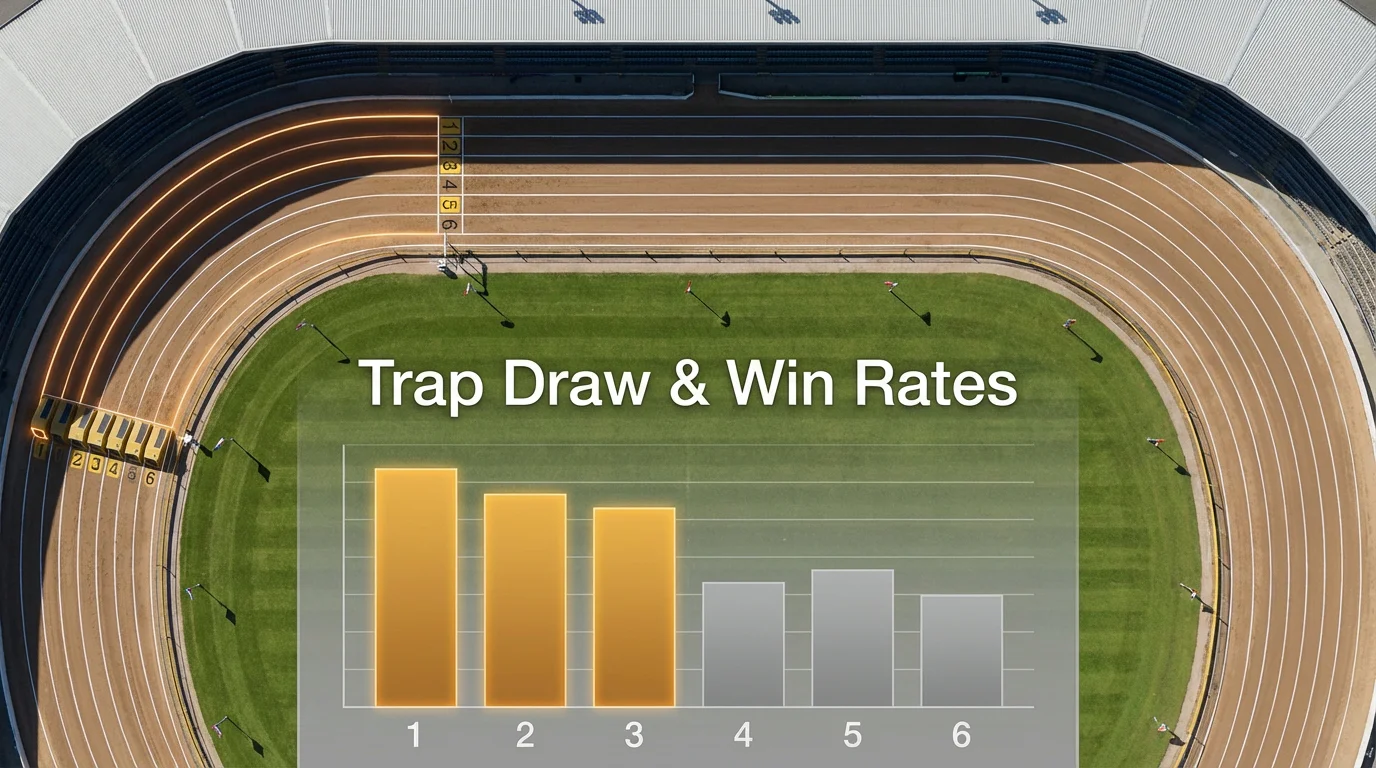
Some tracks have a Trap 1 bias so strong it appears in every grade, every distance. Others are genuinely neutral. The difference between these two types of venue is not subtle — it is a structural feature of the track design, and it persists across thousands of races. Ignoring trap statistics at the wrong venue is not just analytically incomplete; it is knowingly discarding relevant information.
The theoretical win rate for any trap in a six-runner greyhound race, assuming complete neutrality, is 16.67%. In practice, no track is perfectly neutral — the physical geometry of bends, the width of the track, and the configuration of the first corner all create asymmetries. The question is not whether a bias exists but how large it is and whether it is large enough to be betting-relevant.
At Crayford, one of the tightest circuits on the UK calendar, Trap 1 win rates in sprint races have historically exceeded 23% over large samples — a statistically significant deviation from the neutral baseline of 16.67%. Trap 6 at the same distances runs at rates approaching 10–11%, a deficit of roughly 40% from neutral. The track’s tight anti-clockwise configuration and cambered bends give railers a measurable advantage from the moment the traps open: they cover less ground, face less interference, and reach the first bend in front. The data is consistent across grade levels, which strengthens the case that this is a structural effect rather than a sample artefact.
Harlow presents a similar picture for similar geometric reasons. A compact circuit with a pronounced inside bias, Harlow’s Trap 1 and Trap 2 consistently outperform on sprint distances. The effect is less extreme than at Crayford — the first bend is slightly less punishing for wide runners — but it is still betting-relevant, particularly in sprint-grade races where the early pace advantage of inside traps is more determinative.
At the other end of the spectrum, Towcester and Nottingham are among the more neutral tracks on the circuit. Towcester’s wide, sweeping layout and extended back straight mean that wide runners can race more freely without the distance penalty imposed by tight bends. Trap 6 win rates at Towcester are closer to neutral across most distances, and the difference between Trap 1 and Trap 6 is within the range of statistical noise in smaller samples. This relative neutrality is precisely why Towcester is considered a prestige venue: the best dog tends to win rather than the best-drawn dog.
Romford occupies middle ground. Its configuration does produce a moderate inside bias — Trap 1 and Trap 2 win at above-neutral rates on the sprint distance — but the effect is less pronounced than at Crayford. Importantly, the bias at Romford appears to vary by grade: in open and A1 races, where all six dogs are of comparable ability and trap-running style, the bias is less evident. In lower-grade races where the field contains a wider range of ability, the structural advantage of an inside draw matters more because the better dog cannot always overcome the geometric disadvantage.
Sunderland, the primary track in the north of England, has a configuration that produces a moderate outside bias in some distances — an unusual pattern that runs counter to the more commonly discussed inside advantage. This reflects the specific bend geometry at the venue and is worth noting for punters who focus on northern racing. Trap 4 and Trap 5 have historically performed above neutral at certain Sunderland distances, which is a counterintuitive but data-supported observation.
The practical guidance from aggregate trap statistics: always look up the specific trap data for the venue and distance before assigning significance to the draw. General rules — “inside is always best” — are not universally accurate and can actively mislead. GBGB’s published statistical data and Timeform’s track information pages are the correct starting points for venue-specific trap analysis.
Individual Track Statistical Profiles
Each of the seventeen active UK tracks has its own statistical fingerprint. Here they are. The profiles below summarise the key statistical characteristics of each venue — predominant bias, typical favourite win rates, and the features of each circuit that most directly affect result patterns. These are derived from multi-season GBGB data and should be treated as informed baselines, not fixed laws.
Crayford — South-east London. Sprint distance 380m, middle distance 540m, long distance 714m. Pronounced inside bias on all sprint distances; Trap 1 is statistically the strongest draw in the country at 380m. Tight anti-clockwise bends. Favourite win rate in graded racing: approximately 33–35%, slightly below national average, reflecting the field variance introduced by strong draw effects.
Romford — East London. Primary distance 400m, also 575m. Moderate inside bias at 400m. High-volume evening card with consistent graded programme. Favourite win rate: approximately 36%, close to the national average. One of the highest-volume tracks on the SIS/Sky Sports Racing broadcast schedule, meaning its prices are actively traded and the market is relatively efficient.
Wimbledon — South-west London. Distances 400m, 480m, 640m. The track’s bend configuration is more gradual than Crayford, producing a less extreme inside bias. Open race pedigree — Wimbledon has historically hosted major events including the Greyhound Derby in earlier decades — means its fields tend to be of higher average quality. Favourite win rate in open-class events closer to 40%.
Walthamstow / Henlow — Henlow in Bedfordshire is the active GBGB-licensed East Anglian venue following the closure of Walthamstow. Sprint distances 285m, 462m. Moderate inside bias. Standard graded programme.
Towcester — Northamptonshire. Distances 400m, 480m, 670m, 840m (marathon). Home of the English Greyhound Derby. Wide, sweeping track with near-neutral trap bias across all distances. High favourite win rates in open-class and Derby events — approaching 42–45% — reflecting the quality and predictability of top-class fields. The track’s configuration rewards ability over draw, making it one of the more straightforward statistical environments for backing market leaders.
Nottingham — East Midlands. Distances 262m, 450m, 630m. Hosts the Select Stakes, one of the major events on the UK calendar. Relatively neutral trap bias. Standard graded programme. Favourite win rate: approximately 35–37%.
Sheffield — South Yorkshire. One of the largest tracks in the UK. Distances 421m, 630m, 840m. Gradual bends, moderate inside advantage at sprint distances. Strong northern following and high field quality in open races.
Sunderland — North-east England. Distances 285m, 480m. Moderate outside bias at certain distances — a statistical outlier worth noting. Favourite win rate: approximately 34%. Primary track for north-east racing.
Newcastle — North-east England. Distances 305m, 480m, 630m. Standard graded programme with a loyal northern following. Moderate inside bias at sprint distances, closer to neutral at longer trips.
Kinsley — West Yorkshire. Distances 460m, 630m. Compact track with moderate inside bias. Regional northern venue with consistent graded card.
Doncaster — South Yorkshire. Distances 305m, 500m. Moderate inside bias on sprint distances. Well-attended evening card with regular televised coverage.
Pelaw Grange — County Durham. Distances 290m, 462m. Compact circuit with a pronounced inside bias at the shorter distance.
Yarmouth — East Anglia. Distances 290m, 462m, 714m. Hosts the East Anglian Cup. Standard bias profile; moderate inside advantage at sprint distances.
Peterborough — Cambridgeshire. Distances 275m, 480m, 630m. Open track with moderate bias. Standard graded programme.
Hove — East Sussex. Distances 330m, 515m, 695m. Open race pedigree with moderate inside bias. Favoured by south-coast punters.
Milton Keynes — Buckinghamshire. Distances 480m, 630m. Relatively modern track with a near-neutral configuration. Standard graded programme.
Harlow — Essex. Distances 238m, 415m, 575m. Pronounced inside bias on the 238m sprint — one of the most extreme in the country at that distance. Compact anti-clockwise circuit. Trap 1 win rates at 238m approach Crayford-level significance.
Open Race vs Graded Race Statistics
Open races produce shorter favourites — and they tend to win more often. But the value is different. This distinction between graded and open racing statistics is one of the most important and most consistently misunderstood aspects of UK greyhound form analysis. The two types of racing produce different statistical environments, and treating them as interchangeable leads to systematic errors in how you assess probability and price.
In graded racing, the field is theoretically competitive within the grade band: an A4 race should contain dogs that are broadly comparable in ability at the current grade. In practice, the field contains a range — a recently promoted dog that won comfortably at A5, a dog that has been in A4 for months and is fading, a dog returning from injury. The competitive balance varies race by race, but the grade system provides a floor of comparability. The result is a favourite win rate of approximately 35–37% across the full graded programme, with the variance described earlier.
Open races are invitation events. Dogs are entered on merit — their owner or trainer applies or receives an invitation — rather than being assigned by grade. The fields in open races are typically smaller in terms of competitive range: the worst dog in a Derby qualifying heat is still better than most A2 graded runners. This concentration of talent at the top means that the gap between the best dog and the fourth-best dog in an open race is often larger than in a typical graded event, because the field has been curated by reputation and form. Counterintuitively, this produces a higher favourite win rate in prestige open events — Derby finals, for example, often see the market leader win at above 40%.
The market reacts to this difference, but not always correctly. Open race favourites are often shorter than their graded equivalents because the event attracts more media attention and casual money. When a dog enters an open event on the back of a high-profile graded win, the market may underprice the competition’s quality — the other invited dogs are also among the best in the country, and their recent form in lower-profile open events may not be fully visible to the general betting public. This creates opportunities in open races where a well-priced second or third market choice has strong open-race form that the market has not fully discounted into the favourite’s price.
For forecast and tricast betting, open races generate substantially higher dividends. Because the fields are more evenly matched and the correct order of three dogs finishing in an open final is genuinely difficult to predict, the CSF and tricast dividends in open events can be multiples of those paid in equivalent graded races. A combination tricast on a Derby qualifying race with six strong runners will pay more to 10p than the same bet on an A4 graded race with two dominant dogs. This is one of the clearest cases in greyhound betting where the bet type should be matched to the racing type: open-race tricasts are worth more serious attention than their graded equivalents.
One further statistical distinction: the sectional time data in open races is more useful for inter-race comparison than graded time data. Because open-race dogs are running against equivalent-ability competition consistently, their times over the same track and distance are directly comparable. A dog recording 28.92 seconds at Towcester’s 480m in three consecutive open heats is a reliable statistical benchmark. The same dog’s A3 time at the same track, run against weaker competition, would likely be faster but less meaningful as a quality indicator.
How to Apply Track Stats to Real Bets
Statistics inform; they don’t decide. Here is how to fold them into your selection process without letting the numbers crowd out the rest of your analysis. The temptation when you first engage with track statistics is to apply them mechanically — back inside traps at Crayford, oppose favourites at tracks with low favourite win rates, and so on. That approach will produce some successes and some notable failures, and the reason for both is the same: statistics describe aggregate patterns, not individual outcomes.
The correct use of track stats in a selection process is as a filter and a weighting tool, not a decision engine. Start with the racecard — form figures, grade, time, weight, running style — and form an initial view of the race. Then apply the statistical layer: does the trap draw reinforce or undermine your selection? If you favour Trap 3 at Crayford on form, knowing the inside bias data should prompt you to check whether Trap 1 or Trap 2 has a dog with comparable form at a higher price. If the answer is yes, the statistical layer has added value by directing your attention to a potentially better-priced option.
The favourite win rate data is most useful as a calibration check on your confidence levels. If you have identified a short-priced favourite at a track with a 32% favourite win rate, and you are proposing to back it at 4/7, the implied probability of 63.6% is substantially above the statistical average for favourites at that venue. That does not make the bet wrong — the dog may genuinely be far superior to its field — but it means the burden of evidence should be higher before you commit at that price.
Tracking your own results by track is one of the highest-value habits you can build as a greyhound punter. If your win percentage at Romford is 34% and your win percentage at Crayford is 22%, the data is telling you something about either your track knowledge or your analysis process at the two venues. The GBGB results database at gbgb.org.uk and the Timeform form service both allow you to filter results by venue, grade, and distance, giving you the raw data to build a personal performance record alongside the published aggregate statistics.
Frequently Asked Questions
Where can I find official greyhound trap statistics for UK tracks?
GBGB publishes results data for all licensed UK meetings at gbgb.org.uk, including historical results by trap, grade, and distance. Timeform’s greyhound statistics pages carry trap win rate data for major venues, and Racing Post maintains form databases that allow filtering by trap and track. Some third-party greyhound statistics sites aggregate GBGB data into more accessible trap bias tables — these are useful supplements but should be cross-referenced against primary GBGB data. The most detailed trap analysis, including time-series data over multiple seasons, requires a paid subscription to Timeform or Racing Post’s premium tiers.
Does trap bias matter more at short distances or long distances?
Trap bias is generally more pronounced at shorter distances. The reason is mechanical: in a sprint race of 285m or 380m, the first bend is reached very quickly after the traps open, giving inside runners minimal time to be overtaken before they gain the geometric advantage of the inside rail. In longer races — 630m and above — the greater number of bends and the longer running time allow more opportunity for mid-track and wide runners to recover position and compete. At Crayford’s 714m distance, the Trap 1 advantage is measurably smaller than at 380m. As a practical guide: weight trap bias heavily at sprint distances, moderately at middle distances, and lightly at stayings trips.
Is the favourite win rate the same in all grades?
No. The favourite win rate varies significantly by grade. In the top grades — A1 and A2 — where competition is most uniform, favourites win at rates closer to 32–34%, reflecting the narrower ability gap between the market leader and its competitors. In lower grades — A6, A7, A8 — favourites win more often, sometimes exceeding 40%, because a genuinely superior dog dropped down from higher grades stands out clearly against the field. The national average of approximately 30–35% is a blended figure across all grades. For practical betting purposes, knowing the specific favourite win rate for the grade you are betting on, at the specific track you are using, is more useful than the national aggregate.
Numbers Don’t Lie — But They Do Mislead Without Context
Track stats are a lens, not a crystal ball. Use them to narrow the field, not to guarantee the winner. The punter who uses statistics as a rigid selection system — “Trap 1 at Crayford always wins, Trap 6 never wins” — will find the data eventually embarrasses them, because aggregate patterns coexist with individual exceptions. The dog with the outstanding form and the clear class advantage will win from Trap 6 at Crayford. Not often. But often enough to ruin a mechanical strategy.
The correct relationship with track statistics is forensic rather than prescriptive. You are looking for cases where the statistical evidence and the form evidence point in the same direction. A strong railer in Trap 1 at a tight circuit, with recent form that shows a higher grade and better times than its rivals, is a dog where the statistical and analytical layers are aligned. That alignment is where the most confident selections come from. When the two layers conflict — the statistics suggest one outcome, the form suggests another — that is a signal to look harder and bet less, not to override one source of evidence with the other. Also read our UK greyhound trap 1 win statistics.
The data is available, it is largely free, and most punters ignore it. That situation creates exactly the kind of edge that patient, evidence-based betting can exploit. The aggregate statistics on this page represent a starting point, not a conclusion. Pull the specific data for the track you are betting on, build your own records across your betting history, and let the numbers inform — not replace — your judgement.