
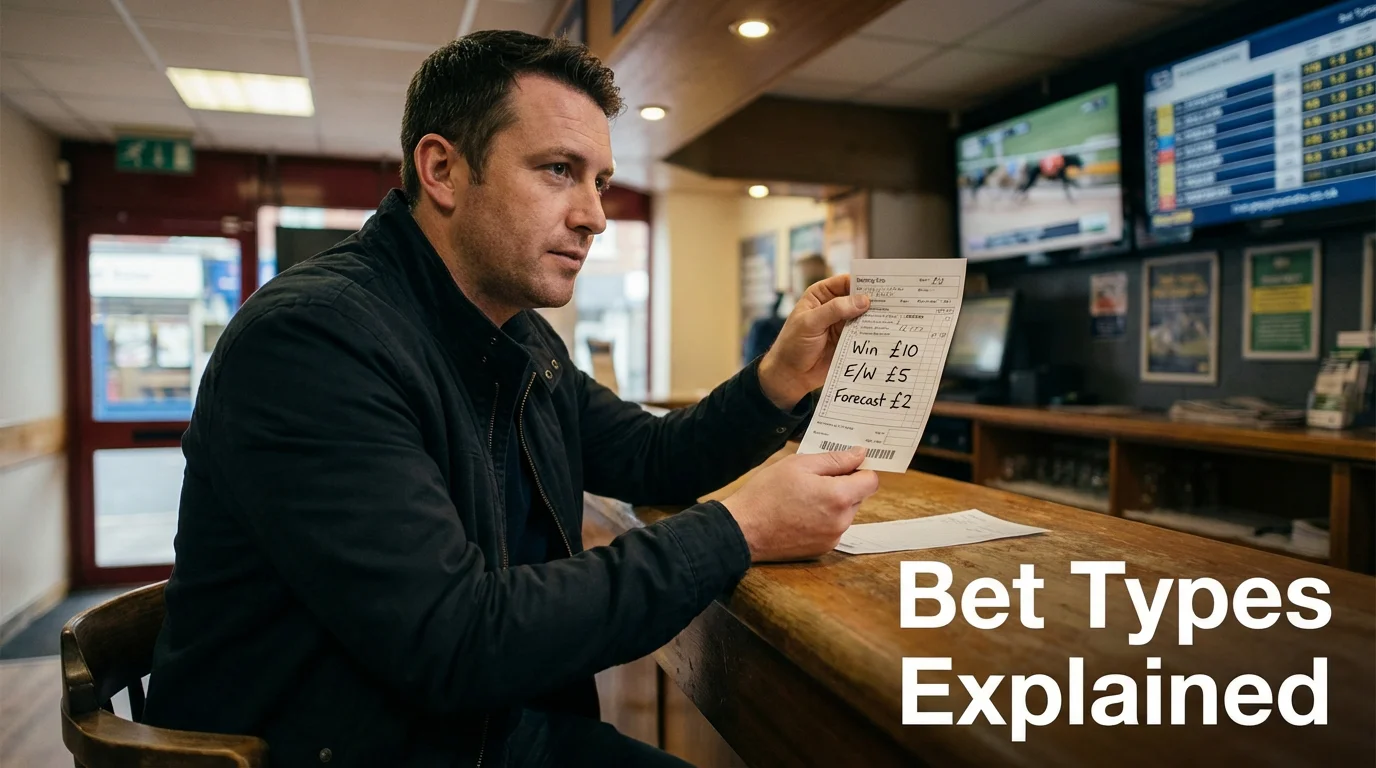
Most punters know the win single. The ones making real money from the dogs know six more bet types by heart. That is not an exaggeration — it is a structural reality of how greyhound markets are priced. The win single is efficient; bookmakers know it well and price it accordingly. The moment you move to a forecast, a combination tricast, or a carefully constructed accumulator, the market thins and, occasionally, the value opens up in ways that a straightforward win bet simply cannot provide. Find more bet type guides at dogracingresultstoday.
UK greyhound racing offers one of the widest menus of bet types in British sport. Six runners per race means the combinatorial possibilities — forecast, tricast, reverse forecast, combination forecast — are genuinely exploitable by a punter who understands both the mechanics and the when. This guide covers every bet type available on UK greyhound racing: the simple ones most people already use, and the more complex ones that separate casual bettors from those approaching it as a discipline. Each section explains how the bet works, how the return is calculated, and when it makes sense relative to what the racecard is telling you.
Win and Each-Way Bets on Greyhounds
The win single is the foundation. The each-way is its safety net — but it costs you, and not always equally. Understanding both thoroughly is the prerequisite for anything more complex, because all the multi-dog and multi-race bets described later in this guide are built on these basic units.
A win single on a greyhound is exactly what it sounds like: you pick one dog to finish first. If it does, you receive your stake multiplied by the odds, plus your stake returned. A £10 win bet on a dog at 4/1 returns £50 — £40 profit plus £10 stake. If it finishes anywhere other than first, you lose the £10. The simplicity is part of the appeal. The limitation is that greyhound fields are genuinely unpredictable; with six runners, even a strong favourite wins roughly 35–40% of the time in top-grade races. The win market is efficient, meaning the prices offered by bookmakers generally reflect the probability reasonably well. Value — situations where the price is higher than the implied probability justifies — is present, but it takes analysis to find.
The each-way bet splits your stake in two equal halves. Half goes on the dog to win; the other half goes on it to place — that is, to finish in a defined position that counts as a paying place. In standard greyhound racing with six runners, most bookmakers pay each-way on the first two places at one-quarter of the win odds. With four or fewer runners, the race is win-only at most bookmakers; check the terms before placing. Major events with large fields may offer three places — the English Greyhound Derby qualifying rounds, for example.
Here is how an each-way return is calculated in practice. You place a £5 each-way bet — £10 total stake — on a dog at 5/1. The dog finishes second. Your win half loses: that £5 is gone. Your place half wins: £5 at one-quarter of 5/1, which is 5/4. £5 at 5/4 returns £6.25 profit plus your £5 stake — £11.25 back. On a £10 stake, you have returned £11.25. The dog finishing second has salvaged the bet and produced a small profit. If the same dog wins, both halves pay: win returns £30 on the £5 win stake, place returns £11.25 on the £5 place stake, total back £41.25 on £10 staked.
The critical issue with each-way betting on greyhounds is the place fraction. At one-quarter odds for two places, the implicit break-even point for the place half of your bet is a dog priced at 3/1 or shorter. If you are backing a 6/4 favourite each-way, the place return at one-quarter odds for two places is only 3/8 — meaning your place half barely returns more than your stake even if the dog runs second. The each-way bet genuinely adds value only at longer prices, where the place fraction pays meaningfully more than evens. As a rule of thumb, each-way bets on greyhounds at odds shorter than 4/1 are rarely mathematically sound unless the place terms are unusually generous.
The place-only bet — simply backing a dog to finish in the places without also backing it to win — is available at some bookmakers on greyhounds. The payout is the place fraction of the win odds: one-quarter at standard terms. Place-only betting on greyhounds is rarely profitable because the margin is already significant before you apply the fraction, but it is an option worth knowing about for specific situations — returning dogs whose fitness is uncertain but whose class suggests they will be placed.
Starting price versus early price is a decision that applies to win and each-way bets. Taking an early price locks in the odds at the time of betting; taking SP means you receive whatever price the bookmaker settles at the off. For greyhounds, prices can shift significantly in the minutes before a race, particularly on televised meetings where market activity increases. Best Odds Guaranteed — offered by most major UK bookmakers on greyhound racing — means that if the SP is higher than your early price, you receive the SP. This is a meaningful bonus over a betting session and is one of the primary factors in choosing a bookmaker for greyhound betting. If BOG is available, taking early prices becomes almost always the right move, since you capture any market drift upward without losing out if the price shortens.
Forecast and Tricast Bets: Mechanics and Payouts
Forecast betting rewards those who understand why a dog finishes second almost as much as first. This is genuinely true: the forecast is not a harder version of the win bet — it is a different kind of analysis altogether. You are not just asking which dog wins; you are asserting a specific finishing sequence for the first two places. That specificity is what drives the payout up, and it is also what makes forecast returns so much more volatile than win returns.
A straight forecast requires you to name the first and second-placed dogs in the correct order. If you select Dog A to win and Dog B to finish second, both must happen exactly as stated. Any other result — Dog B first, Dog A second, or either dog finishing elsewhere — loses the bet. The dividend is calculated using the Computer Straight Forecast formula applied by the track and settlement service, based on the starting prices of both selections. The CSF formula is not a simple product of two odds; it incorporates a combined payout structure that produces higher returns when both dogs are at longer prices and lower returns when both are short-priced.
The reverse forecast bets on Dog A to win and Dog B second, and also Dog B to win and Dog A second — two straight forecasts at once. It costs twice the unit stake. The advantage is obvious: you do not need to call the order correctly. If either dog wins with the other finishing second, you win. This is by far the most common forecast bet used by UK punters on greyhounds, and it is the sensible starting point for forecast betting because the additional cost is modest compared to the reduction in variance.
The combination forecast takes the logic further. Rather than two selections, you pick three or more dogs and bet every possible straight forecast combination among them. A three-dog combination forecast generates six straight forecasts (three pairs, two ways per pair). At a £0.10 unit stake, this costs 60p. A four-dog combination generates twelve straight forecasts: £1.20 at 10p per line. The return calculation still uses the CSF formula applied to whichever two dogs finish first and second from your selection. Combination forecasts are particularly useful when the form suggests one dog is a near-certainty to place but the winner is genuinely open between two or three other runners.
The tricast is the forecast extended to three places: you must name the first, second, and third-placed dog in the correct order. A straight tricast at 10p on a six-runner race with three selections is a single bet of 10p — and a winning return that can run into dozens of pounds even at relatively short prices, because the correct three-way order from six dogs is a genuinely difficult prediction. The combination tricast removes the requirement to call the order and bets every possible permutation of your selections in first, second, and third: three selections generate six combinations, four selections generate twenty-four. At a 10p unit stake, a four-selection combination tricast costs £2.40.
The tricast dividend is calculated by the track using a formula similar to CSF but extended to three outcomes. Dividends are declared to a 10p stake as standard. A £2.40 combination tricast returning a dividend of £18.00 to 10p would pay out £18.00 × 24 combinations = £432. That is an extreme example, but it illustrates why combination tricast betting attracts serious attention from punters who have strong form opinions on the top three without being certain of the exact order. On wide-open races with evenly priced fields, the tricast dividend can be remarkably generous.
One practical consideration: not all races at all tracks are eligible for forecast and tricast dividends. Most GBGB-licensed tracks offer CSF and tricast dividends on their standard graded card, but always check the racecard notation. Races with non-runners or very short fields may not qualify. Some bookmakers also cap their own liability on forecast and tricast returns — check the maximum payout terms before placing large combination bets on open races where dividends can be very high.
Accumulators and System Bets on the Dogs
A greyhound accumulator can turn a 5p stake into a substantial return. The legs also compound the risk, and that compounding works with the same cold mathematics in both directions. Accumulators on greyhounds follow the same structural logic as any other sport: you select multiple dogs across multiple races, and all of them must win for the accumulator to pay. The return from the first selection rolls into the second, which rolls into the third, and so on until either the last dog wins or one of them ends the chain.
The arithmetic of a greyhound accumulator is seductive because greyhound odds are generally longer than football result odds at equivalent implied probabilities. A four-dog accumulator — four 4/1 shots — returns 5 × 5 × 5 × 5 = 625 to 1 in raw terms, meaning a £1 stake returns £625. The catch is that four 4/1 shots each have an implied probability of around 20%, and four independent events each at 20% give the accumulator a combined probability of 0.2⁴ = 0.0016, or 0.16%. The true odds against all four winning are approximately 624/1. The bookmaker’s margin means the actual return is unlikely to exceed the true odds, and may be materially lower if you are taking SP on short-priced selections at books with high margins.
A double is the simplest accumulator: two selections, both must win. A treble is three. The move from treble to four-fold is where recreational punters tend to overextend — adding a fourth leg because one more winner would make the payout impressive, while not adequately adjusting for the compounding difficulty. The sharp approach to greyhound accumulators is to limit the legs to races where you have genuine form-based reasons to select each dog, not to fill out the accumulator with best-guesses on races you have not studied. Two strong picks in a double will outperform four weak picks in an accumulator over any meaningful sample.
System bets are multi-selection bets that cover all, or a defined subset of, accumulator combinations from your selections. The most common are the Trixie and the Patent. A Trixie covers three selections and includes three doubles and one treble — four bets in total. A £1 Trixie costs £4. It pays if at least two of the three selections win, unlike a straight treble which requires all three. The Patent covers the same three selections but adds three win singles — seven bets total, £7 at £1 per line — meaning a single winner still returns something.
The Yankee expands to four selections: six doubles, four trebles, and one four-fold — eleven bets. The Lucky 15 adds four singles to the Yankee to make fifteen bets, with two winners needed to return a profit. All of these system bets are available on greyhound racing at major UK bookmakers. They are most useful when you have three or four strong selections but are uncertain about all of them winning — the system structure ensures that partial success is not a total loss.
Pick 3 and Pick 6 pools are available at some tracks and through Tote-based products. Rather than betting with a bookmaker at fixed or SP odds, pool betting aggregates all stakes on a given combination and distributes the pool minus a deduction among winners. Pick 3 requires you to name the winner of three consecutive races; Pick 6 names six. Pool returns can be very large when the combination is obscure and few punters have selected it, and they represent genuine value on days when the card is producing unexpected results. The deduction — typically around 20–25% — is the effective margin, and it is worth comparing to the bookmaker margin on the equivalent accumulator.
Exotic and Ante-Post Greyhound Bets
Beyond the basics, the greyhound betting menu runs deep — if you know where to look. The term “exotic” in greyhound betting refers to markets that go beyond the standard win, place, and forecast offerings. Some are available at most UK bookmakers; others are specific to exchange platforms or Tote products. Understanding them broadens your toolkit, even if you only use them occasionally.
System bets — Trixie, Patent, Yankee, Lucky 15 — sit alongside combination forecasts and combination tricasts as the most widely used structured bet types in UK greyhound betting. The each-way double and each-way treble apply each-way terms to a multi-selection accumulator: in an each-way double on greyhounds, both dogs must be placed (or win) for any return; the mechanics are effectively two each-way bets combined. The returns can be very modest on short prices, which is why each-way doubles on greyhounds rarely represent strong value unless at least one selection is at 5/1 or longer.
Winning margin betting — markets on whether the winner will win by a specific number of lengths — exists on some platforms for major events. Track condition markets, which bet on the going or timing of specific records, are rare but occasionally appear around the Greyhound Derby. These are niche products and not worth prioritising, but they illustrate that the betting menu on the dogs is broader than the standard card would suggest.
Ante-post betting is where greyhound betting intersects most directly with the sport’s calendar. The English Greyhound Derby, held annually at Towcester, generates a substantial ante-post market from the point that entries are published. Punters backing a dog ante-post are taking a price well in advance of the race — often weeks or months before — in exchange for usually much better odds than would be available on race day. The risk is clear: if your selection is withdrawn, most ante-post bets are lost. Some bookmakers offer non-runner no-bet (NRNB) terms on specific ante-post greyhound markets, which removes the withdrawal risk. Always check the terms before placing.
The Select Stakes, the Grand Prix, and the Scottish Greyhound Derby are the other major ante-post events. For serious greyhound punters, the ante-post market on the English Derby provides one of the most genuinely interesting betting propositions in the sport — a long-running market where early form in the qualifying rounds, draw luck, and trainer intelligence all create informational gaps that the shrewd punter can exploit. Dogs that perform strongly in the first-round qualifiers and are still available at double-figure prices for the final are often the best-value positions in ante-post greyhound betting.
Exchange betting — specifically Betfair Exchange — adds a further dimension. On Betfair, you can lay a dog as well as back it. Laying means betting that the dog will not win: you are, in effect, acting as the bookmaker. If the dog loses, you collect the backer’s stake; if it wins, you pay out at the agreed odds. Laying a greyhound is most commonly used as part of a trading strategy — backing at a higher price and laying at a shorter price to lock in a profit regardless of the result — but it is also used as a pure selection strategy by punters who are more confident about which dog will not win than which one will. Exchange margins on greyhounds are typically lower than bookmaker margins, making it worth including in your comparison across platforms.
Finding Value in Greyhound Bet Selection
Value is not about backing winners. It is about backing winners at the right price. This distinction is the most important conceptual shift in greyhound betting, and it applies equally to every bet type covered in this guide. A dog at 8/11 that wins is not a good bet if its true probability of winning is only 40% — the price is too short. A dog at 7/2 that finishes third might still have been a good bet if your analysis suggested it had a 35% chance of winning and the price implied only 22%.
Applying value logic to bet type selection means choosing the structure of your bet based on where the mispricing sits, not just which dog you fancy. If you have strong form reasons to believe a specific dog will run first or second and the market has it at 5/1, the each-way bet is likely to produce value — the place return at 5/4 against an implied 20% win probability with a genuine chance of placing is worth the second half of the stake. If the same dog is at 6/4, the each-way bet produces negligible place return and the win single is cleaner.
For forecast and tricast bets, value assessment requires comparing the CSF or tricast dividend against what you would calculate from the win prices of the selections. A rough test: multiply the implied win probabilities of your two selections and compare the result to the forecast return. If the CSF dividend is significantly higher than the multiplication of implied win probabilities would suggest, the forecast bet is priced above fair value. This happens most commonly when one of the two selections is a shorter-priced dog paired with a longer-priced one — the CSF formula tends to pay generously on combinations involving a mid-range and a longer-priced dog.
Odds comparison is a practical tool that most UK punters underuse. For any given greyhound selection, the win odds can vary by half a point or more across bookmakers at the time of betting. Over a season of regular betting, consistently taking the highest available price rather than the first available price adds a meaningful percentage to your returns. Oddschecker and similar services aggregate prices in real time, and the five seconds it takes to check the best available price is rarely wasted. BOG terms further reduce the cost of early price selection, but comparing prices at the point of betting remains valuable even when BOG is available.
Frequently Asked Questions
How many places are paid on each-way greyhound bets?
In standard UK greyhound racing with six runners, most bookmakers pay each-way on the first two places at one-quarter of the win odds. With four or fewer runners, races are typically win-only. For major events with large fields — such as qualifying rounds for the English Greyhound Derby — some bookmakers extend to three places. Always check the individual bookmaker’s terms for each race before placing, as terms can vary. The declared terms are usually shown alongside the race in the bookmaker’s greyhound markets.
What is the difference between a straight forecast and a reverse forecast?
A straight forecast requires you to name the first and second-placed dog in the correct order. A reverse forecast bets on two dogs to finish first and second in either order, covering both permutations at twice the unit stake. If Dog A finishes first and Dog B finishes second — or Dog B first and Dog A second — the reverse forecast pays. The straight forecast pays only if the result matches the exact order you specified. Both use the Computer Straight Forecast dividend declared by the track. Reverse forecasts are the most commonly used forecast bet in UK greyhound racing because they eliminate the need to call the precise finishing order while still generating higher returns than a win single.
Can I place greyhound accumulators at any UK bookmaker?
Yes. All major UK licensed bookmakers offer greyhound accumulators, including doubles, trebles, four-folds, and standard system bets such as Trixie, Patent, Yankee, and Lucky 15. The selections must be from races at different times — you cannot combine two dogs from the same race into an accumulator with standard bookmakers. Some bookmakers place limits on accumulator payouts; maximum returns vary by operator and are usually in the region of £1 million but can be lower on some products. Check the terms for your specific bookmaker before constructing large-stake accumulators. Betfair Exchange does not offer traditional accumulators but allows multi-event trading strategies.
Place Your Bet With Both Eyes Open
The bet is only as good as the reasoning behind it. The results will tell you if you got it right. That is the compact version of everything this guide covers, and it is worth holding onto when you find yourself drawn towards a four-fold accumulator purely because the return looks compelling. The mechanics of every bet type described here are available to any UK punter with an account at a licensed bookmaker. The discipline to deploy them correctly is a separate matter. Also read our greyhound tricast bet explained UK.
The practical takeaway is this: match the bet type to what the racecard is actually telling you. If one dog looks a near-certainty and the others are open, back the strong selection at the best available price and leave it alone. If you have a strong opinion on a first-and-second combination, a reverse forecast will express that opinion more efficiently than two separate win singles. If you believe three specific dogs will fill the top three places in a competitive race, a combination tricast at a small unit stake can generate a disproportionate return. If you are genuinely uncertain about most of the card, there is no rule that says you must bet on it.
Greyhound betting in the UK is governed by the Gambling Commission and subject to the same regulatory framework as any other licensed betting product. All the bet types described in this guide are available through licensed operators only. Bet responsibly, keep records of your selections and returns, and revisit your form analysis when the results do not align with your expectations — that gap is where the learning happens.