
Every number on that racecard was put there to tell you something — the trick is knowing what. Most punters glance at the trap numbers, scan the odds, and make a decision in thirty seconds. The ones who understand the card take ninety seconds and come away with a meaningfully different view of the race. That gap — sixty seconds of reading — is where most of the edge in greyhound betting lives. Find more form guides at dogracingresultstoday.
A UK greyhound racecard is not a programme in any casual sense. It is a compressed performance record for every dog in the race, laid out in a format that has barely changed in decades. Six traps, six dogs, each carrying a column of figures that tells you where they have been, what grade they have run in, how fast they have gone, and whether their trainer has been sending them out in form or just making up numbers. The card is not a prediction; it is raw material. What you build from it depends entirely on whether you can read it.
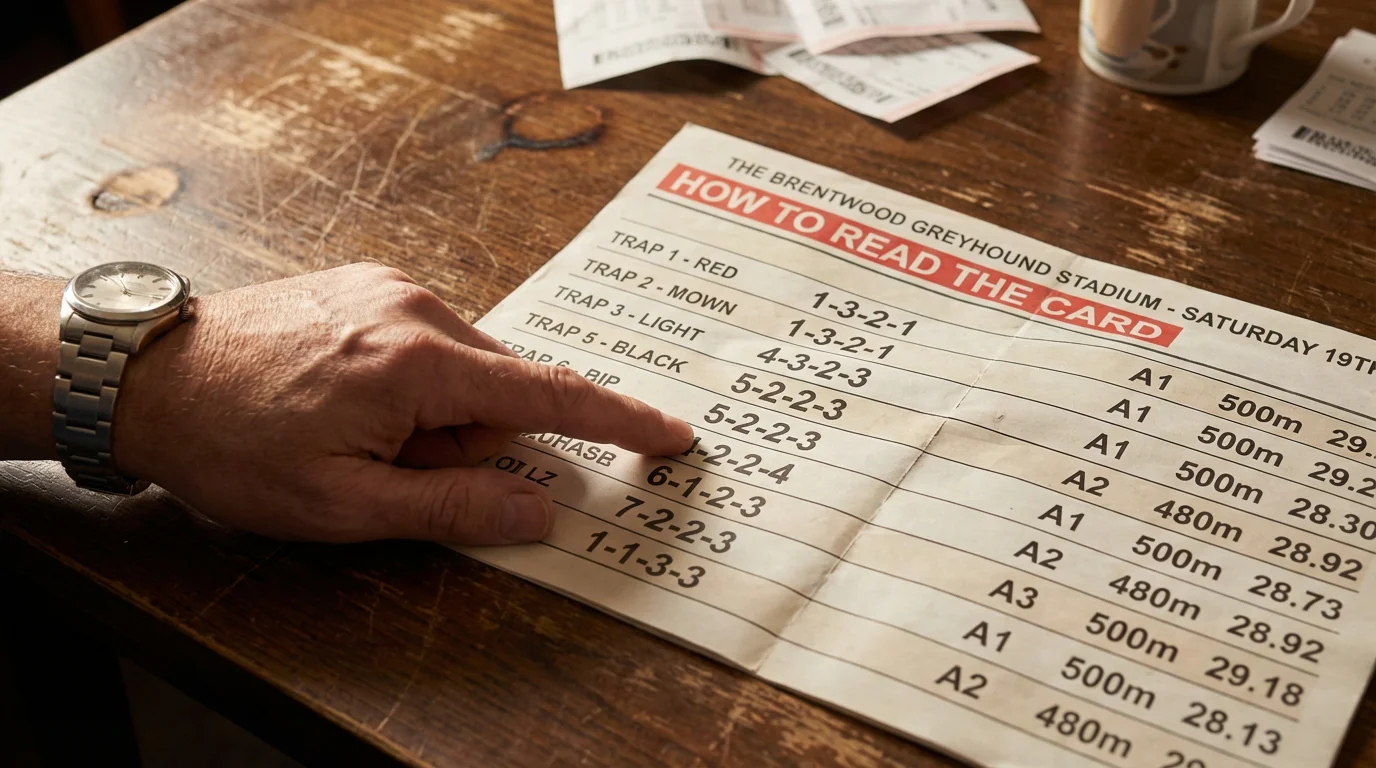
The format varies slightly between Timeform, Racing Post, and the track’s own racecard, but the core data fields are universal. Trap number. Dog name. Owner and trainer. Form string. Last run details — grade, distance, track, time. Weight. Remarks. Each field is a data point; together, they draw a profile. This guide works through every element in the order you will encounter it, explains what each one actually means, and shows you how a sharp punter uses that information before a race rather than after it.
What Is a Greyhound Racecard?
Technically, a racecard is a pre-race document published for every race on the GBGB-licensed circuit. In practice, it is a dense dossier — six dogs, six sets of figures, and enough information to take a clear position on who wins. Here is how to unpack it. It is distributed digitally through results and form services — Timeform, Racing Post, Sporting Life, and the individual track websites — and it governs how serious punters approach selection. Each row in the card corresponds to one dog, running from Trap 1 at the top to Trap 6 at the bottom.
Reading left to right across a standard UK greyhound racecard, you will encounter the following fields in some order: the trap number, the dog’s registered name, its trainer, the owner’s name, the form string (a sequence of digits and letters representing recent finishing positions), details of the last run, the dog’s current grade, its recorded time over the distance, its weight in kilograms, and often a brief remarks column (such as “mid-track wide” or “railer”).
The column that trips up newcomers most reliably is the form string. It reads right to left — the rightmost digit is the most recent run. A form string of 342-123 tells you the dog finished 3rd, 4th, 2nd in its earlier runs, then — after a gap signified by the hyphen — 1st, 2nd, and 3rd in its most recent three outings. That particular string is encouraging: an improving, consistent dog. A form string of 651-564 tells a very different story.
The grade column sits alongside the dog’s name or last-run entry and uses a letter-number system: A grades (A1–A11 at most tracks) for middle distances, D grades (D1–D6) for sprint distances, S grades (S1–S6) for staying/longer distances, P for puppy races, and Open or OR for open-class events. The number indicates class level within the grade — A1 is top-grade, A11 is the lowest entry point. A dog’s grade changes based on its recent results: perform consistently well and you get promoted; finish out of the money consistently and you come down. This system is one of the distinctive features of UK greyhound racing and understanding it is essential to interpreting anything else on the card.
The time column records the dog’s best or last recorded time over the race distance, and it allows direct comparison within the card. If Trap 3’s best time is 28.94 seconds and Trap 5’s best time is 29.42, that gap matters — but only if both were set at the same track and over the same distance. Times do not transfer between tracks, and they do not transfer between distances. A 480m time at Romford and a 480m time at Nottingham are measuring different things — the bends, the going, and the track surface all vary. Keep times relative, not absolute.
The weight column is measured in kilograms and published for every runner. Most dogs weigh between 28kg and 36kg. A dog will not be permitted to race if its weight varies by more than 1kg from its last registered weight, per GBGB Rule 113. What matters is not the absolute weight but the trend — has a dog come in 0.4kg lighter than its last run? 0.8kg heavier? Dogs running light after a period at a higher weight are often sharp; dogs coming in heavy may be carrying condition or returning after time off. The weight column rarely tells the whole story, but it is always worth a glance.
Finally, the remarks or notes column — where it appears — gives the handicapper’s brief summary of running style or notable incidents. “Railer” means the dog hugs the inside rail; “wide runner” means it tracks out on the final bend; “mid-track” is self-explanatory. Running style is particularly important at tracks with tight first bends, where railers hold a geometric advantage out of the traps. Crayford and Harlow are the two most prominent examples, and the racecard remarks will tell you exactly which dogs are likely to benefit.
Decoding Form Figures (What 1–6, F, W, R Mean)
The string of numbers after a dog’s name is not decoration — it is a performance diary. Reading it correctly is the single most important skill in greyhound form analysis, and the good news is that the code is not complicated once you understand the logic behind it.
In UK greyhound racing, each digit in the form string represents the dog’s finishing position in one race. The digits run 1 through 6 — corresponding to the six traps — with 1 being a win and 6 being last. A string like 211326 tells you this dog has run six times recently, won twice, and run out of the money twice. The further right you read, the older the run — the leftmost digit in a continuous string is the oldest, the rightmost is the most recent. Some services format this differently, so always check the notation key on whichever platform you are using.
Hyphens in the form string indicate a gap in the dog’s racing schedule. This gap may be a rest period, an injury layoff, or a kennel change. A short hyphen — representing a few weeks — is unremarkable. A long hyphen representing two or three months is significant: the dog is returning from a spell, and its current form and fitness are genuinely unknown. Horses returning from long breaks are treated with caution; the same logic applies here. The first run back often tells you the dog is not quite right, or — less commonly — that it comes back sharper than it left.
Beyond the digits, you will encounter several letter codes in the form string. These are important:
F — Fell. The dog lost its footing during the race. A single fall is not necessarily diagnostic; it can happen to any dog on a bad night. Two or more falls in a short form string is a concern, particularly at tracks with tight or cambered bends.
W — Walk-over. The dog ran unopposed, usually because other runners were withdrawn. The time may look fast, but it is meaningless for comparison purposes — there was no actual race, no challenge, no pressure on the pace. Treat walk-over runs as if they did not happen when assessing form.
R — Refused or Reserved. The dog declined to leave the trap, or the race was recorded as a non-runner for that dog. Like a walk-over, this run should be discarded from your form reading. A dog that has refused recently — particularly more than once — is a risk in any selection process.
D — Disqualified. Usually due to interference with another runner. The dog may have won or placed on the night, but the result was overturned. Persistent disqualifications suggest an aggressive or wayward dog; occasional ones are part of racing.
P — Pulled up. The dog was withdrawn by the handler or slowed significantly, either due to injury concern or running in obvious distress. A dog pulled up in its last run is essentially a question mark for the next one — unless the remarks column or post-race stewards’ report gives a clear explanation.
The form string is most useful when read in context, not in isolation. A dog showing 4-4-4-4-4-4 looks moderate at first glance, but if those fourth-place finishes were consistently close — within a length — and the dog was racing in A3 grade against strong competition, that is a very different dog to one running fifth and sixth in A8. The grade column validates the form string. Without it, you are reading half a sentence.
One practical rule: weight the most recent three runs more heavily than the rest. Greyhound form can deteriorate quickly with age or injury, and a six-month-old win is a poor guide to tonight’s race. Conversely, a dog that has improved in its last three starts — even if its earlier form looks modest — is often undervalued in the market. The punters who consistently back those improving trajectories are the ones who use the form string as a story rather than a score.
Race Grades and Why They Matter to Bettors
A dog dropping a grade is often a gift. A dog going up a grade is a warning. The UK greyhound grading system is the mechanism by which the sport maintains competitive balance, and understanding how it works — and how it affects betting — is the difference between reading results and understanding them.
GBGB-licensed tracks operate a graded racing structure in which dogs are assigned a grade based on their recent performance. Sprint grades run A1 through A10 or higher depending on the track, with A1 representing the fastest, highest-quality competition and the higher numbers representing lower grades. Some tracks use slightly different nomenclature — T grades for trial races, D grades for novice dogs still building a race record, P grades for pups — but the principle is consistent: your grade reflects what you have done lately, and it changes when you do enough to justify it.
The mechanics work as follows. A dog that wins at A4 will typically be promoted to A3 for its next race. A dog that finishes fifth and sixth in consecutive A5 races may be dropped to A6. The exact promotion and demotion thresholds vary by track, but one or two wins are usually enough to trigger an upgrade, and a consistent run of poor finishes brings the grade down. Trainers and owners have no formal say in the grading decision — it is applied by the track’s racing manager based on the rules.
From a betting perspective, grade changes are one of the most reliable signals on the racecard. A dog being dropped from A3 to A4 has been found wanting at the higher grade, yes, but it may now be running against dogs that are a clear step below its ability. If the dog has been losing narrowly at A3 — finishing second or third rather than out of the money — then the grade drop is an opportunity rather than a condemnation. The market does not always price this correctly, especially for dogs that have been unlucky rather than simply beaten.
Conversely, a dog promoted from A6 to A5 after a comprehensive win is being asked to step up in class. The racecard will show its A6 winning time, and punters may back it on the strength of that win. But the competition is materially stronger. Unless the win was impressive in terms of winning margin and time, treat a freshly promoted dog with measured scepticism in its first race at the new grade. The step up often takes a run or two to adjust to.
Open races — designated OR or Open on the racecard — operate outside the grade system entirely. These events feature dogs invited on merit, often for prize money or as part of a specific competition series. The English Greyhound Derby is the most prominent example. In open races, form comparisons across grade boundaries become even more important, and the track’s graded race times serve as a baseline rather than a direct guide. Open race form is assessed on a different scale, and the dogs running in them are typically at the top of the sport.
When reading a card with mixed form — some dogs with recent A3 form, others with A5 form, currently running in an A4 race — mentally map each dog to the grade of its recent results relative to today’s race level. Dogs running within one grade of their recent outings are on familiar competitive ground. Dogs stepping up two or more grades, or dropping two or more grades, are worth noting as potential value selections in either direction.
Trap Draw: How Starting Box Affects Results
Which trap a dog starts from can be as important as its form — some tracks are almost impossible to win from wide. That is not an overstatement. At certain UK venues, the data across thousands of races shows a persistent, statistically significant advantage for low-numbered traps. Ignoring this on the racecard is like reading a cricket scorecard without checking the pitch conditions.
The trap draw in greyhound racing is not random in the way that drawing a number from a hat might suggest. The racing manager at each track assigns traps based on a dog’s known running style and recent form at that venue. Railers — dogs that naturally track to the inside — are assigned to Traps 1 and 2. Wide runners tend to go in Traps 5 and 6. Traps 3 and 4 are typically occupied by mid-track runners. This allocation system means that the trap number on the racecard is itself a piece of information: if a known railer is in Trap 1, that is the expected assignment; if it has been placed in Trap 3, something unusual has happened or the field is particularly competitive.
The statistical bias at UK tracks runs roughly as follows. At tight, anti-clockwise circuits with sharp first bends — Crayford is the most extreme example — Trap 1 and Trap 2 win at a significantly higher rate than their 16.7% fair share. At Crayford’s 380m and 540m races, historical data has shown Trap 1 winning around 22–24% of all races. Over thousands of races, that gap compounds. Trap 6 at Crayford, by contrast, runs at rates well below average in sprint distances, because wide runners must cover more ground around the first bend before they can get competitive. The result is not a certainty — wide runners win from Trap 6 at any track — but the structural disadvantage is real.
Towcester operates very differently. Its wide, sweeping bends and extended straight provide less inherent advantage to railers, and the trap bias is far more balanced. At tracks like Towcester or Nottingham, form and time are stronger predictors of outcome than trap. This distinction matters enormously when you are trying to apply a rule of thumb across the circuit rather than track by track.
Reading the racecard in light of trap bias involves three steps. First, identify the track and look up its known trap statistics — GBGB publishes historical win rates by trap and distance, and Timeform carries this data for major venues. Second, cross-reference the trap assignments with the dogs’ running styles from the remarks column. A railer in Trap 1 at a tight track is benefiting from both style and structure. A wide runner in Trap 6 at the same track is facing the double disadvantage of extra distance and fewer gaps through traffic. Third, check whether the odds reflect this. Markets at major bookmakers often underprice inside traps at bias-heavy venues because recreational punters back on form or name recognition, not geometry.
One caveat: trap bias does not override exceptional form. A dog that has run 0.5 seconds faster than anything else in the race, over this distance, at this track, is still likely to win from Trap 5. The bias adjusts probabilities at the margins; it does not rewrite the race. Use trap statistics as one layer of analysis, not the deciding factor, and you will find it adds meaningful precision to your selection process.
Trainer and Kennel Data on the Racecard
A trainer in form is a multiplier. Here is how to spot one on the racecard. Greyhound racing in the UK is an owner-trainer sport: most dogs are trained by their owners or by professional licensed trainers at dedicated kennels. The trainer’s name appears on every racecard alongside each dog, and while it often gets ignored, it carries more information than most punters realise.
The most direct way to use trainer data is to track win rates over rolling periods. A trainer who has sent out four winners from twelve runners in the past fortnight is operating in a different mode to one who has had one win from fifteen. Timeform and Racing Post both carry trainer statistics, and the sharp punter cross-references the racecard entry against current trainer form before finalising a selection. When a well-performing trainer enters a dog that already looks strong on form figures and time, the convergence is meaningful.
Trainer data is particularly valuable in two specific scenarios. The first is when a dog changes trainers — a line that appears in the racecard remarks or in the form database. A kennel change can signal anything from the dog being sold to an ownership dispute to a deliberate strategic move by the new trainer to improve the dog’s performance. Some trainers have excellent records with particular types of dog — sprinters, stayers, railers — and a trainer who takes on a dog suited to their specialism is worth monitoring across the next few runs. The first race in a new kennel is often exploratory; the second and third are often when improvement shows.
The second scenario is returning dogs. When a dog has been off the track for a month or more, the trainer’s recent record with returning runners becomes relevant. Some trainers are meticulous about fitness preparation; their returning dogs frequently run to near their best first time back. Others use the first run as a loosener with no expectation of a competitive performance. This pattern is only visible if you track trainers rather than just dogs, and it is one of the few edges that remains available to the patient amateur punter in 2026.
The owner column on the racecard is less immediately useful for betting purposes, but it has one practical application: some ownership groups operate large stables with multiple dogs at a track, and when they enter several runners in the same race, it can indicate a competitive situation where one dog is likely being aimed at while the others are supplementary entries. This is not a guaranteed signal, but it is worth noting when an owner has three runners in a six-dog race.
Frequently Asked Questions
What does the hyphen in a greyhound’s form string mean?
A hyphen separates different periods of racing in the form string, typically indicating a break between campaigns. For example, a form string of 3-1-2-41-12 shows three sets of runs with two gaps between them. The most recent run is always on the right. A hyphen representing a gap of more than a month signals a rest period or injury layoff, and the dog’s first run back after a long break should be treated with caution — fitness may not be fully restored.
Can I get greyhound racecards for free in the UK?
Yes. GBGB publishes full racecards for all licensed UK meetings at gbgb.org.uk at no charge. Racing Post provides free racecard data with form, although detailed form analysis tools are behind a subscription. Timeform also offers free basic racecard access. Most major bookmakers display simplified racecards when you navigate to the greyhound markets, which include trap numbers, dog names, and current odds but may not carry the full form string depth. For serious analysis, Racing Post or Timeform’s paid tier provides the most comprehensive data.
How far in advance are greyhound racecards published?
For the majority of UK tracks, the racecard for an evening meeting is published the morning of race day or the evening before. GBGB-licensed tracks submit their race entries and trap draws to the central registry in advance, and the published racecard reflects the confirmed trap allocation after the draw. Some tracks use a same-day draw process, meaning the racecard is not finalised until a few hours before racing begins. Sky Sports Racing and SIS broadcast schedules often confirm the day’s meetings from midday, and the full card follows once the draw is complete. For major events — the Greyhound Derby, the Select Stakes — racecards are published days in advance.
The Card Never Lies (But You Have to Learn to Read It)
The racecard rewards the patient. Put in the time, and the results will stop being surprises. That is not a promise that the card will tell you the winner of every race — it won’t. Nothing will. But the difference between punters who read the racecard properly and those who scan it for a familiar name is the difference between informed risk and guesswork dressed up in confidence.
The steps are straightforward in principle. Read the form string right to left, most recent to oldest. Note the grades attached to those recent runs and compare them to today’s grade. Check the times — same track, same distance only. Look at the weight trend. Identify running style from the remarks, then map it to the trap assignment. Factor in the trap bias data for this specific track and distance. Finally, check the trainer’s recent form. That is seven layers of information, each one public, each one available for free or at low cost, and together they give you a substantially richer picture of the race than the starting price alone. Also read our understanding greyhound form figures.
The racecard is the result before the race. Everything the result will eventually tell you — the winner, the margin, the time — is latent in those columns of figures before the hare even moves. Most people wait for the result and then explain it in hindsight. The point of reading the card properly is to make the result less surprising, and over time, to find the races where the market has got the pricing wrong. That is where betting value lives: not in certainty, but in the gap between what the card says and what the odds imply.
Bookmark the sources — gbgb.org.uk for official racecards, Timeform and Racing Post for full form — and come back to the card for every meeting you intend to bet on. You do not need to analyse all twelve races at Romford tonight. Pick the two or three where your reading of the card gives you a clear view, and leave the rest alone. Selective, disciplined reading of the racecard is the foundation of everything that follows.