
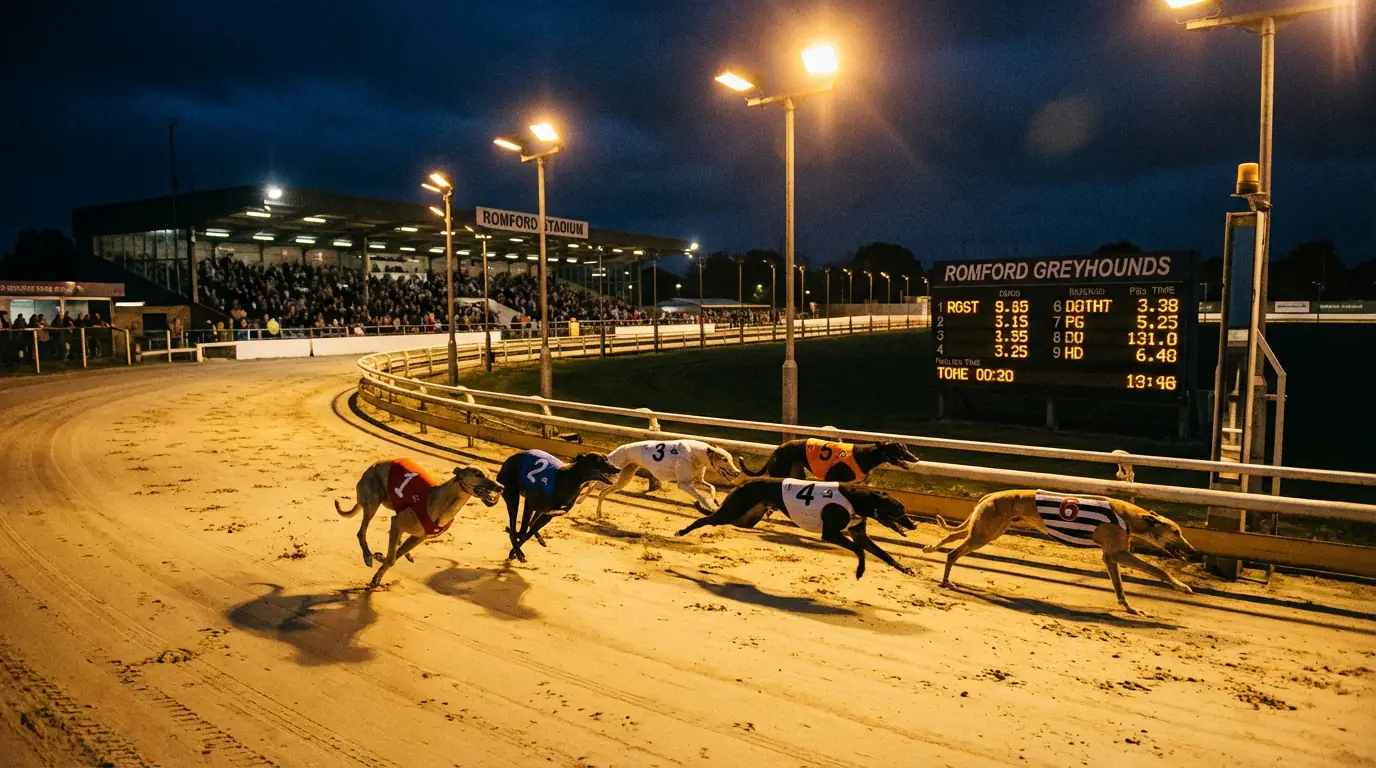
Romford is not just another greyhound track on the results board. It is one of the busiest and most consistently attended stadiums in the country, running evening cards several times a week and producing results that serious punters treat as a live data feed rather than a simple tally of winners and losers. Understanding what the Romford results mean — not just which dog crossed the line first, but what the splits, the finishing times, and the betting market tell you about the card as a whole — is the difference between checking a scoreline and actually reading form. This guide covers the track, the results service, the betting landscape, and how to extract real value from a night of racing at Essex’s most prominent greyhound venue. Get live results at dogracingresultstoday.
Romford Stadium is located in the London Borough of Havering and has been running greyhound racing since 1929. That longevity means it carries a rich dataset. For a punter building a form model or simply comparing a dog’s latest performance against its previous runs, Romford’s consistent track conditions and well-maintained timing infrastructure make it one of the more reliable sources of comparative data in UK greyhound racing. The track is managed under the Premier Greyhound Racing umbrella, which also operates several other major UK stadiums and provides the broadcast infrastructure that feeds results to Timeform, the Racing Post, and the Sporting Life almost instantly after each race.
Romford Greyhound Stadium: Track Profile and Race Schedule
Romford runs on an oval circuit with standard distances of 225 metres, 400 metres, 575 metres, 750 metres, and 925 metres. The 400-metre trip is the bread-and-butter distance on most cards — it represents the best balance of early pace and stamina that the graded system at Romford is built around. The 225-metre sprint card, when it appears, is a different beast entirely: it rewards explosive early pace and trap-one runners who can grab the rail before the first bend.
Race nights at Romford typically run on Mondays, Wednesdays, Fridays, and Saturdays, with evening cards starting around 7pm and running through to approximately 10pm. Additional morning and afternoon meetings take place during the week. The schedule is subject to change around public holidays and major events, but the evening format is consistent enough that regular Romford punters can plan their session well in advance. Each card generally contains between 12 and 16 races, a volume that makes it one of the larger evening programmes in London and the South East.
Results are posted almost in real time through the Premier Greyhound Racing platform at greyhounds.attheraces.com and through Timeform’s fast results service. The GBGB at gbgb.org.uk also maintains an official results archive for all licensed meetings. For live race-by-race updates during the card, the Sporting Life fast results page tends to post within seconds of the official finishing order being confirmed.
The graded structure at Romford runs from A1 at the top through to A10 at the bottom of the open-performance grades, with S grades for stayers and OR designating open race events. Each grade theoretically represents a comparable tier of ability, though any experienced Romford punter will tell you that the actual spread of ability within a grade varies considerably — especially at the lower end of the card where recent injury layoffs and track debutants can skew the field significantly.
One thing worth noting about the Romford schedule in 2026 is the increased prominence of Friday and Saturday evening fixtures in the wider betting market. These cards attract heavier handle from the bookmakers, which in turn means sharper opening prices and greater liquidity for exchange bettors. A Tuesday card at Romford and a Friday card may technically run the same grades, but the market quality around them is noticeably different — and that difference matters if you are trying to find value rather than just action.
How to Read Romford Results and Finishing Times
The Romford results table is dense. At first glance it is a column of numbers — finishing positions, trap numbers, names, times, and odds. In practice, it is a form archive that updates a dozen or more times per night. Learning to read it properly requires understanding what each component tells you, and which components most punters skip.
The finishing time is the single most underused data point in a Romford result. At 400 metres, the average winning time in A-grade racing hovers around 24.00–24.50 seconds depending on track conditions and wind. A winner posting 23.70 at 400 metres in an A5 grade is not just running fast relative to the field — it is potentially running fast relative to its own previous times and to the grade above. That is a meaningful signal. Conversely, a winner clocking 24.80 in the same grade might have won by three lengths in a race where nothing ran to form. The time makes those two results look very different from what the first column alone suggests.
The winning margin matters almost as much as the time. A comfortable three-length win in a slow time is a different result from a short-head victory in a fast time. The fast short-head indicates competition and genuine quality; the slow comfortable victory might indicate the dog was idling in front. Neither reading is definitive, but both inform the next selection decision when the dog reappears.
Trap numbers appear in the results as the first column after the finishing position. A win from Trap 1 at Romford is statistically the least surprising outcome on the card — Romford’s left-hand circuit favours railers, dogs who prefer to run close to the inside rail, and Trap 1 gives them the shortest possible path to the first bend. That statistical tendency is well-known and is consequently already priced into the market. The value from trap bias at Romford comes from knowing when it does not apply: wide-running dogs drawing Trap 1, or late-running stayers on the 575-metre trip where early position matters far less than stamina in the closing stages.
BSP and SP columns in the results table tell you where the market put the dog before the race. A winner returned at 6/1 SP in a race where its form suggested 2/1 or shorter says the market missed something — perhaps an unfavourable draw, a recent break from racing, or simply low profile. A well-fancied favourite winning at its expected price tells you the market priced it correctly, which is almost as informative in its own way. The gap between expectation and result is where form analysis either pays off or exposes its own blind spots.
Forecast returns appear alongside SP in most results services for Romford. These are the dividend paid to punters who correctly predicted the first two finishers. Unusually high forecast returns — well above what the individual odds would imply as a combined probability — often indicate a race that ran in unexpected order, with beaten favourites or market movers failing to perform. Those results are worth flagging for investigation rather than simply filing away as another line in the archive.
Romford Betting Markets and Where to Find the Best Odds
Romford is well-served by the major UK bookmakers. Bet365, Ladbrokes, William Hill, Betfair, Paddy Power, and Betfred all carry Romford meetings, and most offer live streaming for funded account holders. The depth of market varies between them: on the win and place market for standard A-grade races, the difference in odds across bookmakers can be marginal at the head of the market. On forecast and tricast markets, the variation is considerably more interesting, and it is worth checking multiple operators before committing.
Best Odds Guaranteed is available on Romford races at most major bookmakers for UK meetings. This means that if you take an early price before the race and the starting price is bigger, you receive the SP. Given that greyhound markets move frequently in the final minutes before a race — particularly if a well-fancied dog is scratched or if heavy money arrives for a rival — BOG is a genuine safety net for Romford ante-post bettors. Confirm BOG terms before placing, as some bookmakers restrict it to certain race grades or exclude sprint and stayers’ card events.
The Betfair Exchange carries Romford markets and offers BSP as an alternative to bookmaker SP. For Romford graded races, BSP tends to outperform bookmaker SP on beaten favourites and mid-price winners because the exchange aggregates money from a broader pool of bettors. Whether that outperformance is consistent enough to make BSP the default choice depends entirely on your betting profile — if you primarily back short-priced favourites, the bookmaker SP may actually work better due to BOG availability on those prices.
Oddschecker is the most efficient way to compare live prices across bookmakers for Romford races. The greyhounds section aggregates odds from the major operators in real time and highlights the best available price. On a busy Romford card with sixteen races, shopping for the best price rather than defaulting to a single bookmaker can add meaningful return over the course of an evening. It takes roughly thirty seconds per selection. Over a month of regular Romford punting, that discipline compounds.
Romford Track Stats: Trap Bias and Favourite Win Rate
Trap bias at Romford has been a subject of sustained analysis by greyhound form students for years. The left-hand circuit creates a measurable advantage for inside traps over the standard 400-metre trip. Traps 1 and 2 consistently produce more winners than their one-in-six share of races would predict. Trap 6, positioned on the outside, faces the longest journey to the first bend and wins at a rate significantly below the statistical expectation in A-grade events. That does not mean Trap 6 dogs are poor bets — it means they need a clear track to work from wide, and the odds need to reflect the obstacle in front of them.
Favourite win rates at Romford sit broadly in line with the national UK average for graded racing, which OLBG’s annual statistics consistently track at around 35–37% across A-grade fixtures. In open races at Romford, where the ability spread tends to narrow and the market is sharper, favourite win rates climb noticeably — sometimes into the 45–50% range. The practical implication: backing favourites at Romford in graded races over a long sample is a slow-drain exercise. The market is efficient enough to price them accurately, which means there is very limited edge in following the market blindly on graded nights.
Where Romford produces more interesting patterns is in the behaviour of dogs returning from a break. Greyhounds that have had three or more weeks off tend to run below their previous times on the first run back, regardless of the grade. A dog returning after a layoff in an A4 race having previously competed in A3 company looks like a class dropper on the racecard but may simply be ring-rusty. The results from its first run back are therefore not fully representative, and should be weighted accordingly when assessing the subsequent form entry.
The 225-metre sprint card produces its own statistical quirks. At this distance, Trap 1 dominance is even more pronounced — the race is largely decided at the first bend. Finishing times at 225 metres cluster tightly around 13.50–14.20 seconds, and deviations from that window are worth flagging. A sprint winner clocking 13.30 is running at a level that puts it among the fastest times in the country at that distance, and such a run should update the dog’s form assessment significantly upward.
After Romford’s Card: What the Results Tell Experienced Punters
The results from a full Romford card are not just a record of what happened. They are raw material for the next meeting. Every finishing time updates the track’s par times for each grade and distance. Every change in position — a dog that finished third last week winning tonight — updates the form picture for a field of competitors who will mostly re-appear within the next seven to fourteen days at the same venue.
The most productive reading of a Romford results card is retrospective analysis combined with forward projection. Which dogs ran to form? Which ran above it — and why? Was the opposition unusually weak, or did the time genuinely suggest improvement? Which dogs ran below their ability — was there interference at the first bend, a wide draw in adverse conditions, or simply an off-night? These questions turn a results page into a research tool, and the answers accumulate into a working picture of each dog’s current trajectory.
For punters who follow Romford regularly, the returning-favourite phenomenon is particularly instructive. A dog that ran prominently last week but failed to win will often attract market support in its next start. If the reason for the defeat was circumstantial — baulked at the first bend, wide draw, slow break — then the market support is rational. If the defeat was on a clean run with a clear trip and the dog simply was not fast enough, that market support represents overreaction, and the price should be challenged rather than followed. Also check our live greyhound racing results.
Romford results are available for archival research through the GBGB database, Timeform, and the Racing Post going back several years. Building a track-specific model from that data is not a weekend project, but even a basic understanding of how par times shift between grades, how trap bias distributes across distances, and how returning dogs run on their first start back will improve the quality of every decision made at the next Romford card. The track is fast, the data is public, and the card runs four nights a week. The results are already there. The question is whether you are using them or just reading them.