
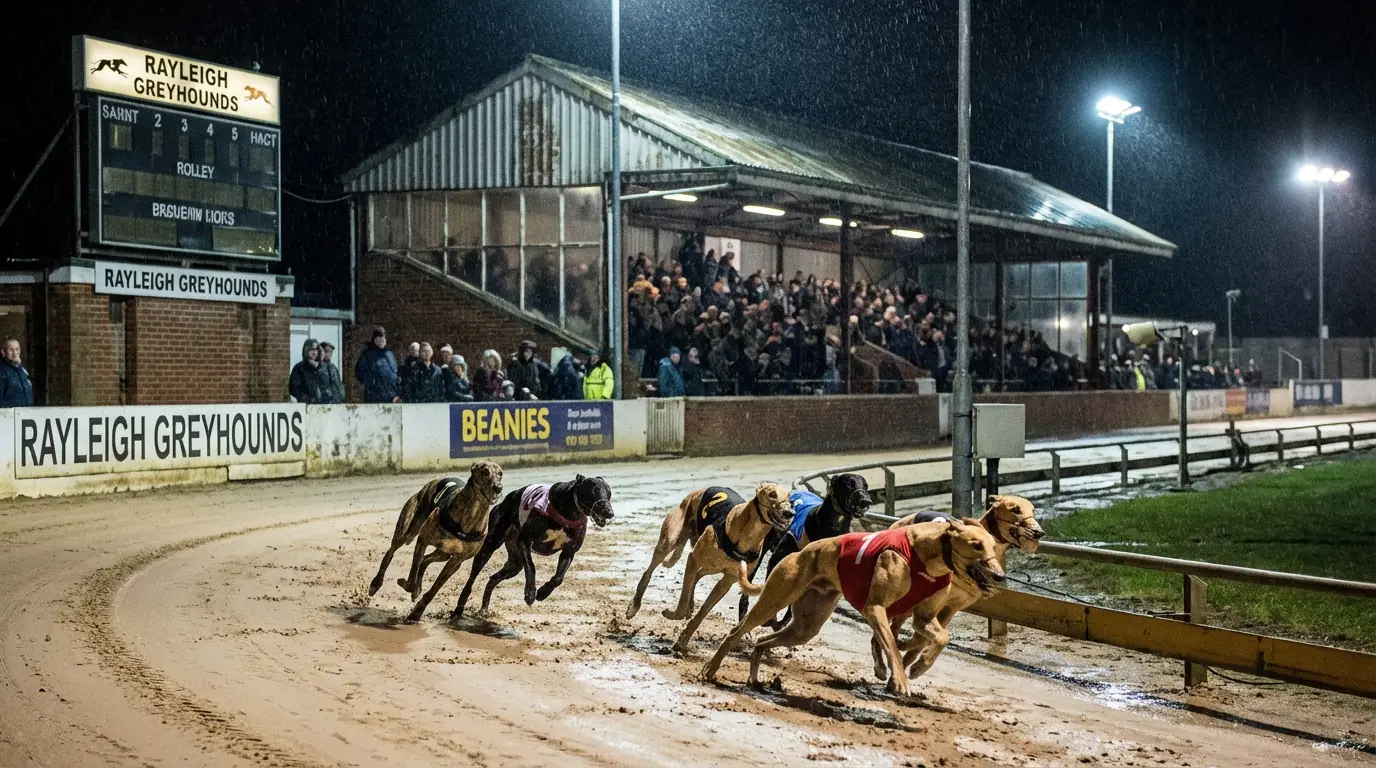
Crayford was a track that punished ignorance. Its tight bends and compact oval circuit created one of the most pronounced trap biases in UK greyhound racing, and a punter who approached Crayford results without understanding that bias was not reading form — they were reading noise. The inside traps dominated here in a way that felt almost unfair until you understood why: the geometry of the circuit meant that a railer from Trap 1 covered demonstrably less ground than a wide-running dog from Trap 6, and at racing pace over 380 metres, that difference in distance translated directly into a difference in winning chance that had nothing to do with ability. Crayford Stadium closed permanently in January 2025 after Entain announced it was no longer viable to operate the site, but the form principles it embodied — and the historical data it produced — remain essential reference material for understanding trap bias in UK greyhound racing. Get live results at dogracingresultstoday.
This matters not just for pre-race selection but for reading what the results mean. A Trap 6 winner at Crayford in A-grade racing is a genuinely exceptional performance — it requires either a dominant ability advantage or a very particular set of circumstances involving interference, slow breaks, and chaos in the early stages. When you see a wide-draw winner in a Crayford result, the first question is not whether to back that dog next time. The first question is whether the win reflects the dog’s ability or the card’s disorder. The difference is everything.
Crayford Greyhound Stadium: A Track That Rewarded Railers
Crayford Stadium was located in south-east London, in the London Borough of Bexley, and operated as a GBGB-licensed venue from 1986 until its closure in January 2025. It ran under the Premier Greyhound Racing umbrella and regularly hosted evening cards, with the stadium compact compared to the wider-circuit venues like Towcester. That compactness defined everything about how races were run and how the results should be read.
Race distances at Crayford included a 380-metre standard distance, a 540-metre middle-distance trip, a 714-metre long-distance event, and an 874-metre marathon. Each distance had a distinct character. The 380 metres was the bread-and-butter distance on most graded cards and was where the Trap 1 and Trap 2 advantage was most pronounced. The 540-metre and 714-metre trips gave wide runners more opportunity to recover position, and trap bias softened measurably at these longer distances, though it did not disappear entirely.
The left-hand circuit at Crayford means the first bend arrives quickly after the traps, and inside draw translates almost directly into inside position at that bend. A railer drawing Trap 1 typically reaches the bend first and, if unchallenged by another inside runner from Trap 2, can dictate the rail position through the entire first turn. Once a railer settles on the inside at Crayford, the race is frequently decided — the dog behind it cannot pass on the inside, and passing on the outside means covering additional ground at high speed.
Wide-running dogs at Crayford are not automatically poor selections, but they require specific conditions to compete. A wide runner with a clear outside track — perhaps because a strong Trap 1 railer has drawn wide, or because the field is dominated by middle-ground runners — can find daylight and use its wider-circuit running style. These conditions are rare enough that it is worth flagging them specifically rather than simply applying a blanket discount to all wide draws at Crayford. When those conditions exist, the wide runner in question is frequently available at a longer price than its ability justifies, precisely because the general knowledge of Crayford’s trap bias has led the market to over-discount outside draws as a category.
Today’s Crayford Results: Where to Access Them and When They Post
Crayford results for today’s evening card post to the major UK greyhound results services in near-real time. Timeform’s fast results page at timeform.com/greyhound-racing/results/today and the Sporting Life’s greyhound results section both update within seconds of the official finishing order being confirmed by the stadium timing system. These are the fastest access points for the immediate result, SP, and BSP returns.
The Premier Greyhound Racing broadcast network carries Crayford racing live through the greyhounds.attheraces.com platform, and most major UK bookmakers stream Crayford meetings for qualifying account holders. Bet365, William Hill, Ladbrokes, and Betfred are the most consistently reliable streaming providers for Crayford evening cards. It is worth verifying that a specific meeting is available on your preferred platform before the card begins — streaming availability occasionally varies by meeting depending on broadcast rights arrangements for that particular evening.
For the official results archive, the GBGB at gbgb.org.uk/racing/results holds complete Crayford records going back several seasons. This archive is the correct reference for any historical form research at Crayford — verifying a dog’s previous times at the track, checking its trap records across past appearances, or comparing its finishing times across different grades. The GBGB archive is not designed for speed but is complete and authoritative.
During the evening card itself, bookmaker racecard pages typically display the result of each race as it is confirmed, alongside any SP adjustments. For punters managing multiple bets across a Crayford card, the bookmaker interface provides the fastest settlement confirmation, though the raw data arrives at Timeform and Sporting Life marginally ahead of most bookmaker result pages.
Reading Crayford Form: What the Results Tell Us About Running Styles
Reading Crayford results effectively requires a prior knowledge of running style for each dog in the field. The results do not label dogs as railers or wide runners — that classification exists in the form guide and racecard notes rather than in the results table itself. But the results, when read over multiple appearances, reveal running style implicitly. A dog that consistently wins from Trap 1 or 2 at Crayford while running comparable times from Trap 3 or 4 is demonstrating rail preference. A dog that consistently runs below its Crayford par time from wide draws but performs to form when drawn inside is a confirmed railer and should be assessed accordingly whenever its draw is wide.
The finishing time column in Crayford results is particularly useful because the track’s consistency of surface and the reliability of its timing systems make time comparisons relatively straightforward. Par time for A-grade racing over 380 metres at Crayford sits around 23.50–23.90 seconds. Performances meaningfully faster than 23.50 represent the top end of the grade; performances slower than 24.00 warrant investigation — either the dog ran below form, the race was unusually messy, or the conditions were adverse.
Winning margin data in Crayford results is worth reading in conjunction with the time. A Trap 1 railer winning by six lengths in a fast time has dominated — it had the ideal draw, used it perfectly, and ran a strong time into the bargain. A Trap 1 railer winning by six lengths in a slow time may simply have cantered home against weak opposition. The distinction matters enormously when that dog reappears in its next start and the market has priced both performances as equivalent quality.
Dogs returning to Crayford from other tracks require careful assessment. A dog with a form string built entirely at wider-circuit venues — Towcester, Nottingham, or the former Wimbledon layout — may be facing Crayford’s tight bends for the first time on a given card. That first appearance at Crayford is almost never representative of the dog’s true ability at the track. The market typically does not discount it sufficiently, and the result from that debut run is a learning experience for the dog rather than a reliable form line for future Crayford appearances.
Trap 1 and Trap 2 Dominance at Crayford: The Numbers
The statistical case for inside trap dominance at Crayford is unambiguous. Across multiple seasons of GBGB-recorded results, Traps 1 and 2 at Crayford over the 380-metre standard distance win at combined rates that significantly exceed their one-third theoretical share of races (two traps out of six). Trap 1 alone frequently posts win rates in the 22–27% range in A-grade races at this distance — substantially above the 16.7% base expectation.
This dominance is not distributed equally across distances. At 265 metres, the Trap 1 win rate at Crayford can exceed 30% in sprint-specific grade events. At 540 metres, it drops towards the 18–20% range. At 714 metres, the distribution is closer to balanced, with inside draw providing only a marginal advantage over a race of that length where positional dynamics evolve significantly through the course of the contest.
The corollary of this dominance is that outside traps at Crayford — particularly Traps 5 and 6 — are systematically underpriced by the market in terms of implied winning probability. The market knows Trap 1 dominates; the market shortens Trap 1 runners accordingly. But the market occasionally does not fully price the degree of disadvantage facing a Trap 6 draw at 380 metres. A Trap 6 dog offered at 5/1 in a race where its ability justifies 5/2 against a theoretically equal field has had two-and-a-half points of odds added simply by drawing wide. Whether that extra margin compensates for the disadvantage depends on the gap in ability between the outside drawer and the inside drawers in the specific race — which is exactly the calculation a form analysis should be performing.
Trap 2 at Crayford is worth specific mention because it is frequently undervalued relative to Trap 1. The trap bias narrative focuses on Trap 1, which attracts the most market discussion and the most selective betting. Trap 2, occupying the next position and offering nearly equivalent access to the inside rail if Trap 1 breaks slowly, tends to carry fewer betting points of premium in the market than Trap 1. Over a long sample, Trap 2 win rates at Crayford are competitive with Trap 1 win rates, and the odds available on Trap 2 runners are systematically better than the equivalent Trap 1 odds. That differential, exploited consistently, represents a small but real statistical edge at a venue where even marginal edges compound significantly over a season of betting.
Betting Strategy for Crayford Races Based on Form and Results
Any coherent approach to betting on Crayford races starts with the trap draw and works outward. The draw is not the only factor but it is the first filter. A strong form dog drawing Trap 1 at 380 metres at Crayford is the market’s favourite because the market understands the track — that favourite is often correctly priced and offers no value. The interesting cases are the strong form dogs drawing Traps 3 or 4, where the draw is a mild disadvantage but the market has overpenalised for it, and the average form dogs drawing Trap 1, where the draw is a genuine advantage but the ability is not there to exploit it fully.
Forecast betting at Crayford deserves particular attention. Because inside traps dominate, the forecast market — predicting the first two finishers in correct order — at Crayford is heavily weighted toward inside-to-outside ordering. Traps 1 and 2 finishing in the first two positions is statistically the most common outcome at 380 metres. The forecast return for a Trap 1 / Trap 2 combination at Crayford is consequently depressed — the market knows this combination lands frequently and prices it accordingly. The value in Crayford forecast betting often lies in identifying the cases where an outside draw has the ability to force its way into the frame despite the positional disadvantage, particularly at longer distances where the trap bias softens.
Bankroll management at Crayford needs to account for the track’s predictability. Because the trap bias is well-known and the racing is frequent, Crayford markets tend to be efficiently priced for the most obvious selections. There is less long-odds value in following the structural biases than at a venue where those biases are less widely understood. The edge at Crayford comes from form research that goes beyond the draw — identifying dogs that are improving through their current campaign, catching trainers in form, or reading the results of recent Crayford cards to spot dogs that have been unlucky in traffic. The bias is real; exploiting it profitably requires more than a blanket rule about backing Trap 1. Also check our live greyhound racing results.
Results from Crayford, tracked carefully over a season, build a form picture that is extraordinarily consistent. The track does not lie. Dogs that run well here, run well consistently. Dogs that struggle with the bends, keep struggling. For a punter willing to maintain a Crayford-specific form file — even a simple record of each dog’s times across appearances, trap draws, and running style notes — the investment pays back over time in decisions that are measurably sharper than those made from the results page alone.