
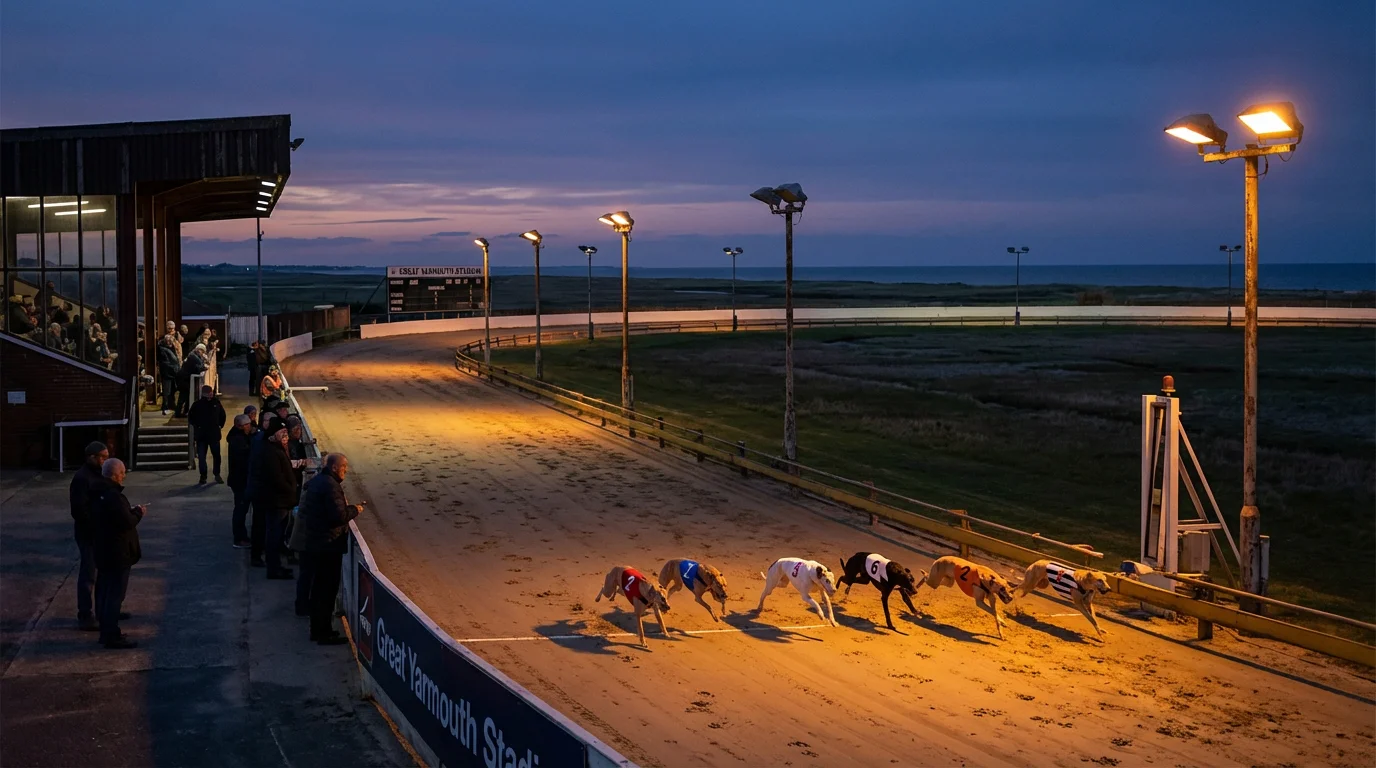
Great Yarmouth Stadium carries a distinction that most UK greyhound venues cannot claim: it hosts the East Anglian Derby, one of the oldest regional invitation events on the greyhound calendar. That single fact changes the weight of Yarmouth’s results page for any punter serious about national form. On an ordinary Tuesday evening, Yarmouth produces graded racing that is competent and readable. During the East Anglian Derby series, it produces results that benchmark East Anglian, South East, and occasionally national-level form against each other in open competition. Both contexts require different reading — and confusing the two is a reliable route to poor decisions. Get live results at dogracingresultstoday.
Outside the Derby period, Yarmouth is a well-run regional track serving Norfolk’s greyhound racing community with consistent evening cards throughout the year. The kennel base is East Anglian in character — trainers from Norfolk, Suffolk, and Essex dominate the grade structure — and the form is internally coherent once you have a working knowledge of the active competitors. For a punter who invests that knowledge, Yarmouth is a useful source of well-priced opportunities in a market that the national betting public follows only loosely.
Great Yarmouth Greyhound Stadium: Profile and Annual Schedule
Great Yarmouth Stadium operates under GBGB licensing and runs cards primarily on Mondays, Wednesdays, and Saturdays. The annual programme spans most of the calendar year with appropriate breaks around public holidays. Race distances at Yarmouth include a sprint distance of 277 metres, a standard mid-distance of 462 metres, a stayers’ distance at 659 metres, and a marathon at 843 metres. The 462-metre trip is the most common on graded cards and provides a genuine test of sustained pace that differentiates the upper grades from the lower ones fairly clearly.
The stadium is a mid-size GBGB-licensed venue, consistent with its status as the leading greyhound track in East Anglia. It operates within the wider PGR broadcast network, meaning results feed into the national data infrastructure and the track’s races are accessible via bookmaker streaming services. The annual East Anglian Derby — historically run in the spring or early summer months — elevates the venue’s profile nationally for the duration of the series and brings a quality of competition that sits well above the standard graded card.
OLBG’s annual UK greyhound statistics note that Yarmouth’s open race favourite win percentage is towards the lower end of the UK distribution — the 36% range, compared to venues like Central Park which posted 52% in open races in recent seasons. That lower favourite win rate in open events at Yarmouth is worth filing: when the East Anglian Derby field assembles, the favourite is not as reliable a steer as it would be at some other invitation venues, and the market’s confidence should be treated with corresponding scepticism.
The track surface at Yarmouth is subject to the East Anglian weather, which can produce conditions ranging from firm summer going to wet and soft winter surfaces. Going descriptions accompany all GBGB-submitted results and are worth noting when building time comparisons across different Yarmouth meetings. A par time for A-grade racing at 462 metres under firm conditions and the same par under soft going are meaningfully different numbers, and treating them as equivalent is a basic error that degrades any time-based analysis.
How to Access Yarmouth Greyhound Results Today
For today’s Yarmouth results, the fastest and most reliable sources are Timeform’s greyhound results page at timeform.com/greyhound-racing/results/today and the Sporting Life fast results section. Both update within seconds of the official finishing order being confirmed by the track timing system and display the full result: finishing positions, dog names, trap numbers, official times, SP, and BSP returns. For a punter monitoring multiple evening cards simultaneously, the Sporting Life layout is marginally more efficient because it aggregates all running UK meetings on a single page.
The GBGB official results archive at gbgb.org.uk/racing/results is the authoritative source for historical Yarmouth form data. It holds complete records for all GBGB-licensed meetings — finishing margins, going conditions, full field entries, official times, and SP returns — accessible by venue and date. For any research that requires more than the most recent few weeks of Yarmouth form, the GBGB archive is the correct starting point.
During the East Anglian Derby period, the Racing Post’s greyhound section supplements the raw results with editorial context — draw analysis, trainer comments, sectional information where available, and form comparisons between the invited runners. The Racing Post’s coverage of invitation events is more detailed than its treatment of standard graded cards, which makes it a useful secondary source during Derby rounds even for punters who primarily use Timeform for speed and the GBGB for archival depth.
Live Yarmouth results during an evening card are also available through bookmaker racecard pages. Bet365, William Hill, and Ladbrokes display confirmed results alongside their Yarmouth racecards as the card progresses. For punters who place their bets through these platforms and want to manage open positions across a Yarmouth card without switching between multiple sites, the bookmaker interface is the most integrated option — it combines bet management with result confirmation in a single view.
Yarmouth’s Open Race Statistics and What They Reveal
Yarmouth’s open race results carry a statistical profile that diverges from its graded racing in ways that are analytically interesting. The lower favourite win rate in open events noted above is not a statistical anomaly specific to one or two years — it reflects a structural feature of how Yarmouth’s invitation events tend to be constructed. The East Anglian Derby in particular draws a field where the ability range within the field is genuinely compressed, meaning no single dog has an overwhelming form advantage over the rest. When all six dogs are genuinely competitive, the race result is more open than the betting market typically acknowledges, and the favourite’s implied probability overstates its actual chance of winning.
Wide-running dogs perform relatively well at Yarmouth compared to their equivalent performance at tighter-circuit venues. The track geometry gives outside drawers more room to find their stride, and the 462-metre distance is long enough that a wide runner with good stamina can recover from an early positional deficit and still compete for the frame. This does not mean outside draws are profitable to back systematically at Yarmouth — it means the discount applied to wide draws should be smaller than at circuits like Crayford, and the occasional wide-draw winner at Yarmouth reflects ability rather than chaos.
The stayers’ events at 659 metres at Yarmouth produce a small but distinct form pool. Very few UK tracks offer regular long-distance competition, and the dogs that specialise at this distance develop a form record that needs to be assessed entirely within the stayers’ category. Yarmouth’s 659-metre results are a useful reference point for any punter following specialist long-distance greyhounds, because the pool of comparable evidence is national in scope and Yarmouth events contribute meaningfully to it.
Finishing margins in Yarmouth open races tend to be narrower than in graded events — a consequence of the reduced ability variance in invitation fields. Short-head and neck finishes are common in East Anglian Derby races, and the forecast market for those events reflects this: combined probabilities for the front two dogs are priced tightly because the market expects a close finish. Finding value in Yarmouth open race forecasts therefore requires not just identifying which two dogs will fill the frame but identifying at what odds that outcome is mispriced — a more demanding task than simply reading the form.
Betting on Yarmouth Events: Markets and Streaming
Yarmouth races are covered by all major UK bookmakers through the standard BAGS and SIS network. Win, each-way, forecast, tricast, and combination markets are available across standard graded cards. During the East Anglian Derby, most bookmakers also offer ante-post markets on the individual round results — backing a dog to progress from the first round before the draw is made, for example, or taking a price on the outright winner before the semi-finals. These ante-post markets can represent genuine value during the earlier rounds of a competition where form knowledge outpaces the market’s attention.
Live streaming for Yarmouth is available through bookmaker platforms carrying Premier Greyhound Racing content. Bet365, William Hill, and Betfred consistently offer Yarmouth meeting streams for qualifying account holders. The greyhounds.attheraces.com platform carries live Yarmouth coverage and is a useful free-access backup if your primary bookmaker’s stream is unavailable for a specific meeting. Verify that the particular card is listed as broadcast before the racing starts — streaming availability occasionally varies by specific date.
BOG applies to Yarmouth races at most major UK bookmakers on the same terms as other UK greyhound meetings. Its value at Yarmouth during Derby rounds is enhanced because the tighter ability range in open races means the market is more actively debated in the lead-up to each race, and price movements of a point or more are common. Taking an early price on a Yarmouth East Anglian Derby selection and knowing the BOG safety net is in place allows engagement with the market before it settles, which is often when the best prices are available.
Each-way betting at Yarmouth during Derby events deserves particular consideration. On a six-dog field, each-way terms typically pay for first and second at one-quarter odds. In a genuinely open field where the ability range is compressed, the place part of an each-way bet has a higher-than-usual probability of landing, and the total return profile is more favourable than in a race with a dominant favourite and a weaker remainder. The each-way market at Yarmouth Derby events is, for this reason, regularly worth examining even for punters whose default approach to greyhound racing is win singles.
The East Anglian Derby: Yarmouth’s Premier Results Day
The East Anglian Derby is a multi-round invitation event run at Yarmouth in the spring or early summer, featuring greyhounds qualified on the basis of their recent form across East Anglian and broader regional racing. It is not a national championship — the English Greyhound Derby at Towcester sits in a different category entirely — but it is a legitimate regional benchmark event, and the results from its rounds carry form weight that exceeds what the grade of competition might suggest.
The format typically involves heats, semi-finals, and a final, with a field of invited runners drawn by ballot for each round. The ballot element is significant: a strong dog drawing an unfavourable position in the heats may not progress to the semi-final despite being the best dog in the competition. That structural contingency means Derby results need to be read with the draw clearly in mind. A dog that failed to win its heat but finished close in a time that suggests it ran well can be a better betting proposition in the semi-final than its heat result alone indicates.
Historically, East Anglian Derby winners have often been dogs already performing at or near the top of A-grade racing at Yarmouth or at other regional venues in the East. First-time Derby visitors from outside the region occasionally perform well — a dog from a strong London kennel entering the draw can represent a genuine class advantage — but the home-track familiarity of regular Yarmouth competitors provides a real benefit at an event run on a track where they have established form histories. That factor tends to narrow in significance as the rounds progress and the weaker field members are eliminated. Also check our live greyhound racing results.
For the punter who follows the East Anglian Derby seriously, the most valuable preparation is not the morning of the final but the weeks preceding it. Reading the qualifying form, understanding which dogs are improving through a campaign, noting which trainers have targeted the event deliberately — all of that reconnaissance is done before the first heat draw is made. By the time the final runs, the best-prepared Yarmouth watcher already has a clear view of the form map, and the betting decisions follow from that preparation rather than from reading the racecard for the first time on the day.