
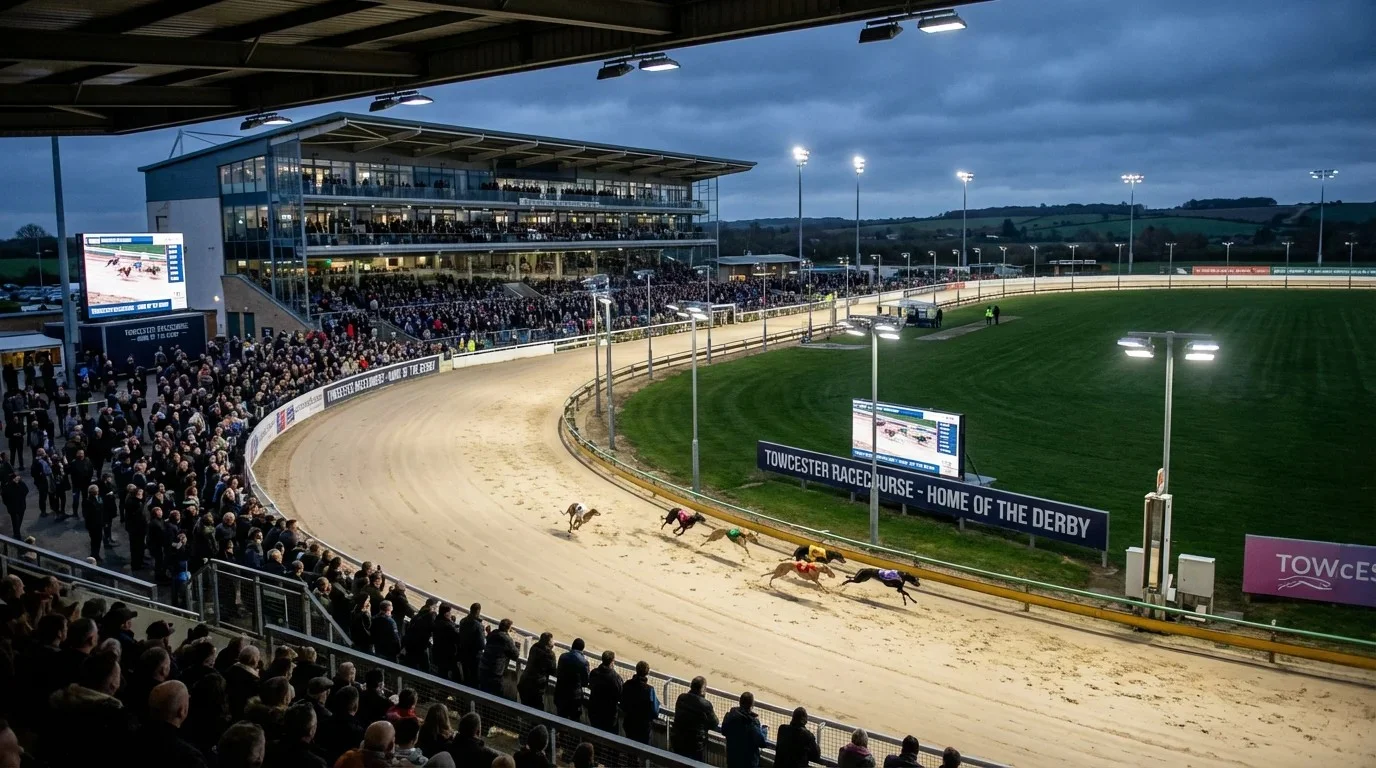
Towcester is where the English Greyhound Derby is run, and that fact alone puts its results page in a different category from every other GBGB venue in the country. The Northamptonshire stadium is the largest and most prominent greyhound track in the UK, its wide-radius circuit designed to give the sport’s best athletes the room to express their full ability rather than have outcomes determined by draw luck and first-bend crowding. When the Derby is running — typically through late spring and into summer — Towcester’s results are the primary form reference for anyone tracking the country’s top greyhounds. The rest of the year, the track produces high-quality graded and open racing that carries its own analytical weight, on a surface where the data is unusually clean and the form particularly transferable. Get live results at dogracingresultstoday.
The wide-track design is the central fact of Towcester form. It means that the trap bias which dominates analysis at circuits like Crayford or Romford is genuinely softer here, that wide-running dogs can compete on more equal terms, and that race results more accurately reflect ability than positional luck. A Towcester result is therefore a relatively pure ability signal. That purity is worth paying for in the quality of form analysis it enables, and it is the reason that serious greyhound form students treat Towcester form with particular respect when dogs from the venue appear elsewhere in the country.
Towcester Greyhound Stadium: The UK’s Biggest Stage
Towcester Stadium in Northamptonshire hosts the English Greyhound Derby — universally regarded as the sport’s most prestigious event. The track runs a year-round programme of graded and open racing, with evening cards typically scheduled on Tuesdays, Fridays, and Saturdays. The Derby rounds add a separate layer of major-event scheduling during the summer series, with heat nights running across the full week during the intensive competition period.
Race distances at Towcester include 260 metres for sprint events, 480 metres for a standard mid-distance grade, 500 metres which is the Derby distance, 655 metres, 686 metres for stayers, and 906 metres for marathons. The 500-metre trip is the most analytically significant in the Towcester programme. It is also the distance that provides the clearest ability benchmark when dogs from other UK venues compete at Towcester for the first time — the wide track at 500 metres strips away positional advantages and tests raw pace and stamina in a way that tighter circuits simply cannot replicate.
The Towcester circuit’s wider bends substantially reduce the advantage that inside draws hold at more compact venues. OLBG’s annual statistics note that Towcester regularly features in the top five UK tracks for open race favourite win percentage — a rate reflecting the fact that on a track where the racing runs relatively cleanly and ability can be expressed, the form book lands more reliably than at venues where first-bend chaos is a routine variable. For the punter who values predictability, Towcester’s results provide a more reliable form signal than most other venues in the country.
The stadium infrastructure at Towcester supports the Derby’s status as a broadcast and commercial event. Sky Sports Racing carries significant Derby coverage, and the hospitality and ticketing operation at the venue is substantially larger than at any other UK greyhound stadium. For a punter attending in person during Derby rounds, the trackside betting infrastructure reflects this — bookmaker pitches and tote facilities are more comprehensive than at regional venues, and the pre-race information environment is richer as a result.
Accessing Towcester Race Results and Dividends
Towcester results for today’s card post to the standard fast results services in near-real time. Timeform at timeform.com/greyhound-racing/results/today and the Sporting Life fast results page update within seconds of the official finishing order being confirmed, displaying winning dog, finishing positions, trap numbers, official times, SP, and BSP returns. For Derby meetings specifically, the Racing Post’s greyhound section provides the most comprehensive supplementary coverage — draw analysis, trainer comments, sectional data, and market commentary that contextualises each result within the broader Derby form narrative.
Forecast and tricast dividends from Towcester are worth recording alongside the basic finishing order. At major Towcester events — particularly Derby heats and semi-finals — forecast returns can be substantial when a fancied dog is beaten by an outsider. Those dividends are part of the form record and help calibrate the market’s efficiency across the event. A consistently high forecast return for the first two finishers across Derby heats suggests the market is having difficulty pricing the mid-range and wider field accurately, which is information that carries directly into semi-final and final market assessment.
The GBGB official archive at gbgb.org.uk/racing/results holds complete Towcester records for all GBGB-licensed meetings. For Derby research specifically, the archive allows reconstruction of a full historical picture — which trainers have competed successfully at Towcester over multiple years, how Derby heat results have predicted final outcomes, and how specific distance times at Towcester translate in form comparisons with other venues. That historical depth is one of the most valuable assets available to a serious Derby punter.
The attheraces.com platform carries the live Towcester broadcast feed, and most major bookmakers offer streaming for Towcester meetings. During Derby rounds, Sky Sports Racing’s dedicated coverage means the event is available through standard TV subscriptions as well as bookmaker platforms — a rare example of a UK greyhound event receiving terrestrial television-grade broadcast infrastructure. For any punter who wants to watch rather than just read the results, Towcester during the Derby is the easiest UK greyhound event to access via multiple channels simultaneously.
What Towcester’s Wide Track Means for Form Interpretation
The analytical implication of Towcester’s wide-radius circuit is fundamental. On a compact circuit like Harlow, a dog’s finishing time reflects not just its raw ability but also its draw, its running style, and the degree of interference it encounters in a field where six dogs are competing for limited space around tight bends. At Towcester, the same dog on a wider circuit with fewer interference variables produces a time that is a cleaner expression of its current ability. This makes Towcester times more directly comparable across different runs than times from tighter circuits.
When a dog competes at Towcester for the first time having previously raced exclusively on compact circuits, the first-run result is typically the least representative. Dogs accustomed to running tight and relying on inside-bend position need time to adjust to the different demands of a wide-radius track where they cannot rely on proximity to the inside rail as a positional defence. Conversely, genuine wide runners — dogs that prefer to race on the outside — often improve markedly when they encounter Towcester’s bends for the first time. Reading a wide runner’s first Towcester result against its tighter-circuit form requires acknowledgement that the two environments favour different mechanical profiles.
Sectional times at Towcester are more frequently recorded and published than at most other UK venues, particularly during major events. The opening sectional — the time from traps to the halfway point of the race — tells you how early each dog has committed its pace and how much it has in reserve for the second half. At 500 metres on a wide track, the ability to sustain pace through the back straight and into the final bends is a genuine differentiator. Dogs that produce fast opening sectionals but slow overall times are burning out before the finish — a pattern that becomes more visible at Towcester’s distance than at shorter circuits where the race is over before the fade becomes apparent.
Cross-track form calibration using Towcester as the reference point is one of the more analytically rewarding exercises available to a UK greyhound punter. Because Towcester’s racing runs cleaner than most venues and the times are more reliable ability indicators, a dog’s performance at Towcester provides a calibration point against which its results elsewhere can be retrospectively assessed. If a dog runs a 29.50 at 500 metres at Towcester in an A2 heat, and it has been running 29.30 at 500 metres at a tighter-circuit venue in A3, the Towcester time tells you that the tighter-circuit times are at least partially inflated by favourable track geometry rather than representing raw ability. That is meaningful information for the next time you assess its form away from home.
Derby and Major Event Results at Towcester
The English Greyhound Derby is a multi-round competition running from late May through to the final in late June or early July. The format consists of six rounds of knockout racing, with the first round typically featuring large numbers of heats, each with six runners, progressively narrowing the field through subsequent rounds until only six dogs remain for the final, which is run over 500 metres. The first-round heat draw is conducted by ballot, and the results from the heats determine which dogs progress to the next stage. This structure means that the heat results are simultaneously performance data and qualification data — a dog that runs a fast time but does not finish in the qualifying positions exits the competition regardless of the absolute quality of its run.
Historical Derby results are one of the richest datasets in UK greyhound racing. The event has been running at Towcester since the stadium took over Derby hosting duties, and the form archive covers multiple renewal years. Patterns that emerge from that history include the relative performance of different kennel regions in the heats versus the final, the degree to which heat draw luck explains or fails to explain semi-final qualification, and the consistency with which very fast heat times predict final performance. These patterns do not deliver certainties but they provide useful prior probabilities that inform Derby betting decisions.
Other Towcester invitation events, while less nationally prominent than the Derby, follow a similar multi-round format and produce form data that benchmarks the country’s top A-grade competitors in open competition. Results from these events are worth tracking for the same reason as Derby results: they force form comparisons that the graded system alone cannot produce, and the dogs that perform well in invitation competition at Towcester are demonstrating genuine quality on the country’s fairest track.
Betting on Towcester: How to Read the Premium Market
Towcester markets — particularly during Derby rounds — are among the most efficiently priced in UK greyhound racing. The national attention the event attracts, the quality of punters it draws to the market, and the volume of information publicly available in the form of sectional times, trainer comments, and broadcast coverage all contribute to a market that is harder to beat than the typical graded night at a regional venue. That does not make it unprofitable — it means the bar for finding genuine value is higher, and the arguments for selections need to be more precise.
Ante-post betting on Derby rounds is available from most major bookmakers at every stage of the competition. Taking a price on a Derby finalist before the semi-finals draw is announced can represent genuine value if you have done the form work and have a clear view of which dogs are the most consistent performers across the heat rounds. The draw has a material impact on semi-final and final outcomes even at Towcester — inside draws retain a statistical advantage even on the wider track — and knowing which dogs are comfortable racing from any trap versus those that significantly prefer inside draws is essential context for ante-post Derby positioning.
BOG applies to Towcester races at most major UK bookmakers on standard UK greyhound terms. Its value during Derby rounds is particularly high because the market is most actively traded on the morning of racing and through to the start time, and prices move significantly in both directions as money arrives. Taking an early Derby price backed by BOG protection is standard practice for informed Derby punters. The bookmakers who offer BOG on Derby markets understand this — it is priced into their margins — but the protection still has real value when the race price shortens by two or three points in the hours before the off. Also check our live greyhound racing results.
The exchange market at Towcester during Derby events carries more liquidity than any other UK greyhound event in the calendar. BSP on Derby finals approaches the quality of a major horse racing exchange market — the pool is large enough that individual bets do not materially move the price, and BSP settlement on Derby runners typically falls within a narrow range of the bookmaker SP. For punters comfortable with exchange trading, the Derby at Towcester is the one greyhound event in the year where the exchange infrastructure genuinely rivals the bookmaker market in depth and efficiency.