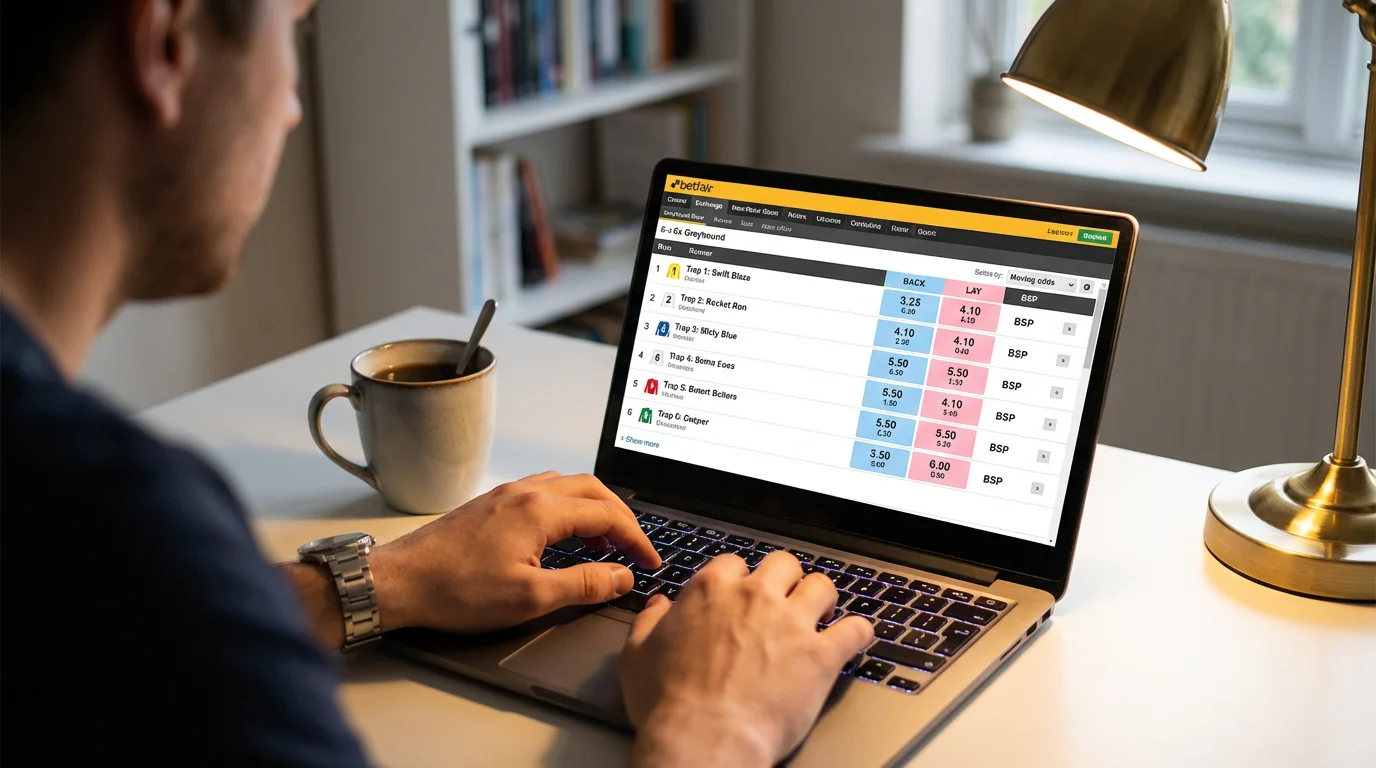
The Betfair Starting Price changed the economics of greyhound betting when it arrived. Before BSP, UK greyhound punters had two options: take a fixed price from a bookmaker or accept the industry Starting Price at the off. Both options carried the bookmaker’s margin — baked into the fixed price or embedded in the SP through the on-course market structure. BSP introduced a third route: a price generated by the exchange market, free of traditional bookmaker margin, settled at the moment the traps open. For punters willing to learn how it works, it became the single most effective tool for improving long-term returns on UK greyhound betting.
BSP is not a magic bullet. It has limitations, conditions, and situations where it performs worse than the alternatives. But the data across thousands of UK greyhound races is clear: on average, BSP returns more than SP on winning selections, particularly at mid-range and longer odds. Understanding why that is the case, how to use BSP practically, and when to avoid it entirely is essential knowledge for any punter who treats greyhound betting as more than casual entertainment.
What Is BSP and How Is It Set?
BSP stands for Betfair Starting Price. It is the price at which unmatched bets on the Betfair exchange are settled at the start of a race. When you place a back bet at BSP, you are not accepting a fixed price — you are requesting that your bet be matched at whatever price the exchange market produces at the off. The price is calculated algorithmically by Betfair’s system, which balances all the unmatched back and lay money in the market at the moment the race begins.
The mechanism works like this. In the minutes and hours before a greyhound race, backers and layers place orders on the Betfair exchange at various prices. Some of these orders are matched (a backer at 4.0 finds a layer willing to accept 4.0) and some remain unmatched. When the race goes off, Betfair’s algorithm calculates the price that would clear the maximum volume of unmatched bets on both sides. That price is the BSP. Every BSP back bet is settled at this price, and every BSP lay bet is settled at this price.
The critical point is that BSP is not set by a bookmaker. There is no firm pricing up a market with a built-in margin. The price emerges from the collective activity of exchange participants — backers who think a dog will win and layers who think it will not. Betfair takes a commission on net winnings (typically 5%, though this can be reduced through volume discounts), but the price itself is margin-free. This structural difference is why BSP tends to offer better value than traditional bookmaker prices, especially on greyhound racing where bookmaker margins are among the highest in UK sports betting.
One detail worth noting: BSP liquidity on UK greyhound markets varies significantly. Evening meetings at major tracks like Romford, Monmore, and Nottingham attract enough exchange activity for BSP to function reliably. Afternoon BAGS meetings at smaller tracks may have thinner markets, which can produce volatile BSP figures that do not always reflect the true probability of an outcome. The depth of the market matters — a BSP generated from thousands of pounds of unmatched orders is a more stable and trustworthy price than one generated from a few hundred.
BSP vs SP: Which Pays More on Average for UK Greyhound Races?
The short answer is BSP, and the margin is not trivial. Analysis of UK greyhound races consistently shows that BSP returns more than SP on winning selections across the price range, with the advantage growing as the odds increase. At short prices — dogs at evens or shorter — the difference between BSP and SP is small, sometimes negligible. At mid-range prices (3/1 to 6/1), BSP typically returns 10-20% more than SP. At longer prices (8/1 and above), the differential can exceed 25%.
The reason for this gap is the bookmaker margin embedded in the SP. The industry Starting Price is derived from the on-course bookmakers’ boards, and those boards include each firm’s overround — the built-in profit margin that ensures the total implied probabilities exceed 100%. In a typical six-dog greyhound race, the SP overround sits between 118% and 125%. BSP, by contrast, is generated by exchange activity with no built-in margin. Betfair’s commission is charged on net winnings, not on individual bet prices, so the prices themselves are closer to fair value.
The practical implication for punters is significant. If you back a thousand greyhound winners over a season at SP, you will collect less in total payouts than if you had backed the same thousand winners at BSP — even after Betfair’s commission. The commission reduces the BSP advantage but does not eliminate it. At the standard 5% commission rate, BSP still outperforms SP on average for winners at 5/2 and above, which covers the majority of greyhound race winners in UK graded racing.
There are caveats. BSP can occasionally produce a lower price than SP on a specific race, particularly when late money on the exchange comes for a dog after the traditional market has closed. Individual results vary. But the aggregate data is unambiguous: over a large sample, BSP is the better deal for the bettor.
How to Back at BSP on Betfair Exchange
Placing a BSP bet on Betfair is straightforward once you know where to find the option. On the Betfair exchange greyhound market, each race displays the standard back and lay columns with live prices. To bet at BSP instead of a fixed exchange price, you select the BSP option on the betslip — this is usually a toggle or a separate column marked “SP” or “BSP” on the coupon. You enter your stake, confirm the bet, and it is placed without a specified price. The bet will be matched and settled at whatever BSP the algorithm calculates at the off.
You can also set a BSP limit. This is a maximum price you are willing to accept — if the BSP comes in higher than your limit, the bet is matched at the BSP; if it comes in lower, the bet is voided and your stake is returned. BSP limits are useful when you want the benefits of exchange pricing but do not want to risk being settled at a price that is too short to offer value. For example, if your analysis says a dog is a value bet at 3/1 or higher but not at 2/1, you can set a BSP limit of 3.0 (in decimal odds) and the bet will only stand if the BSP meets or exceeds that threshold.
Timing is less critical with BSP than with fixed exchange prices, because you are not trying to match at a specific number. You can place a BSP back bet hours before the race or seconds before the off — the outcome is the same, because the price is determined at the start regardless of when you placed the order. This is a practical advantage for punters who do their form analysis in advance and want to lock in selections without monitoring the market in real time.
One operational note: Betfair charges commission on net winnings, not on stakes. If you back three dogs at BSP during an evening session and two lose while one wins, the commission applies only to your net profit across those bets. This means BSP betting is most cost-efficient when you are betting selectively rather than on every race — fewer bets, higher conviction, better net positions.
BSP Strategies for Greyhound Punters
The simplest BSP strategy is also the most effective: use BSP as your default settlement method for all greyhound back bets at odds of 5/2 and above, and compare against fixed bookmaker prices only when BOG is available. This approach captures the average BSP premium over SP across the price range where it is most pronounced, without requiring you to time the market or monitor exchange activity. It is a passive strategy that works through volume and probability rather than active trading.
A more targeted approach is to focus BSP betting on specific race types where the exchange market tends to be deeper and the BSP more reliable. Evening meetings at the top UK tracks by turnover — Romford, Monmore, Sunderland, Nottingham, Towcester, Sheffield, Harlow, Yarmouth, and Hove — generate the most exchange activity and produce the most stable BSPs. Restricting your BSP betting to these meetings reduces the risk of being caught by a thin market producing an erratic price.
For punters who are comfortable with more active strategies, BSP can also be used in combination with fixed exchange prices. If the pre-race exchange market offers a back price that exceeds your value threshold, you take the fixed price. If the available price is below your threshold, you place a BSP bet with a limit, accepting that the bet may not be matched if the market tightens. This hybrid approach requires more attention but captures value from both the live market and the BSP calculation.
When to Avoid BSP and Take Early Prices Instead
BSP is not always the best option. The first situation where early fixed prices beat BSP is when a bookmaker offers Best Odds Guaranteed on a greyhound race. With BOG, you take a fixed price and are paid the SP if it is higher. Since SP itself is usually close to BSP at short prices, and since BOG gives you the upside of price drift with no downside, taking BOG at a competitive fixed price is often a better risk-adjusted choice than relying on BSP alone.
The second situation is when you have strong reason to believe the price will shorten before the off. If a dog is available at 5/1 in the morning and you expect heavy support to push it to 3/1 by race time, taking the 5/1 fixed price locks in value that BSP will not deliver. BSP reflects the price at the off, after all the money has come in. If the market moves against you, BSP will settle at a shorter price than the early fixed-odds opportunity you could have taken.
The third situation is thin markets. On afternoon BAGS meetings at smaller tracks — where exchange activity is light — BSP can be unreliable. A single large order placed moments before the off can skew the price significantly, producing a BSP that is either artificially short or artificially long. In these low-liquidity environments, a fixed price from a traditional bookmaker offers more certainty and is often the pragmatic choice. BSP works best where the exchange market works best: on well-attended evening meetings where enough money flows through the market to produce a price you can trust.