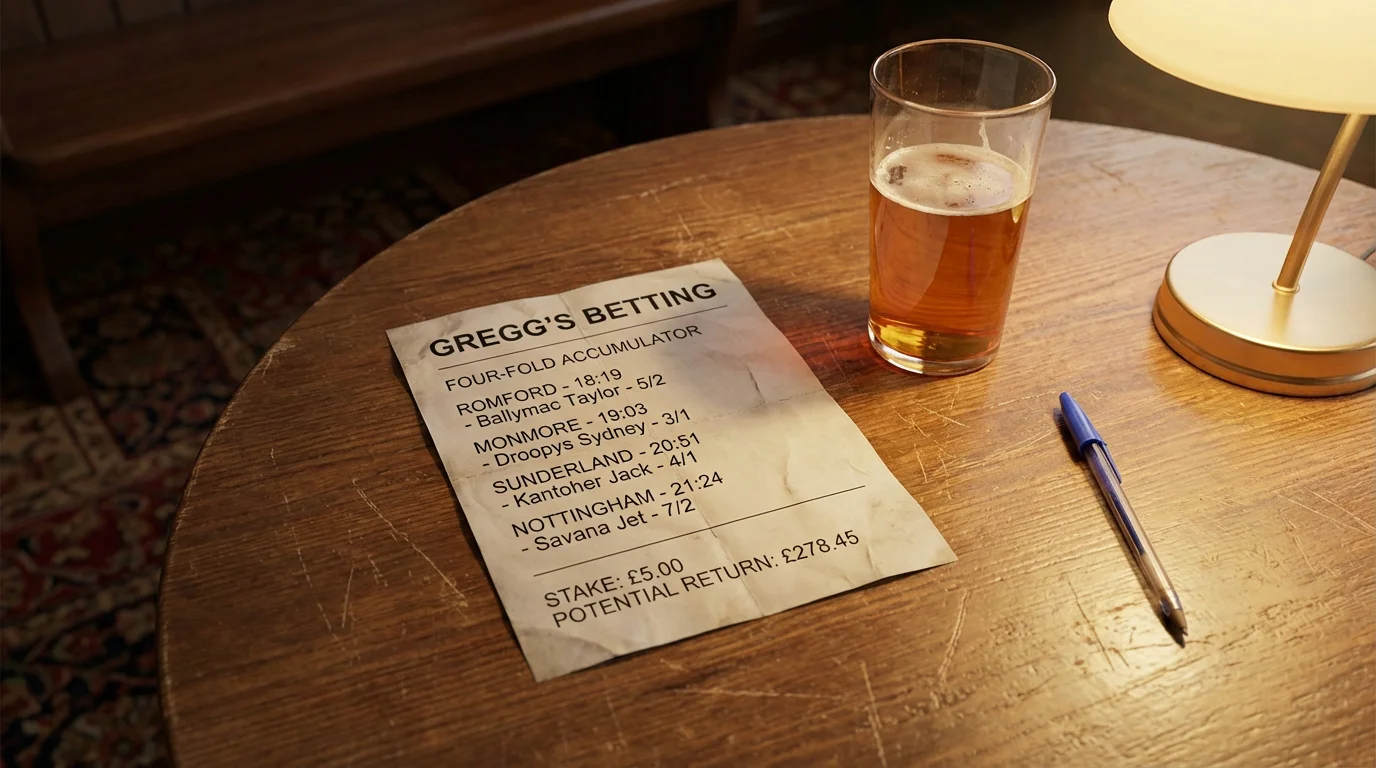
The greyhound accumulator is the bet that keeps the dream alive. A small stake across four, five, or six selections, each one rolling the returns into the next, building towards a payout that dwarfs anything a single race could deliver. It is the bet that fills social media feeds with screenshots of five-pound stakes returning five hundred. What those screenshots do not show is the hundreds of losing slips that preceded them. The accumulator is mathematically the least efficient bet available to a greyhound punter, and it is also the most popular. That tension between emotional appeal and statistical reality defines everything about accumulator betting on the dogs.
None of which means accumulators should be avoided entirely. They have a legitimate place in a disciplined betting approach — as long as that approach acknowledges what an accumulator actually is, how the bookmaker’s margin compounds across legs, and what strategies exist to manage the downside. This guide covers the mechanics, the construction, the system-bet alternatives, and the risk management principles that separate punters who use accumulators strategically from punters who use them as lottery tickets.
How a Greyhound Accumulator Works
An accumulator links two or more selections into a single bet where the returns from each winning selection roll into the next. A double links two selections: if the first wins, the total return (stake plus profit) becomes the stake on the second. A treble links three. A four-fold links four. The pattern continues as far as the bookmaker allows, with some operators accepting accumulators of up to twenty or more legs on greyhound racing.
The appeal is in the maths. If you back four dogs at 3/1, the win single on each returns four pounds on a one-pound stake. The four-fold accumulator returns 256 pounds on a one-pound stake — because 4 x 4 x 4 x 4 = 256. The multiplication is what creates the headline numbers that make accumulators exciting. But the same multiplication applies to the probability of losing. Each leg you add reduces the overall probability of the bet winning, and the reduction is not linear — it is exponential.
Consider the same four dogs at 3/1. Each has an implied probability of winning of 25% (ignoring margin for simplicity). The probability of all four winning is 0.25 x 0.25 x 0.25 x 0.25 = 0.39%. That is roughly one in 256 — the same number as the potential return. In a fair market, the expected value of the accumulator is exactly the same as the expected value of four individual singles. The difference is variance: the accumulator concentrates all your risk and reward into a single outcome, while four singles spread it across four independent events.
The problem is that the greyhound market is not fair. The bookmaker’s overround on each leg means the true probability of each dog winning is lower than the implied probability from the odds. At a 120% book, a 3/1 dog has a true probability closer to 21% than 25%. Across four legs, that margin compounds: the true probability of the accumulator winning drops to around 0.19% — roughly half the implied figure. The bookmaker’s edge doubles, triples, and quadruples as you add legs. This compounding margin is the fundamental cost of accumulator betting, and it is why accumulators are the most profitable product for bookmakers across all sports.
Building a Greyhound Accumulator: Selection Strategy
If you are going to bet accumulators on greyhounds, the selection process matters more than in any other bet type. Every weak leg is a multiplier of failure. A four-fold with three strong selections and one speculative inclusion is not 75% good — it is likely to lose, because the speculative leg has a disproportionate chance of being the one that brings the entire bet down. The discipline of accumulator construction is ruthless elimination of marginal selections.
Start by setting a maximum number of legs. Four is sensible for UK greyhound racing. Beyond four legs, the compounding margin and the variance become so severe that the bet functions as a lottery ticket regardless of selection quality. Professional and semi-professional greyhound punters who use accumulators at all typically restrict themselves to doubles and trebles, where the margin cost is lower and the strike rate is survivable.
Select from different meetings or at least different races on the same card. Combining selections from the same race is not possible in a standard accumulator (you would need a forecast or tricast for that), but combining selections from consecutive races at the same track carries a subtle risk: if track conditions change during the meeting — rain, a track fault, a running rail adjustment — all your selections are affected. Diversifying across tracks reduces this environmental correlation.
Prioritise selections where your form analysis identifies a clear, evidence-based edge. The ideal accumulator leg is a dog that you would back as a confident win single: strong recent form, favourable trap draw, appropriate grade, and a price that exceeds your estimate of its true probability of winning. If a selection does not meet that standard on its own merits, it should not be in the accumulator. The temptation to add an extra leg because it “looks good” or “could easily win” is the single most common error in accumulator construction. Resist it every time.
Trixie, Patent and Heinz Bets on Greyhounds
System bets are structured alternatives to straight accumulators that provide partial cover when not all selections win. They cost more per unit but reduce the all-or-nothing risk of a standard accumulator, and for greyhound bettors who want the multiplied returns of linked selections without the binary outcome, they are worth understanding.
A Trixie requires three selections and consists of three doubles and one treble — four bets in total. If two of your three selections win, you collect on one double. If all three win, you collect on three doubles and the treble. The Trixie does not include singles, so you need at least two winners to see any return. A one-pound Trixie costs four pounds. The advantage over a straight treble is that you are not wiped out if one selection loses — you still collect on the doubles involving your two winners.
A Patent also requires three selections but adds three singles to the Trixie structure — seven bets in total (three singles, three doubles, one treble). A one-pound Patent costs seven pounds. The inclusion of singles means you collect something even if only one of your three selections wins. This makes the Patent the most conservative system bet on three selections, and it is particularly useful in greyhound betting where even well-analysed selections can be beaten by the variance inherent in six-dog racing.
A Heinz requires six selections and covers fifteen doubles, twenty trebles, fifteen four-folds, six five-folds, and one six-fold — fifty-seven bets in total. A one-pound Heinz costs fifty-seven pounds, which puts it outside the range of most recreational greyhound bettors. The Heinz and similar large system bets (Lucky 15, Lucky 31, Canadian) exist but are rarely appropriate for greyhound racing because the cost is high and the margin compounds across the many permutations. For most punters, the Trixie and Patent on three carefully chosen selections represent the best balance between cover and cost.
Risk Management in Greyhound Accumulator Betting
The first rule of accumulator risk management is staking. Accumulators should represent a small, fixed fraction of your betting activity — both in monetary terms and in frequency. A common guideline is to allocate no more than 10% of your total betting bankroll to accumulators in any given week, with the remainder deployed on singles and forecasts where the margin cost is lower. This caps your exposure to the high-variance, high-margin bet type while still allowing you to participate in the upside.
The second rule is to never chase accumulator losses by increasing stakes. The losing rate on accumulators is high by design — a four-fold at average greyhound prices wins roughly one in every forty to sixty attempts. Losing runs of twenty or thirty consecutive accumulators are normal, not exceptional. If you respond to these runs by increasing your stake to recover, you are accelerating the rate at which the compounding margin erodes your bankroll. Flat staking on accumulators is not just advisable — it is essential.
Cash-out facilities, offered by most major UK bookmakers, provide a partial risk management tool. If three of your four legs have won and the fourth is about to run, the bookmaker will offer you a guaranteed payout that is less than the full potential return but more than zero. Whether to cash out is a judgement call — the bookmaker’s cash-out price includes their margin, so you are paying for the certainty — but in situations where the fourth leg is a marginal selection or the race conditions have changed since you placed the bet, taking the guaranteed return can be the disciplined choice.
Which Bookmakers Offer the Best Accumulator Terms on the Dogs?
Accumulator terms on greyhound racing vary between bookmakers in three main areas: accumulator bonuses, cash-out availability, and maximum payout limits. Accumulator bonuses add a percentage uplift to your winnings based on the number of legs — a typical structure might add 5% for a double, 10% for a treble, 15% for a four-fold, and so on. These bonuses partially offset the compounding margin, though they rarely eliminate it entirely.
Bet365, William Hill, Coral, and Ladbrokes all offer accumulator products on greyhound racing, though the specific bonus structures and terms change periodically. Cash-out is available on greyhound accumulators at most major operators, though the feature is sometimes restricted on lower-profile meetings. Maximum payout limits on greyhound accumulators are generally lower than on horse racing or football — check the terms, as a six-figure accumulator return that exceeds the bookmaker’s payout cap will be capped regardless of what the slip says.
The most important factor in choosing a bookmaker for greyhound accumulators is not the bonus percentage — it is the underlying odds. A 10% accumulator bonus is worthless if the bookmaker’s base prices are 15% worse than a competitor. Build your accumulator at the bookmaker offering the best individual prices on your selections, and treat any bonus as a secondary benefit rather than the deciding factor. The base price is where the real money is won or lost.