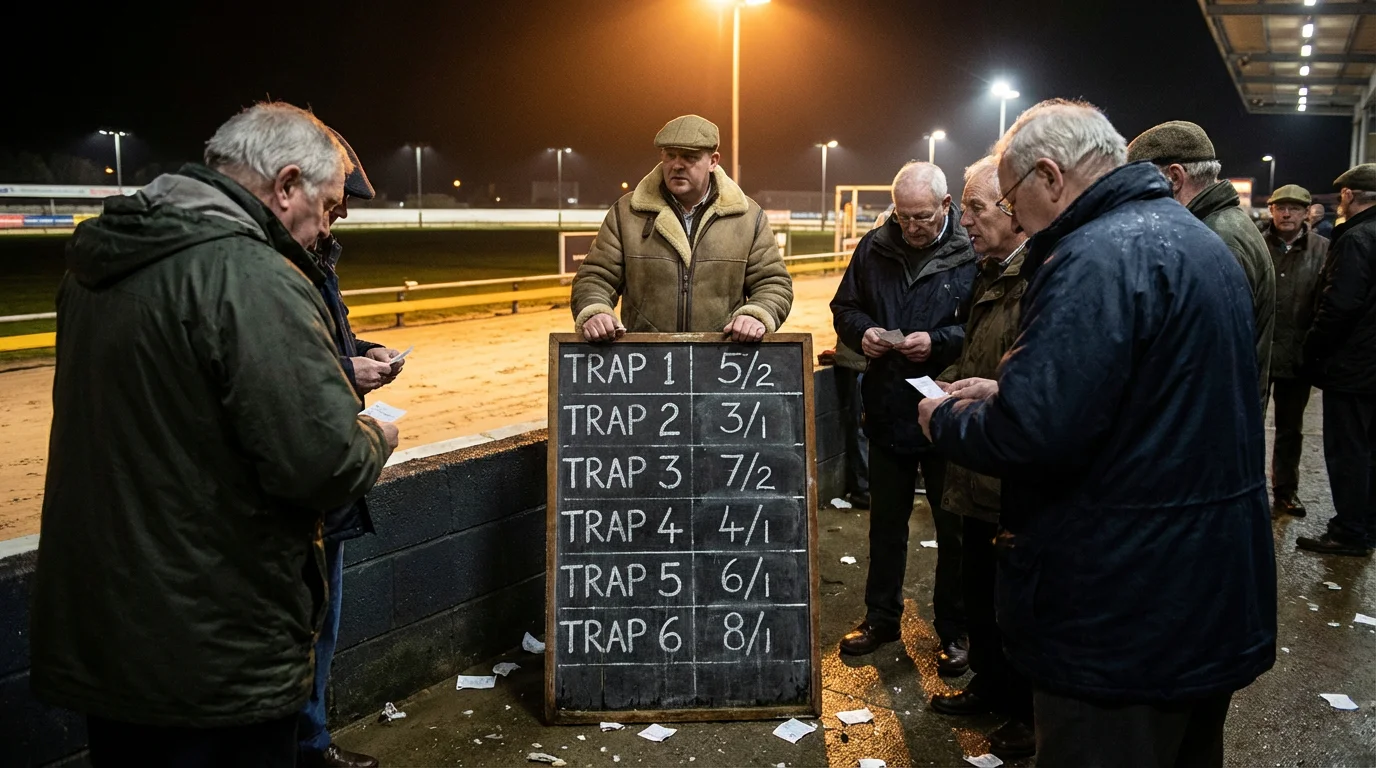
The odds attached to a greyhound before a race are the market’s condensed judgement on that dog’s chances. They encode probability, margin, and money flow into a single figure — and most punters read them without understanding any of those layers. In UK greyhound racing, odds come in several forms: the traditional fractional price you see on a bookmaker’s board, the Starting Price recorded after the race, the Betfair Starting Price generated by exchange activity, and the early prices offered hours before the off. Each tells a slightly different story, and the differences between them are where informed bettors find — or lose — value.
Greyhound odds also behave differently from odds in horse racing or football. The fields are smaller (six dogs, not twelve or twenty), the races are more frequent (a new market every eight to ten minutes at most tracks), and the bookmaker margins are significantly higher. Understanding how those margins work, where the price inefficiencies sit, and which odds format gives you the best return on a winning selection is not optional if you take UK dog racing seriously. It is the baseline skill that separates punters who break even from punters who slowly bleed their bankroll through overround.
Fractional Odds in UK Greyhound Racing: How to Read Them
UK greyhound betting uses fractional odds as standard. When you see a dog priced at 5/1, the numbers mean you win five pounds for every one pound staked, plus your stake back. A dog at 2/1 returns three pounds total on a one-pound bet. A dog at 4/6 is odds-on — you stake six pounds to win four, collecting ten pounds total if the dog wins. The denominator is always your stake unit; the numerator is your profit.
Fractional odds that look unusual to beginners — 11/8, 7/4, 100/30 — follow the same logic. At 11/8, you win eleven pounds for every eight staked. At 7/4, seven for every four. The reason these fractions exist rather than simpler numbers is that they allow bookmakers to price markets with precision. The difference between 5/2 and 11/4 is small in probability terms (roughly 28.6% versus 26.7%) but meaningful over hundreds of bets. Bookmakers use these increments to manage their book — the total of all implied probabilities across a six-dog race — and the granularity is part of how they build their margin into the market.
One detail that trips up newer punters: greyhound odds move fast. Because races are short and fields are small, a single large bet can shift the market noticeably. A dog opening at 3/1 in the morning might be 2/1 by the time the traps open if money has come for it, or it might drift to 4/1 if a rival has attracted support. Watching how the odds move in the final minutes before a race — known as the market move or steam — provides information about where the money is going, which is not always where the form suggests it should.
For practical purposes, most UK punters do not need to memorise every fractional increment. The key prices to know instinctively are: evens (1/1), the short odds-on range (4/6, 4/5, 8/11), the mid-range (2/1 to 5/1 where most greyhound winners fall), and the longer prices (6/1 and above, where forecasts and tricasts start to become attractive alternatives to win singles).
Understanding Implied Probability from Greyhound Odds
Every set of odds corresponds to an implied probability — the chance the bookmaker’s price suggests the dog has of winning. Converting fractional odds to implied probability is straightforward: divide the denominator by the sum of numerator and denominator, then multiply by 100. A dog at 3/1 has an implied probability of 1 / (3+1) = 25%. A dog at 4/6 has an implied probability of 6 / (4+6) = 60%.
The reason this matters for greyhound bettors is that the sum of all implied probabilities in a six-dog race will always exceed 100%. That excess is the bookmaker’s overround — their built-in profit margin. In a perfectly fair market with no margin, the six dogs’ implied probabilities would add up to exactly 100%. In UK greyhound racing, the total typically lands between 115% and 125%, depending on the bookmaker and the race. That 15-25% overround is significantly higher than in horse racing (typically 110-118%) or football (104-108%), which means greyhound bettors are working against a steeper mathematical disadvantage from the outset.
Understanding implied probability allows you to identify where the overround is distributed. Bookmakers do not spread their margin evenly across all six dogs. They tend to load more margin onto the shorter-priced runners, because casual bettors gravitate to favourites and are less price-sensitive at short odds. A favourite priced at 6/4 might have a true probability of 38% but an implied probability of 40% — a modest distortion. A 10/1 outsider, by contrast, might have a true probability of 7% but be priced at an implied 9% — a larger relative distortion. This structural bias means that, purely on a margin basis, betting longer-priced dogs in greyhound racing often offers better value relative to the bookmaker’s overround than backing favourites.
None of this guarantees profit, of course. But it reframes how you evaluate prices. Instead of asking whether 3/1 feels right for a particular dog, you can ask whether the dog’s actual chance of winning exceeds 25%. If your analysis says the dog has a 30% chance, the bet has positive expected value regardless of whether the dog wins or loses that specific race.
SP vs BSP vs BOG: A Complete Comparison for UK Punters
Three pricing mechanisms dominate UK greyhound betting, and each works differently. The Starting Price is the official industry price returned at the moment the traps open, calculated from the on-course bookmakers’ boards. It is the price your bet settles at if you take SP rather than a fixed early price. The Betfair Starting Price is the exchange equivalent — a price determined by the unmatched money in the Betfair exchange market at the off. Best Odds Guaranteed is not a price in itself but a bookmaker promotion that guarantees you the higher of your fixed price or the SP.
The practical difference between SP and BSP is often significant for greyhound punters. BSP tends to be slightly higher than SP on average, because the exchange market does not include a bookmaker’s margin — Betfair charges a commission on net winnings instead (typically 5%, reducible with volume). Studies comparing SP and BSP across thousands of UK greyhound races have consistently found that BSP returns around 15-20% more than SP on winners at odds of 3/1 and above. At shorter prices, the difference narrows because the exchange market for favourites is more efficiently priced.
BOG bridges the gap between fixed-price and SP betting at traditional bookmakers. If you take a price of 4/1 in the morning and the SP drifts to 6/1, you are paid at 6/1. If the SP contracts to 3/1, you keep your 4/1. The asymmetry is entirely in the punter’s favour, which is why BOG is one of the most genuinely valuable promotions in greyhound betting. Not all bookmakers offer BOG on greyhounds — and some that do restrict it to certain tracks or times — so checking availability before placing a bet is essential.
The choice between these three depends on your betting style. Exchange bettors who are comfortable with Betfair’s interface and commission structure will usually get better long-term value from BSP. Punters who prefer traditional bookmakers and want price certainty combined with upside protection should seek out BOG offers. Taking SP without either of these safeguards is almost always the worst option for the bettor, because SP carries the full weight of the bookmaker’s margin with no offsetting benefit.
How Bookmaker Margin Affects Greyhound Payouts
The overround on UK greyhound markets is, bluntly, one of the highest in regulated sports betting. Where a Premier League football match might carry a total book of 104-106% and a horse racing handicap 112-118%, a standard six-dog greyhound race at an evening meeting routinely sits between 118% and 125%. Some afternoon BAGS meetings — lower-profile cards that bookmakers price with less competitive pressure — can push above 130%.
What this means in practical terms is that the average greyhound bettor is paying a higher tax on every wager than their counterpart in horse racing or football. Over a long enough sample, a bettor who selects winners at exactly the true probability rate will still lose money, because the prices they are paid are systematically lower than fair value. The size of the margin determines how much lower. At a 120% overround, you are effectively paying 20 pence on every pound bet in margin, compared to roughly 5-6 pence on a typical football accumulator coupon.
The practical response to this is not to avoid greyhound betting — it is to be more selective. Margins vary between bookmakers, between tracks, and between individual races. The same race at the same track can carry a 117% book at one bookmaker and a 126% book at another. Checking odds across at least three or four bookmakers before placing a greyhound bet is not optional diligence — it is the single most effective way to reduce the margin you pay. Over a season, the cumulative difference between consistently taking the best available price and consistently taking whatever price is in front of you can easily be the difference between a modest loss and a meaningful one.
Where to Find the Best Greyhound Odds in the UK
Odds comparison for greyhounds is less well-served by third-party tools than horse racing, but it is still possible. Oddschecker covers most BAGS and evening greyhound meetings and displays prices from the major UK bookmakers side by side. For exchange prices, the Betfair greyhound markets are the primary venue, with some activity also on Betdaq and Smarkets for higher-profile events.
Among traditional bookmakers, the greyhound odds leaders tend to be those with a strong heritage in the sport. Bet365, William Hill, Coral, and Ladbrokes all price UK greyhound racing regularly, but their margins differ. Bet365 and Coral have historically offered tighter greyhound margins on evening racing, while Ladbrokes and William Hill tend to be more competitive on Derby and major open events. The Betfair exchange consistently offers the best effective odds on greyhounds at 3/1 and above after commission, provided there is sufficient liquidity — which is reliable for evening meetings at major tracks but patchy for afternoon BAGS cards.
The best odds on any given greyhound race are almost never at a single bookmaker. They are assembled by checking two or three fixed-odds bookmakers, comparing their prices against the exchange, and then deciding whether a BOG offer at one bookmaker outweighs a marginally better fixed price at another. It takes thirty seconds. Over a season, those thirty seconds per bet compound into a measurably better return. The odds are the market’s opinion. Your job is not to accept the first opinion you see — it is to find the best one available.