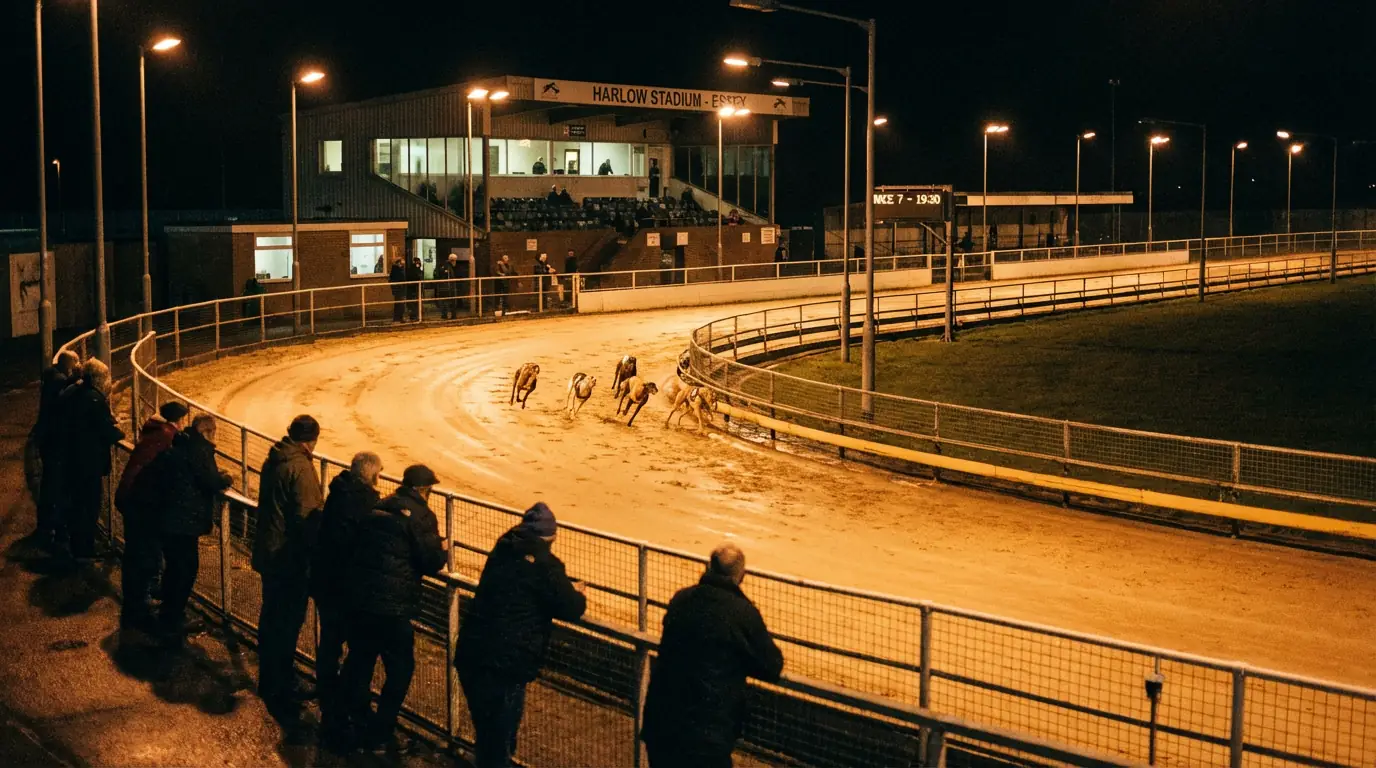
Harlow Stadium does not attract the national press attention that Romford or Towcester command, and it is not trying to. It runs a reliable weekly programme of evening greyhound racing in Essex, draws a local following that knows the dogs, knows the trainers, and takes the form seriously. For the rest of the UK betting public, Harlow tends to appear as a line on the results page rather than a destination — which is precisely the reason its results repay careful attention. When punters are not looking, form signals are easier to find.
The track sits within the Premier Greyhound Racing network, which means its results flow into the standard national data infrastructure. Timeform, the Sporting Life, and the GBGB archive all carry Harlow meeting data. That integration makes Harlow a fully readable venue for any punter willing to build a form picture rather than just scan the evening’s winners. The card structure is consistent, the grade ladder is stable, and the dogs that compete here regularly are the kind of solid, mid-range greyhounds whose form is actually more predictable than the high-variance talent that appears at marquee venues.
Harlow Greyhound Track: Race Distance and Card Structure
Harlow operates on an oval circuit with principal race distances of 238 metres, 415 metres, 592 metres, and 769 metres. The 415-metre trip is the standard workhorse distance on most cards and represents a middle-ground test of pace and stamina that suits a broad range of athletic profiles. It is long enough that a slow-breaking railer has time to recover if it can secure an inside position through the first bend, but not so long that pace-dominant dogs are overwhelmed in the closing stages.
Evening cards at Harlow typically run on Mondays and Wednesdays, with morning sessions on Fridays, Saturdays, and Sundays. The occasional additional card is scheduled around calendar events and the broader fixture programme. A standard Harlow card contains twelve to fourteen races, usually covering a mix of A grades, sprint card entries at 238 metres, and stayers’ events at 592 or 769 metres. The grade depth runs from A1 through the lower end of the performance ladder, with open race events appearing when the fixture calendar and kennel availability align.
One characteristic of Harlow’s card structure worth noting is the regularity with which the same dogs reappear across consecutive meetings. Because the kennel base serving Harlow is regionally concentrated — predominantly Essex and the wider London commuter belt — the pool of active graded competitors is compact enough that a punter following three or four weeks of results will begin to recognise most of the names. That familiarity is not a trivial advantage. Knowing which dogs are managed conservatively by their trainers and which are run hard and frequently gives context to results that would otherwise require much deeper investigation.
The track surface at Harlow is maintained to GBGB standard, and official going descriptions accompany the results data submitted after each card. Those going conditions are worth tracking because Harlow’s Essex location means the surface can be significantly affected by autumn rain and frost in the winter months. A string of results on a soft surface followed by a return to firm conditions will produce meaningfully different times even from the same dogs, and a punter who ignores the going column when making time comparisons will draw incorrect conclusions from perfectly valid data.
Finding Harlow Greyhound Results Quickly
Harlow results for today’s meeting post to the standard UK greyhound results infrastructure in near-real time. Timeform’s fast results service at timeform.com/greyhound-racing/results/today and the Sporting Life greyhound results page are the fastest access points, updating within seconds of the official finishing order being confirmed by the stadium timing system. Both services display finishing position, dog name, trap, time, SP, and BSP returns in a compact format that gives a complete picture of each race within moments of completion.
The GBGB results archive at gbgb.org.uk/racing/results is the correct destination for historical Harlow form research. It holds complete records for all licensed meetings — field sizes, finishing margins, official times, going conditions — going back several seasons. Searching the GBGB archive for a specific dog’s Harlow history gives a complete track-specific form record that is not always easy to extract from the more general-purpose Racing Post or Timeform form pages.
Most major UK bookmakers display live results alongside their greyhound racecard pages for running meetings. Bet365, William Hill, and Ladbrokes all carry Harlow cards. The bookmaker result confirmation arrives fractionally later than the dedicated results services but is the most convenient access point if you are already managing bets on the same card. For punters running a deliberate multi-card evening — tracking Harlow alongside Romford or another simultaneous meeting — the Sporting Life aggregated results view is the more efficient choice because it presents all active meetings on a single scrollable page.
One underused Harlow results access point is the PGR broadcast archive on greyhounds.attheraces.com. Completed race videos from recent Harlow cards are available there alongside the results data, which means you can watch the race shortly after it completes and validate your reading of the result against what actually happened on track. For a mid-tier venue like Harlow where replay access is not always front-of-mind, that combination of result plus video is more analytically valuable than either element alone.
Harlow Track Stats: What the Results Data Shows
The statistical profile of Harlow results broadly follows the national pattern for GBGB oval circuits. Inside trap bias is present and measurable, most pronounced at the 238-metre sprint distance and softest at 769 metres. Across the standard 415-metre trip in A-grade racing, Trap 1 posts a win rate that sits approximately four to six percentage points above its expected one-in-six share. That is meaningful but not extreme — Harlow is not the kind of trap-bias venue that justifies blanket backing of inside draws regardless of form. It is the kind of venue where inside draw is one relevant factor among several, and its weight in any selection decision should be proportional to how close the ability gap between the inside and outside runners actually is.
Favourite win rates at Harlow in graded racing are consistent with the wider UK average. The OLBG annual greyhound statistics, which track favourite win percentages by track across the full UK calendar, show graded favourite rates nationally clustering between 34% and 38%. Harlow’s data lands within that range across most recent seasons. In open races at Harlow — which are less frequent than at higher-profile venues — the favourite win rate increases, as it does at all UK tracks, because the compressed ability range in curated fields makes favouritism a more reliable signal.
Winning margins at Harlow over 415 metres in A-grade racing average around 1.5 to 2 lengths, consistent with the national median. Races decided by four lengths or more are worth flagging — they indicate either a dominant individual performance or a field that collectively underperformed. A dog winning Harlow A4 racing by five lengths in a fast time is a dog that almost certainly belongs in A3 company, and the results from the following two or three weeks should be read with that upward trajectory in mind.
Dogs returning to racing at Harlow after a break of three or more weeks consistently run below their pre-break times in the first outing back, which mirrors the national pattern. The Harlow form student who tracks this and discounts first-run-back times appropriately will avoid the common error of treating a slow return-to-racing performance as evidence that a dog has declined in ability. The second run back is typically the more reliable indicator, and the third the most comparable to pre-break form.
Markets and Promotions for Harlow Dog Racing
Harlow races are covered by all major UK bookmakers through the BAGS and SIS network. The win market, each-way market, forecast, tricast, and combination markets are available across standard evening cards. Market depth at Harlow is somewhat shallower than at the busier London venues — handle on a Tuesday Harlow card is considerably lighter than on a Friday Romford card — which means the odds on mid-range runners and outsiders occasionally reflect less sophisticated pricing than you would find on a higher-profile meeting. That is not inherently bad news for the informed punter; it creates the occasional mispriced selection that sharper markets would have corrected.
Best Odds Guaranteed applies to Harlow races at most major UK bookmakers under the standard terms for UK greyhound meetings. The practical value of BOG at Harlow is genuine but context-dependent. Because the market is less heavily traded than at London’s busiest venues, late price movements are common — a favourite can shorten by a full point or more in the final minutes as limited money arrives — but they are also less reliably directional than at higher-volume meetings. BOG protects against adverse movement for punters who price up early; it does not guarantee that early prices were good to begin with.
The Betfair Exchange carries Harlow markets with liquidity that reflects the venue’s secondary status in the national betting hierarchy. BSP settlement is available but the exchange pool is shallower than at Romford or Crayford, which occasionally produces BSP returns that diverge from bookmaker SP by a wider margin than they would at a higher-volume meeting. For Harlow specifically, the bookmaker win market with BOG coverage tends to offer more predictable settlement than the exchange for most punters who are not actively trading the price movement.
Betfred and Paddy Power run periodic greyhound-specific promotions — Best Odds Guaranteed, Winning Tricast Bonuses, and Free Bet Club offers — that apply to Harlow meetings alongside their other UK greyhound coverage. These promotions do not offer extra value specific to Harlow, but they are available there, and a punter who uses them at busier venues should apply the same promotional discipline to Harlow cards. Over a calendar month of regular greyhound betting, the difference between a punter who consistently applies BOG and promotional offers and one who ignores them accumulates meaningfully.
Using Harlow Results to Spot Dogs in Form
The most productive use of Harlow results for an active punter is as a form-spotting exercise. Because the pool of competing dogs is relatively small and consistent, the results from three or four consecutive Harlow cards tell a clear story about which dogs are running well, which are improving through a campaign, and which have peaked. Tracking this narrative across a small, stable field is considerably more tractable than following the form of dogs competing across multiple venues — the variables are fewer, the comparisons are more direct, and the improvements or declines in a given dog are easier to isolate.
A practical approach: after each Harlow card, note the finishing times for the top two or three dogs in each A-grade race alongside their previous Harlow times at the same distance. A dog whose times have tightened by 0.1 to 0.2 seconds across three consecutive starts is on a progressive campaign. Its market price will typically lag the improvement by a run or two because the market cannot fully price improvement it has not yet confirmed in a winning result. The window between the improvement being visible in the times and it being priced into the market is where the betting value lives.
Trainer patterns at Harlow are worth a separate line of attention. The trainers who compete regularly at the venue develop a relationship with its conditions — they know when their dogs are ready to win, they know which grades to target, and they have a feel for the track’s quirks that travelling trainers lack. A Harlow-based trainer posting a sequence of placed efforts followed by a sudden win is often running a planned campaign rather than experiencing a lucky break. Tracking those sequences across the results archive is one of the more reliable edges available to a Harlow specialist, and it requires nothing more than a simple spreadsheet and the willingness to build the habit.
Harlow results will never make the front page of the Racing Post. But they will, over time, give a careful reader a precise and reliable picture of a segment of UK greyhound racing that the wider market observes only casually. In betting, that asymmetry of attention is not a disadvantage. It is the definition of an edge.