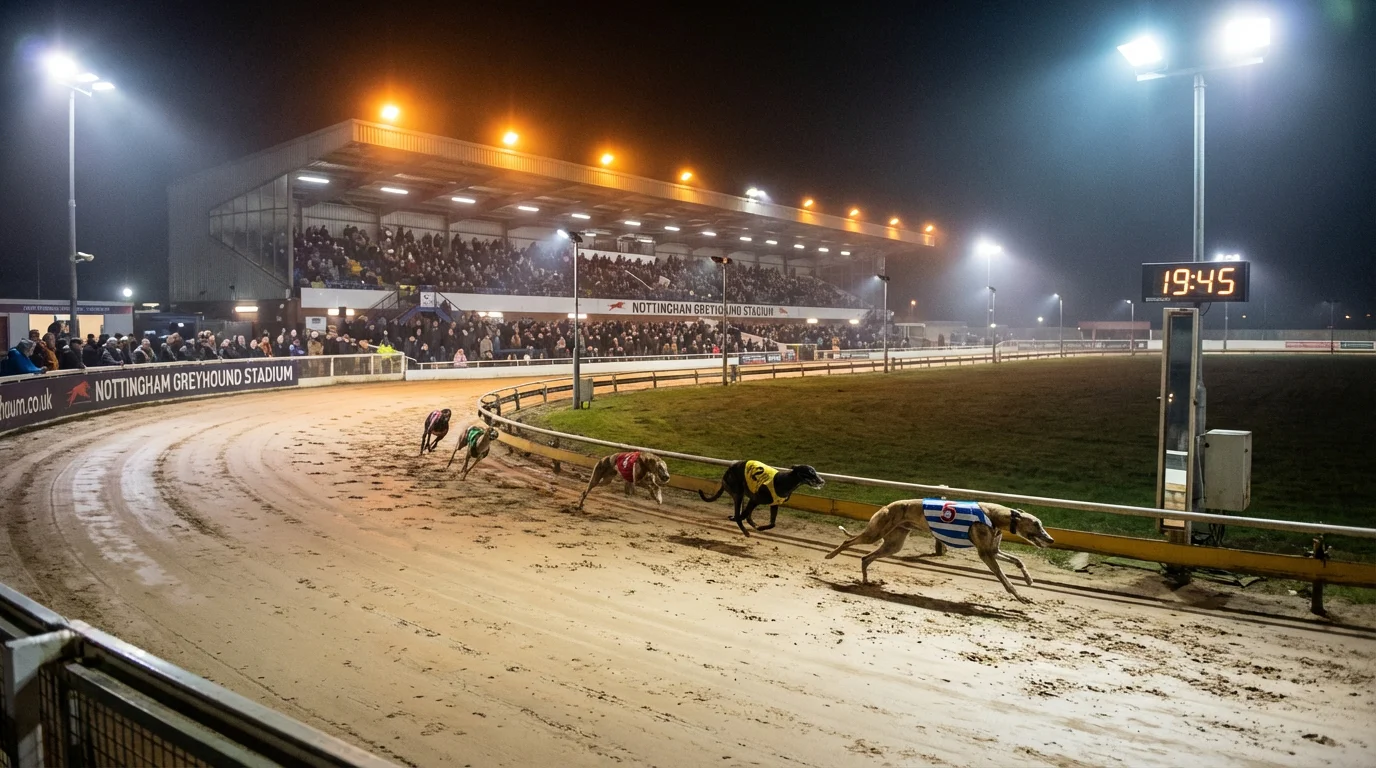
Nottingham has a quiet authority in UK greyhound racing. It is not the loudest venue in the country, nor the most fashionable, but it is consistently one of the more analytically interesting tracks to follow — largely because it hosts the annual Select Stakes, one of the highest-profile invitation events on the greyhound calendar. That event alone gives Nottingham’s results page a different context from most other venues: when you read a Nottingham result in September or October, you may be reading form from a dog that was good enough to qualify for a national invitational. That should recalibrate how you weight those performances.
Beyond the Select Stakes, Nottingham runs a busy year-round programme of graded racing that produces a consistent, reliable stream of results data. The track operates under GBGB licensing and is managed by Arena Racing Company (ARC), which means its results feed into the major data services — Timeform, the Racing Post, and Sporting Life — with the same speed and accuracy as any other top-tier UK venue. For a punter in 2026 trying to build a working knowledge of current greyhound form across the Midlands, Nottingham is the natural starting point.
Nottingham Greyhound Track: Layout, Distances and Grade Structure
Nottingham runs on a standard oval circuit with race distances of 255 metres, 305 metres, 480 metres, 500 metres, 680 metres, and 730 metres. The 500-metre distance is the primary competition distance, used for the Select Stakes and other major events. It is considered one of the fairer standard trips in UK racing — long enough to reward greyhounds that can sustain early pace through two full turns, without being so long that the outcome is dominated by stamina outliers.
The track geometry at Nottingham is relatively open compared to tighter London circuits like Crayford or the old Wimbledon layout. The bends are wider, which in practice reduces the raw advantage of Trap 1 railers and gives wide-running dogs a more realistic chance of getting a clean run to the first bend. This does not eliminate trap bias entirely — inside traps still hold an advantage in most grades — but it softens it enough that the most extreme Trap 1 premium that punters apply at narrow circuits should be discounted at Nottingham.
The graded structure follows the national GBGB framework: A1 through A10 for open grades, S grades for stayers, and OR for open invitation events. Nottingham’s Select Stakes falls into the open race category and is run at 500 metres. The field for the Select Stakes is invitation-only — six dogs are selected by the Greyhound Writers Association on the basis of their form in the preceding months — making it a prestigious invitational rather than a standard graded competition.
One structural feature of Nottingham’s card worth noting is its use of the 730-metre distance for specialist stayers’ events. Very few UK tracks consistently offer 730-metre racing, and the small field of dogs that compete well at this distance develop a distinctive form profile that is almost entirely separate from the standard graded form. If you are assessing a dog that regularly competes at 730 metres at Nottingham, compare its times and positions within the stayers’ category rather than against the A-grade field — the two populations do not overlap meaningfully in terms of form data.
Checking Nottingham Results Today: Sources and Speed
Nottingham results for today’s card are available through the standard fast results infrastructure. Timeform at timeform.com/greyhound-racing/results/today posts finishing orders, times, SP, and BSP returns within seconds of each race completing. The Sporting Life fast results service is equally quick and provides the same core data. For a punter wanting to monitor results from multiple tracks simultaneously — Nottingham alongside Romford and another evening card, for instance — the Sporting Life layout is arguably more efficient because it aggregates multiple venues in a single scrollable view.
The GBGB official results archive is the correct reference point for historical Nottingham form. Available at gbgb.org.uk/racing/results, it holds complete records for all GBGB-licensed meetings including full field sizes, finishing margins, official times, and SP returns. The archive is not designed for speed but is indispensable for the kind of multi-month form analysis that underpins a serious Nottingham betting approach.
For the Select Stakes period specifically — typically running through the autumn months — the Racing Post provides supplementary editorial coverage including draw analysis, trainer comments, and sectional time comparisons that are not always available for standard graded cards. During a major Nottingham open event, the Racing Post’s greyhound desk is worth consulting alongside the raw results data, because the context it provides for each result materially changes how that result should be interpreted.
Most major UK bookmakers confirm Nottingham results on their racecard pages as races complete during the evening session. The booking platform result confirmation is rarely faster than Timeform’s dedicated results service but is useful if you are already on the bookmaker’s site managing open bets on the same card.
Nottingham’s Track Stats: Open vs Graded Race Outcomes
The statistical distinction between open race outcomes and graded race outcomes at Nottingham is sharper than at most other GBGB venues. In graded racing, the favourite win rate at Nottingham is broadly consistent with the national average — somewhere between 34% and 38% depending on the year and the grade sample. That is not a particularly useful edge; it is simply the market being efficient. In open races at Nottingham — particularly during the Select Stakes series — the favourite win rate is notably higher, partly because the field has been curated for ability and partly because the market participants bring considerably more information to the pricing process.
Trap bias at Nottingham, as noted above, is measurably softer than at narrow-circuit London venues. In graded racing over 500 metres, Trap 1 still wins more often than a random distribution would predict, but the premium is typically 3–5 percentage points above the 16.7% base expectation rather than the 8–10 percentage point premiums seen at circuits like Crayford. In sprint racing at 305 metres, the trap bias is more pronounced because the distance to the first bend is compressed. The 305-metre card at Nottingham rewards early pace and inside draw in a way that closely mirrors the sprint card dynamics at other UK tracks.
One statistic that consistently stands out at Nottingham is the performance of wide-running dogs in open races. When the field is strong and the track is running true, dogs from Traps 5 and 6 win a disproportionate share of Nottingham open events compared to their equivalent performance in graded races. The wider bends give them the room they need to find their stride. This is not a betting strategy in isolation, but it is a meaningful correction factor when evaluating wide-draw dogs at a Nottingham open card.
Finishing margin data from Nottingham results is worth aggregating over time. The median winning margin in A-grade races at Nottingham over 500 metres is approximately 1.5 to 2 lengths. Races won by four lengths or more in this grade are either exceptional performances or contests where the opposition ran significantly below form. Both readings are worth investigating rather than taking at face value.
Betting on Nottingham Events: Tips and Where to Stream
Nottingham racing is covered by all major UK bookmakers through the BAGS and SIS network. Win, each-way, forecast, tricast, and combination markets are available for standard graded cards. During the Select Stakes, most bookmakers also offer ante-post markets on individual round results and the overall competition, which adds a longer-term betting dimension that is not available at most other venues.
Live streaming for Nottingham is available through bookmaker platforms carrying Premier Greyhound Racing content. Bet365, Ladbrokes, and William Hill consistently offer streaming for Nottingham meetings, typically requiring either a funded account or a qualifying bet within a recent timeframe. The greyhounds.attheraces.com platform — associated with the At The Races broadcaster — also carries live Nottingham coverage and is worth bookmarking as a free-access option during meetings when bookmaker stream access is not available.
BOG is available on Nottingham races at most major UK bookmakers for UK greyhound meetings. Its practical value is enhanced during Select Stakes rounds, when the market is more actively traded and prices tend to drift or shorten significantly in the hour before racing. Taking an early price on a fancied Select Stakes dog and being covered by BOG if the market drifts removes a meaningful source of risk in an event where market intelligence can move prices sharply.
For the Select Stakes specifically, ante-post betting with each-way terms is available at several bookmakers. The standard each-way terms on a six-dog field pay for first and second at one-quarter odds, which on a 4/1 shot offers a 1/1 place return. Given the compressed ability range in invitation events, the each-way market at Nottingham Select Stakes round prices often represents better value than the win market alone, particularly if you are identifying dogs that you believe will run well without necessarily expecting to win.
Nottingham Results as a Barometer for National Form
One of the more underappreciated functions of Nottingham’s results page is its role as a cross-regional form reference. Nottingham draws kennel representation from the Midlands, the North, and occasionally London and the South East, which means a regular Nottingham card contains dogs that have been competing across multiple regions. When those dogs run on the same track under the same conditions, the results provide a direct form line between regional form pools that would otherwise be difficult to compare.
A Midlands-trained dog that has been running consistently in A3 grade at regional venues meeting a London-trained A3 competitor for the first time at Nottingham — the result of that race is information that neither dog’s home track results could provide alone. If the London dog wins by three lengths in a fast time, that result revises upward the quality of every race that London dog has previously run. If the Midlands dog wins comfortably, it suggests the London form was overstated or the regional level is more competitive than widely assumed. Either outcome updates the form picture for a wider network of dogs.
During the Select Stakes, this cross-regional form integration is even more explicit. The invited field typically includes representation from across the country, and the result effectively ranks those regional form pools against each other in a single race. Punters who track Nottingham’s open race results carefully over the year gain a calibrated view of which kennels and which regions are producing genuinely competitive dogs in the current season — information that pays dividends long after the event itself has concluded.
Nottingham’s results, in this sense, do more analytical work per race than most other venues in the country. The volume is there, the competition is genuine, and the Select Stakes provides an annual benchmark event that forces the form into direct contact with the best greyhounds available. For a punter serious about understanding UK greyhound form in 2026, following Nottingham results is not optional. It is one of the most efficient investments of attention in the calendar.