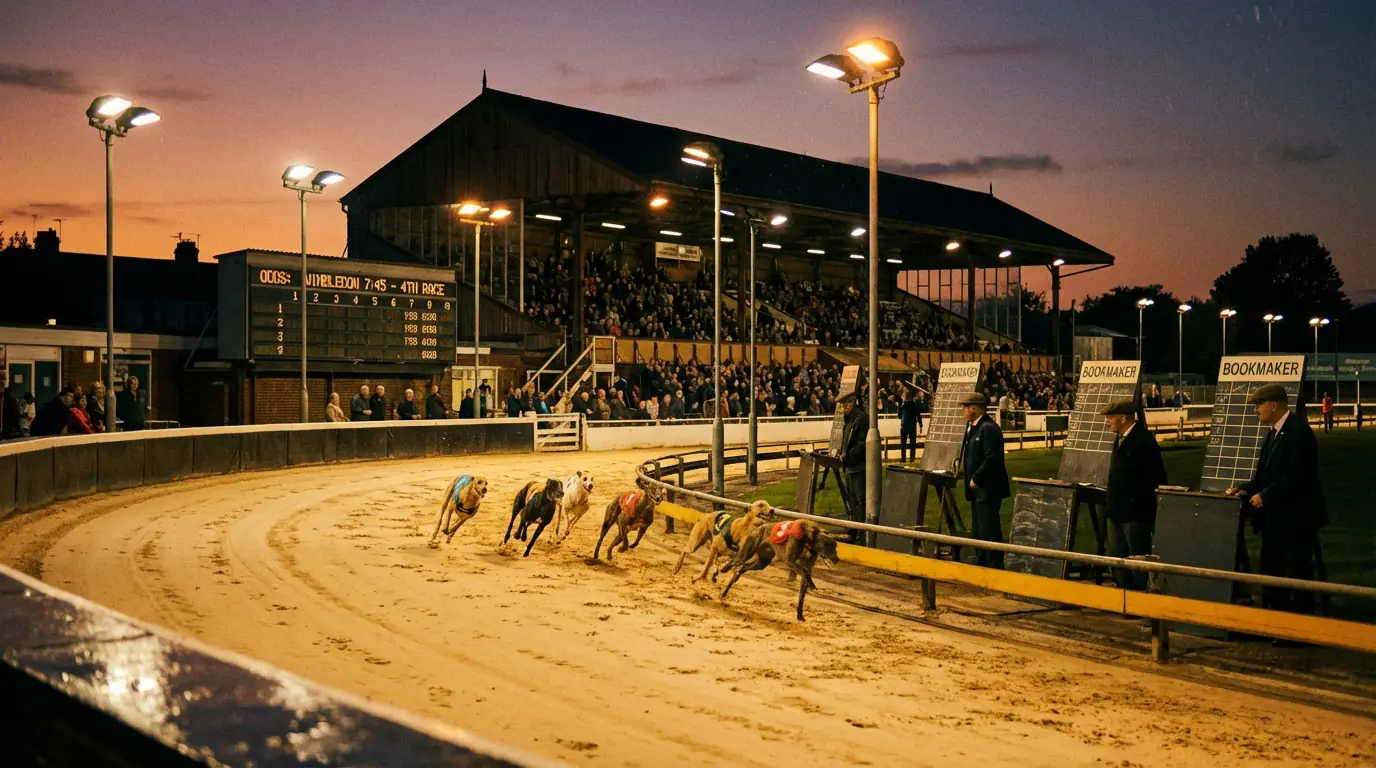
Wimbledon Stadium occupies a peculiar position in UK greyhound racing history: it is simultaneously one of the most famous addresses in the sport and a venue whose recent story has been defined as much by absence as by racing. The original Plough Lane stadium hosted greyhound racing for decades and was a fixture in the results pages of every national newspaper. Its permanent closure in March 2017, and the subsequent demolition of the site in 2018 for AFC Wimbledon’s new football stadium, removed a London landmark from the active schedule. The new Plough Lane football stadium opened in November 2020. Since the greyhound stadium’s closure, there has been no greyhound racing under the Wimbledon banner at the original site.
The situation in 2026 is this: Wimbledon greyhound stadium has been permanently closed since March 2017, and the site now hosts AFC Wimbledon’s football ground. There is no active greyhound racing at the Wimbledon site. The historical form data from Wimbledon remains valuable for understanding London greyhound racing standards, and the Greyhound Board of Great Britain at gbgb.org.uk maintains the authoritative archive of past Wimbledon results.
Wimbledon Greyhound Stadium: Track Characteristics and Key Distances
The Wimbledon of the Plough Lane era ran primarily at distances of 277 metres, 480 metres, and 640 metres. These were not arbitrary — the 480-metre trip was considered one of the more testing standard distances in London racing, rewarding dogs that combined early pace with the ability to sustain it through a longer bend profile than the shorter London tracks. The 277-metre sprint was notoriously explosive: six dogs, a short straight, and a first bend that arrived almost immediately.
Track characteristics at greyhound venues are not merely scenic detail. They shape the form. A dog that excels at a tight 400-metre oval is a different athlete from one bred for a sweeping 480-metre circuit. When reading Wimbledon results, the distance column is the first thing to check, and the performance should always be benchmarked against the dog’s previous runs at the same distance and, where possible, on similar track geometry. A personal best over 400 metres at a tight south London track does not automatically translate to a personal best over 480 metres at Wimbledon.
The graded structure at GBGB-licensed venues follows the same national framework — A grades for open competition, S grades for stayers, OR for open events — but the calibration of those grades is venue-specific. An A3 dog at Wimbledon is not necessarily at the same level as an A3 dog at Romford or Crayford. The finishing times provide the correction: compare the time to the track’s par for that grade and distance rather than using an absolute national standard.
Running style matters significantly at any track with pronounced bend geometry. Railers — dogs who cut to the inside — have an inherent advantage at Wimbledon-style circuits because they cover less ground. Wide runners, by contrast, need either a clear outside track or enough raw pace to overcome the additional distance. When a wide runner wins at Wimbledon, the result carries a quality signal that the same win at a track with gentler bends might not — it means the dog ran fast enough to absorb the disadvantage.
Today’s Wimbledon Results: Where to Find Them Instantly
For live and recently completed Wimbledon results, the fastest and most reliable sources in the UK are Timeform’s greyhound results service at timeform.com/greyhound-racing/results/today and the Sporting Life fast results page. Both services update within seconds of the race completing, pulling directly from the official BAGS (Bookmaker’s Afternoon Greyhound Service) and SIS timing infrastructure.
The Racing Post’s greyhound section is marginally slower to update than Timeform on live results but provides richer contextual data — it includes runner profiles, sectional information where available, and market commentary that helps make sense of unusual results. For the immediate finishing order, time, and SP, Timeform or Sporting Life are the right tools. For the why behind the result, the Racing Post is more useful in the minutes following each race.
Most major UK bookmakers display results alongside their racecard pages for currently running meetings. If you are watching via a bookmaker stream and want the official result confirmed before it appears on screen, the Timeform fast results service typically posts ahead of most bookmaker result confirmations. This matters in practice when you are deciding whether to place a bet in a later race on the same card, informed by what happened earlier.
The GBGB website maintains a full results archive accessible at gbgb.org.uk/racing/results. This is the authoritative record for all GBGB-licensed Wimbledon meetings. It is not designed for fast-results use but is the correct source for historical form research, particularly when verifying finishing positions, times, and SP for dogs you are tracking over multiple months.
Wimbledon Form: How London Dog Racing Results Reflect National Standards
London greyhound racing occupies an interesting position in the national form picture. The tracks in and around the capital — historically Wimbledon, Romford, Crayford, Walthamstow, and Hackney among them — have consistently attracted well-bred, well-kennelled greyhounds. London form is generally regarded as competitive, which means that a dog performing consistently in A-grade London racing is demonstrating genuine ability rather than benefiting from a watered-down provincial field.
That competitive intensity has a direct implication for how you read Wimbledon results relative to national form. A dog trained at a London kennel and competing on London tracks will typically have a form string calibrated against stronger opposition than a dog of equivalent official grade competing at a quieter regional venue. When those dogs meet — at a national open event, for example, or when a London dog is moved to a track outside the capital — the London form often holds up better than the grade comparison alone would suggest.
Sectional times, where available in Wimbledon results, are particularly valuable for this kind of cross-track comparison. The first sectional — the time from the start to the first trap lure — tells you how quickly the dog gets out of the boxes and reaches its racing position. A fast first sectional at Wimbledon from a dog that then runs a competitive time overall is a strong signal of genuine ability. A dog posting slow sectionals while winning is more reliant on the weakness of the opposition, and that dependency tends to be exposed when competition improves.
London trainers are also generally among the more competitive in the country. Names that appear frequently in Wimbledon results carrying consistent win rates are worth noting, because trainer form is a real factor in greyhound performance. A kennel in form produces dogs that are fit, settled, and often running with minor tactical advantages that do not appear anywhere in the published data. Tracking which trainers win regularly at Wimbledon, and in which race grades, is a basic form study that pays dividends over time.
Betting on Wimbledon Races: Markets and Streaming Options
Wimbledon races are covered by all major UK bookmakers through the SIS and BAGS broadcast network. Win, each-way, forecast, tricast, and combination markets are standard. The spread of prices across bookmakers on a typical Wimbledon A-grade race is narrow at the short end of the market but widens considerably on mid-range and outsider prices — a 10/1 shot at one bookmaker may be 14/1 at another, and the difference is worth finding before the race goes off.
Live streaming for Wimbledon meetings is available through the bookmaker platforms that carry Premier Greyhound Racing events, generally requiring a funded account or a qualifying bet within a recent period. Bet365, William Hill, Ladbrokes, and Betfred all offer greyhound streaming for UK meetings. The stream quality is consistent but not identical across providers — if you are watching for pace assessment and early sectional reading rather than pure entertainment, a sharper stream matters.
BOG (Best Odds Guaranteed) applies to Wimbledon races at most major bookmakers for UK greyhound meetings. The practical value of BOG at a busy London venue is higher than at a quieter track — Wimbledon markets are more actively traded in the lead-up to race time, which means prices shift more frequently and the BOG protection covers more ground. Taking an early price on a Wimbledon selection and knowing you receive the best of early or starting price removes one of the standard disadvantages of backing early.
For exchange betting, the Betfair market on Wimbledon races offers BSP settlement and in-play liquidity on running meetings. BSP at Wimbledon tends to be competitive with bookmaker SP on favourites, and frequently exceeds bookmaker SP on mid-range and bigger-priced winners. The caveat is the Betfair commission, which bites into returns at a rate that depends on your account status and the market’s liquidity. Net of commission, BSP at Wimbledon is often the better settlement option for runners priced 3/1 and above.
What Wimbledon’s Results Can Teach You About Racing Form
The most valuable thing a consistent Wimbledon results-reader develops is calibration — a feel for what a good performance at this track looks like and what a misleading one looks like. That calibration cannot be shortcut. It requires watching races alongside reading results, building a mental database of par times, tracking how dogs perform on second and third appearances after a break, and noticing which trainers fire their dogs up well at this venue versus which ones seem to use the first run as fitness work.
Results at Wimbledon carry particular weight when assessing a dog’s readiness for step-up in class. A dog winning comfortably at A5 in a decent time at Wimbledon is not merely an A5 dog — it is a dog demonstrating that it is ready for A4 company. The key qualifier is the time. If the comfortable A5 win was in a slow time because the opposition capitulated early, the class step will expose the dog quickly. If the comfortable A5 win was in a par or above-par time, the step to A4 is a legitimate next move and the market that opens on the following racecard should be scrutinised accordingly.
Wimbledon results also reward close attention to finishing orders beyond the winner. Second and third place are form data, not consolation prizes. A dog that has finished second three times in a row at Wimbledon, each time behind a different winner but consistently running the same time, is telling you something important: it is consistent, competitive, and possibly drawing unlucky. Whether that consistency becomes a win depends on the draw and the opposition. But a punter who knows this about the dog is ahead of the market that only reads the results column for number ones.
Greyhound racing at Wimbledon, whatever its current configuration, has always rewarded the punter who treats the results page as the beginning of the work rather than the end of it. The dog that won tonight will run again in a week. The field that surrounded it will shuffle and reassemble. What happened this evening is already the past. What it implies for the next card is where the analysis — and the opportunity — actually lives.