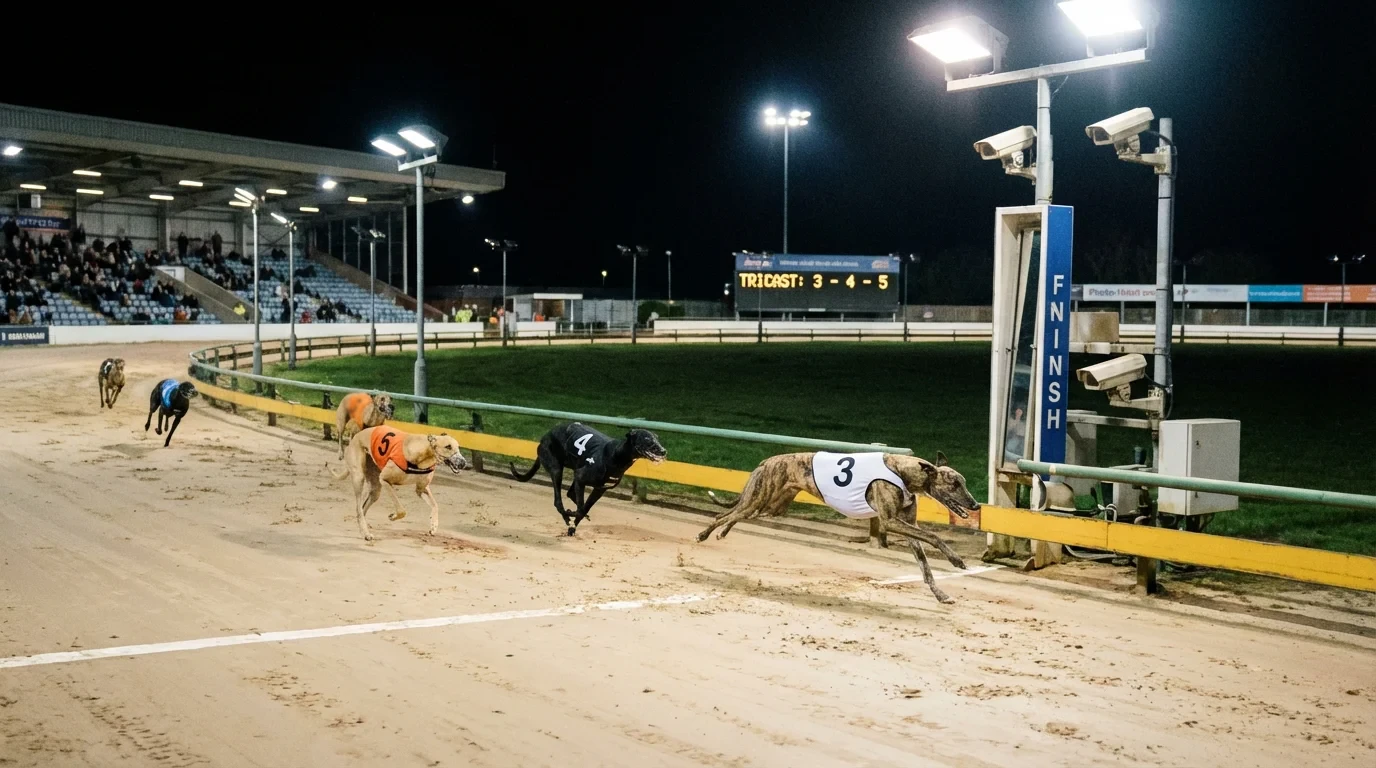
The tricast is the most demanding standard bet in UK greyhound racing. It requires you to predict the first three finishers in a single race, in the correct order. When it lands, the returns are substantial — tricast dividends of fifty, a hundred, or several hundred times the stake are not uncommon in competitive graded races. When it does not land, which is most of the time, you lose your stake entirely. There is no each-way safety net, no partial return for getting two out of three right. The tricast rewards precision and punishes approximation.
For punters who have mastered win singles and forecast betting, the tricast represents the next level of analytical engagement with a race. It is not a bet for every race or every card. It is a bet for specific situations where your form reading, track knowledge, and understanding of running styles converge to give you a defensible view on three dogs and their likely finishing order. Used selectively and staked modestly, the tricast is one of the highest-value weapons in a greyhound bettor’s arsenal. Used indiscriminately, it is an expensive way to prove that predicting three positions in a six-dog race is harder than it sounds.
How a Tricast Bet Works in UK Greyhound Racing
A tricast bet selects three dogs to finish first, second, and third in a specified order. You nominate Dog A to win, Dog B to finish second, and Dog C to finish third. If the race finishes in exactly that order, you collect the tricast dividend. If any of the three dogs finishes in a different position — even if all three fill the first three places but in the wrong order — the bet loses.
Tricasts are available on all UK greyhound races with six or more runners, which in practice means virtually every race on the card. The bet is placed either as a standalone selection on the betslip or, at some bookmakers, through a dedicated tricast interface that shows you the possible permutations. You select your first, second, and third choices, confirm the stake, and the bet is live.
The minimum stake on a tricast varies by bookmaker but is typically as low as ten pence or twenty pence per permutation. This low entry point is part of the tricast’s appeal — you can take a meaningful position on a complex prediction without risking a large amount. A fifty-pence straight tricast that returns a dividend of two hundred times the stake delivers a hundred-pound return. That ratio of risk to reward is what draws punters to tricasts, even knowing that the hit rate is inherently low.
One important detail: tricasts on greyhound racing in the UK are pool bets, calculated using the Computer Tricast formula after the race based on the SPs of all runners. You do not know the exact return in advance. The dividend depends on the Starting Prices of the first three finishers and the overall shape of the market. This means that tricast returns are highest in races where the finishing order was improbable according to the pre-race market — a result involving three mid-price or outsider dogs pays far more than one involving the 4/6 favourite finishing first followed by the second and third favourites.
Straight Tricast vs Combination Tricast: Costs and Returns
The straight tricast is a single bet on one specific finishing order: first, second, third, exactly as nominated. It costs one unit stake. A combination tricast covers all possible finishing orders among your three selected dogs. With three selections, there are six possible permutations (A-B-C, A-C-B, B-A-C, B-C-A, C-A-B, C-B-A), so a combination tricast costs six times the unit stake. If any of the six permutations matches the result, you are paid the tricast dividend for that specific order.
The decision between straight and combination mirrors the logic of straight versus reverse forecasts, but the stakes are higher in both directions. A combination tricast gives you six chances to be right, which is a substantial improvement over one chance, but it also costs six times as much. The net return on a successful combination tricast is the dividend minus five losing stakes, which can still be very profitable on high-dividend results but erodes the value when the dividend is modest.
You can also use extended combinations with four or more selections. A combination tricast on four dogs covers twenty-four permutations (4 x 3 x 2 = 24), costing twenty-four times the unit stake. At five selections, it is sixty permutations. The costs escalate rapidly, and the mathematical reality is that the more permutations you cover, the higher the dividend needs to be to break even — which means you need a more improbable result to make a profit, creating a paradox. Extended combination tricasts are rarely good value unless the race is genuinely wide open and you have strong reasons to believe that the first three places will be filled by dogs from a specific subset of the field.
For most purposes, the straight tricast at a small stake is the sharpest approach. It maximises the return-to-risk ratio and forces you to commit to a specific view of the race, which is analytically honest. If you cannot justify a specific first-second-third order based on form and track data, that is a signal that the race may not be a good tricast candidate rather than a signal to cover more permutations.
How Tricast Returns Are Calculated: A Worked Example
Tricast dividends in UK greyhound racing are calculated using the Computer Tricast (CT) formula, which is based on the Starting Prices of all six runners. The formula is administered by the same body that calculates CSF returns and uses a mathematical model that accounts for the probability of each specific three-dog finishing order given the pre-race market.
Consider a race with the following SPs: Trap 1 at 3/1, Trap 2 at 5/2, Trap 3 at 4/1, Trap 4 at 7/1, Trap 5 at 8/1, and Trap 6 at 10/1. If the result finishes Trap 3 first, Trap 1 second, Trap 6 third, the tricast dividend will be significantly higher than if the result finishes Trap 2 first, Trap 1 second, Trap 3 third — even though both involve three of the four shortest-priced dogs. The inclusion of Trap 6 at 10/1 in the third position inflates the dividend because the market considered that finishing position for that dog to be unlikely.
A typical tricast involving a mid-price winner (3/1 to 5/1), a mid-price second (3/1 to 5/1), and a longer-priced third (7/1 to 10/1) might return anywhere from forty to one hundred and twenty times the stake to a one-pound straight tricast. A tricast where all three places are filled by outsiders — 8/1, 10/1, and 7/1 — can return several hundred times the stake. Conversely, a tricast involving the top three in the market finishing in order — the favourite first, second favourite second, third favourite third — might return as little as eight to fifteen times the stake, reflecting the relative predictability of that outcome.
The lesson from these numbers is clear: tricast value is driven by the improbability of the specific finishing order. Backing the three most obvious dogs in the most obvious order produces thin returns relative to the difficulty of getting the prediction exactly right. The highest-value tricasts involve at least one selection that the market has underestimated — a dog whose form or track suitability suggests it will outperform its SP.
When Tricast Betting Makes Sense Based on Results Data
Tricast betting is not appropriate for every race. The races that produce the best tricast opportunities share several characteristics, and identifying them before the off is a skill that improves with experience and data analysis. The ideal tricast race has a competitive field with form that clearly separates three dogs from the remaining three, but where the exact finishing order among the top three is uncertain enough to generate a meaningful dividend.
Races with a dominant favourite at very short odds — 4/6 or shorter — are generally poor tricast prospects. The favourite finishes first in a high proportion of these races, which compresses the tricast return because the most probable first-place finisher is the one the market already expects. The tricast adds value when the winner is not a foregone conclusion, because the less predictable the winner, the higher the dividend for getting the full order right.
Graded races at A3-A5 level, where dogs are experienced and run to form but are not sharply separated on ability, tend to produce the most consistently attractive tricast opportunities. Open races can also generate large dividends, but the form is harder to read because the dogs are drawn from different tracks and the quality gap between entries can be wider and less predictable. The sweet spot for tricast betting is a race where the form data gives you a genuine analytical basis for ranking three dogs, and where the market prices at least one of those three generously.
Finding Tricast Value in Graded vs Open Races
The distinction between graded and open races matters for tricast bettors in a specific way. In graded races, all dogs are at the same track and have been placed in the grade by the racing manager based on recent performance. This means the form data is directly comparable — all dogs have raced over the same distance at the same venue in recent weeks, and their sectional times, finishing positions, and trap records are measured on the same surface. For tricast purposes, this comparability makes form analysis more reliable and the resulting predictions more robust.
Open races draw dogs from multiple tracks, often running over distances that differ from their usual trip. A dog that has been winning A2 races over 480 metres at Monmore is a different proposition when it appears in an open race over 500 metres at Towcester. The form translation is imperfect, and that imperfection cuts both ways for tricast bettors: it increases the uncertainty (bad for prediction accuracy) but it also increases the likelihood of a surprising finishing order (good for dividend size). The best open-race tricasts come from events where at least two of your three selections have track experience at the host venue. That single factor — familiarity with the bends, the surface, and the distance — reduces the translation noise that makes open-race form unreliable, and gives your tricast a foundation of data rather than speculation.