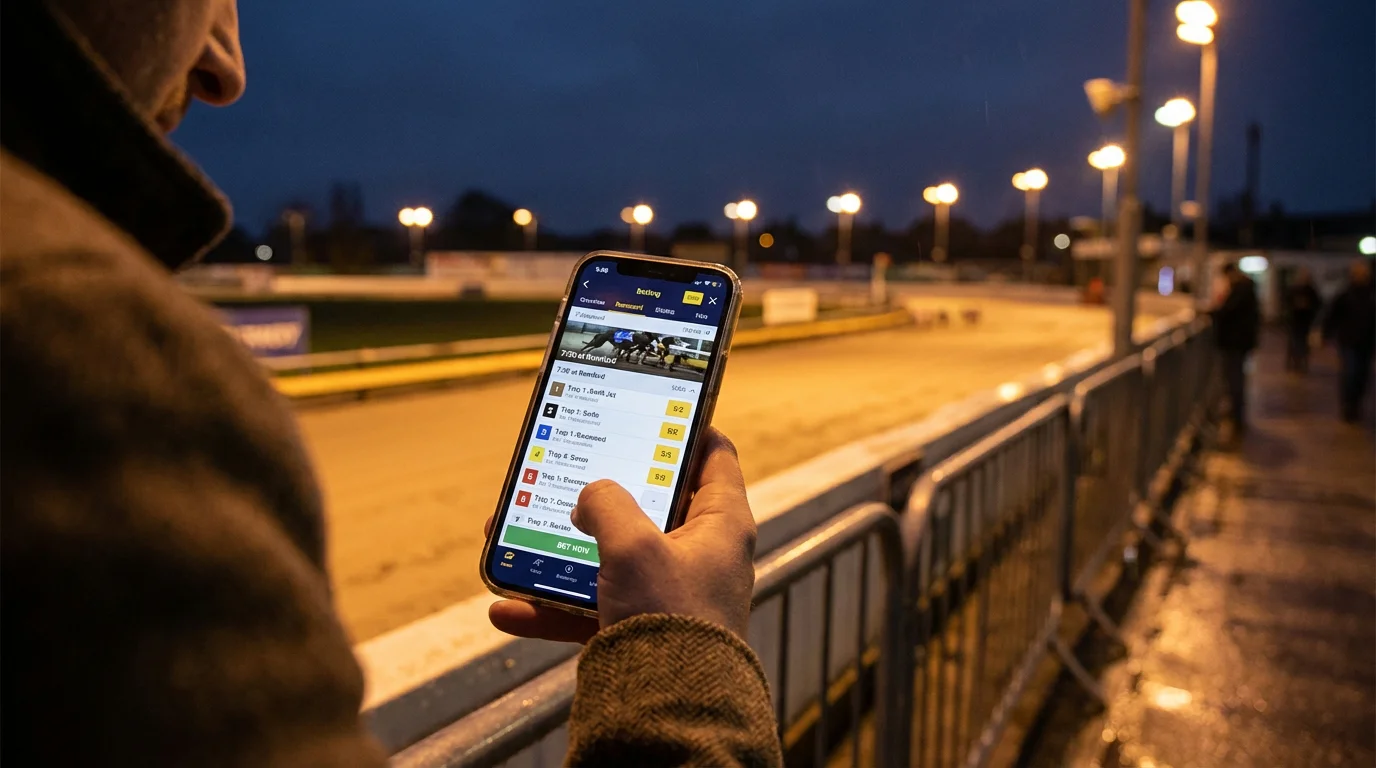
Greyhound racing looks simple from the outside. Six dogs, one trap each, thirty seconds of running, a result. The reality is that betting on the dogs in the UK involves a set of skills and decisions that are not immediately obvious, and the sport’s accessibility — races every few minutes, every evening, at tracks across the country — can work against beginners who jump in before they understand the mechanics. The bookmakers are not going to slow down for you. The races will keep coming whether you are ready or not.
This guide covers the practical steps involved in placing your first greyhound bets in the UK: from choosing and setting up a bookmaker account, through understanding what type of bet to start with, to reading a racecard and managing your money. None of this is complicated, but all of it matters. The punters who last in greyhound betting are not the ones who pick the most winners in their first week — they are the ones who approach the sport with a structure from the start and treat the learning curve with the respect it deserves.
Setting Up an Account: What You Need to Bet on Greyhounds in the UK
To bet on greyhound racing online in the UK, you need an account with a licensed bookmaker. All legal UK bookmakers hold a licence from the UK Gambling Commission, and you can verify any operator’s licence status on the Commission’s public register. The major bookmakers that offer comprehensive greyhound coverage include Bet365, William Hill, Coral, Ladbrokes, Betfair, and Paddy Power, among others. Each covers most UK evening and BAGS (Bookmakers’ Afternoon Greyhound Service) meetings.
Opening an account requires standard identity verification. You will need to provide your full name, date of birth, address, and a form of ID — typically a passport or driving licence. UK law requires all operators to verify that you are at least 18 years old before you can place a bet or even deposit funds. Some bookmakers allow you to browse racecards and watch live streams while your verification is pending, but you will not be able to stake money until the checks are complete.
Once verified, you deposit funds using a debit card, bank transfer, or an e-wallet like PayPal or Skrill. Credit card gambling has been banned in the UK since April 2020. Before you deposit, set a deposit limit — every UK bookmaker is required to offer this tool — and be realistic about what you can afford to lose. A sensible starting deposit for a beginner exploring greyhound betting is an amount you would be comfortable losing entirely, because the probability of losing it while learning is high.
One practical tip: open accounts with at least two or three bookmakers rather than one. Greyhound odds vary meaningfully between operators, and having access to multiple books allows you to take the best available price on any given race. This costs nothing and immediately gives you a structural advantage over punters who bet with a single bookmaker out of convenience.
Choosing Your First Greyhound Bet: The Right Starting Point
Start with win singles. A win single is the most straightforward greyhound bet: you pick one dog to win one race. If it finishes first, you collect your stake multiplied by the odds. If it finishes anywhere else, you lose your stake. There are no complications, no permutations, no need to predict multiple outcomes. For a beginner, this simplicity is the point — it lets you focus on learning how to assess a race without the added complexity of forecasts, tricasts, or accumulators.
When selecting your first races to bet on, favour evening meetings at major tracks over afternoon BAGS cards. Evening meetings at venues like Romford, Monmore, Sunderland, and Nottingham tend to feature graded racing with more predictable form patterns. BAGS meetings, which run during the afternoon primarily as a product for betting shops and online bookmakers, often feature less consistent form and attract less analytical coverage. The quality of available information — racecards, form data, tips — is higher for evening racing, which gives a beginner more material to work with.
Stake size matters from the first bet. A useful starting discipline is to bet the same amount on every race — a flat stake — rather than varying your bet based on confidence. At this stage, your confidence is not calibrated. You do not yet have enough experience to know when you are right and when you merely feel right, and variable staking amplifies the damage from that calibration gap. A flat stake of one or two pounds per race is enough to make the outcome feel real without risking a significant portion of your bankroll on decisions you are still learning to make.
Avoid accumulator bets entirely at the beginning. Accumulators are mathematically the worst bet for any punter who does not already have a positive expected value on individual selections, because the bookmaker’s margin compounds across every leg. They feel exciting. They are structurally designed to lose.
Reading the Racecard Before You Place a Bet
Never bet on a greyhound race without looking at the racecard first. The racecard is published before every race and contains the information you need to make an informed selection: each dog’s trap number, recent form figures, weight, trainer, grade of previous races, finishing times, and sometimes sectional splits. It is available for free on sites like Timeform, Racing Post, and the GBGB website.
The most important column for a beginner is the form string — the sequence of numbers and letters after each dog’s name. These show the dog’s finishing positions in its most recent races, with the most recent on the right. A form string of 2-1-1-3-1 tells you this dog has won three of its last five races and finished in the top three every time. A form string of 5-6-4-6-5 tells you the opposite. Letters in the string indicate non-standard outcomes: F means fell, R means refused to race, and W means a walkover. At a beginner level, focusing on dogs with recent winning form and avoiding dogs with scattered or declining form is a reasonable starting heuristic.
The trap number also matters, though its importance varies by track. Some tracks — particularly tight venues like Romford — have a strong inside-trap bias, meaning dogs in traps one and two win more often than statistical chance would predict. At wider tracks like Towcester, the trap bias is much less pronounced. You do not need to memorise every track’s trap statistics to start betting, but being aware that trap draws influence outcomes is important. If two dogs have similar form and one is drawn in trap one at a track with a known rail bias, that is relevant information.
Grade is the third element to pay attention to early on. UK greyhound races are graded from A1 (the highest standard at a given track) downwards. A dog dropping from A2 to A3 is being placed in a lower-quality field, which gives it a form-based advantage. A dog moving up from A4 to A3 is stepping into tougher company. Grade changes are not always reflected in the odds as accurately as they should be, which is one of the areas where beginners can start to develop an edge with relatively little experience.
Managing Your Bankroll for Greyhound Betting
Bankroll management is the single most important discipline in greyhound betting, and it is the one beginners are most likely to ignore. Your bankroll is the total amount of money you have set aside specifically for betting — not your rent, not your savings, not money you need for anything else. Once you have defined that number, every decision about stake size and bet frequency flows from it.
A standard approach is to never risk more than 2-5% of your bankroll on a single bet. If your bankroll is one hundred pounds, your individual stakes should be between two and five pounds. This protects you from the inevitable losing runs that are a mathematical certainty in greyhound betting. Even a skilled punter with a genuine edge will experience sequences of ten or more losing bets — the variance in six-dog racing is high. If you are staking 20% of your bankroll per bet, a run of five losses wipes you out. At 2-5%, the same losing run reduces your bankroll but leaves you in a position to recover.
Track your bets from the start. A simple spreadsheet with columns for date, track, race, selection, odds, stake, and result is enough. After fifty bets, you will have enough data to see patterns: Are you profitable on evening racing but losing on BAGS? Are your favourites at short prices performing worse than your mid-price selections? Are you betting more per race when you are behind for the session — a classic sign of chasing losses? The data answers questions that your memory and intuition cannot, and the sooner you start collecting it, the sooner you can make evidence-based adjustments to your approach.
Common Beginner Mistakes and How to Avoid Them
The most common beginner mistake in greyhound betting is betting too many races. With meetings running every evening at multiple tracks, and races going off every eight to ten minutes, the temptation to bet on every race is constant. Resist it. Selectivity is not just a virtue — it is a mathematical requirement. The bookmaker’s margin means that every bet you place without a genuine edge costs you money in expectation. Betting fewer races, with better-researched selections, produces better long-term results than high-volume, low-conviction punting.
The second common error is chasing losses. You lose three bets in a row, so you double your stake on the fourth to try to recover. This is the fastest way to destroy a bankroll that exists. Losing runs are normal. They are not a signal to increase your stakes — they are a signal to maintain discipline and trust the process. If your selection method is sound, the results will correct over time. If it is not sound, doubling your stakes will accelerate your losses, not reverse them.
A third mistake is ignoring the racecard entirely and betting on names, trap colours, or gut feelings. Greyhound racing is a data-rich sport. The information you need to make a reasoned selection is freely available, and the punters who use it have a clear advantage over those who do not. You do not need to become an expert overnight, but you do need to look at the form figures, the grade, and the trap draw before every bet. Anything less is not betting — it is guessing. And the bookmakers are not in the business of rewarding guesses.