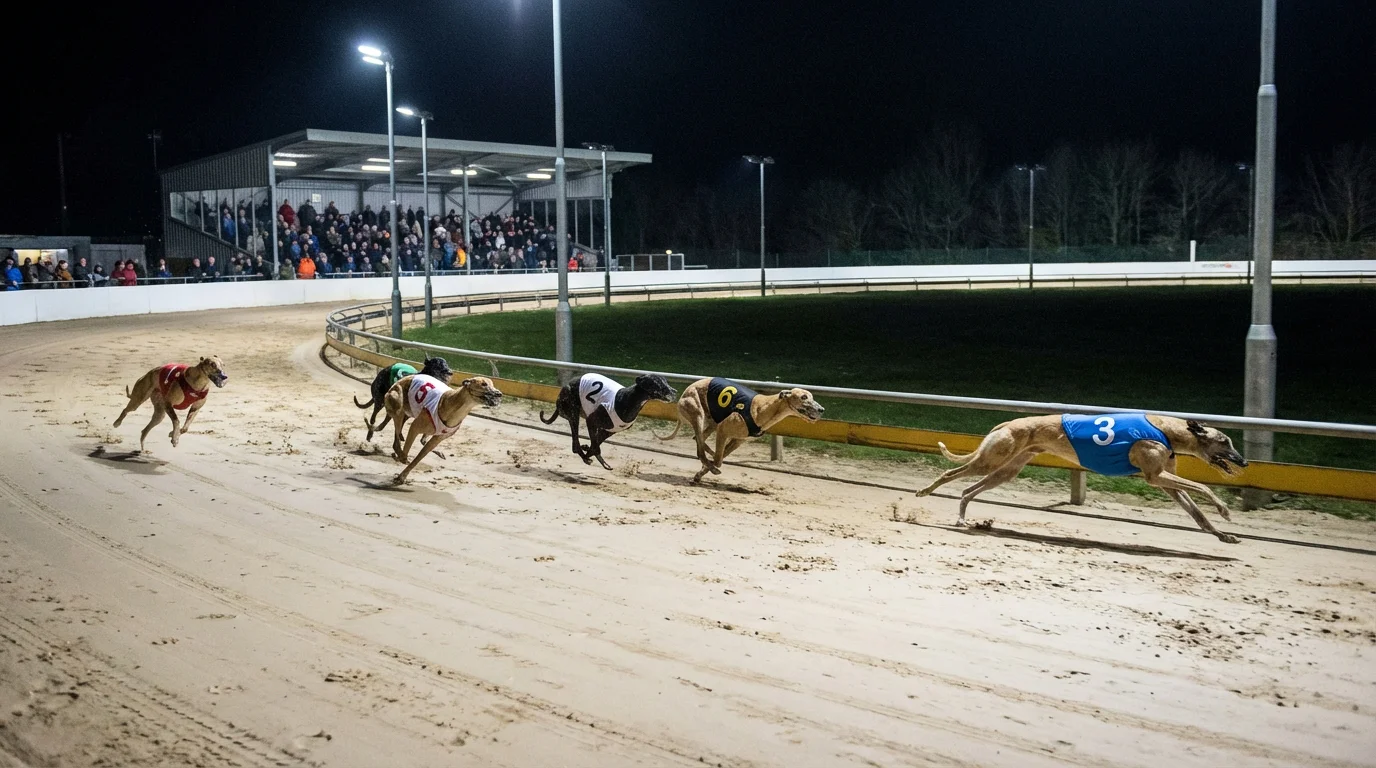
The grading system is the organising principle of UK greyhound racing. It determines which dogs race against each other, how competitive each race is likely to be, and what the result actually means in context. A dog winning an A1 race is doing something categorically different from a dog winning an A7 race, even if both cross the line first. Without understanding the grades, greyhound results are just numbers. With it, they become data points in a coherent system that tracks every dog’s ability, trajectory, and relative standing within the sport.
The grading system also creates the single most consistent source of betting value in UK greyhound racing. When a dog moves between grades — up after winning, down after a poor run — its price in the new grade often lags behind the reality of the move. A class dropper entering a weaker field is sometimes still priced as if it is facing its previous opponents. A dog promoted into stronger company is sometimes backed on the strength of its lower-grade form without adjustment. Recognising and exploiting these grade-change inefficiencies is one of the most reliable methods for finding value in the greyhound markets.
How UK Greyhound Grades Work: A1 to A10, S, OR and Beyond
UK greyhound races are assigned grades by the racing manager at each GBGB-licensed track. The primary grading scale uses the letter A followed by a number, where A1 is the highest standard of graded racing at that track and the numbers increase as the standard decreases. Most tracks run grades from A1 down to A6 or A7, though some venues with larger racing populations extend to A9 or A10. The grades are track-specific — an A3 at Romford is not necessarily equivalent to an A3 at Sunderland, because each track’s racing manager grades relative to the local dog population.
Beyond the A grades, several other categories exist. S grades (S1, S2, etc.) denote staying races — longer distances, typically 600 metres or more, where the grading reflects ability over the extended trip rather than standard sprint distance. D grades indicate development or lower-tier races, often used for dogs that are not yet competitive in the standard A-grade structure. OR stands for Open Race, which sits outside the graded system entirely — open races invite entries from any track and any grade, and they represent the highest level of competition below Category One events.
The grade assigned to a race tells you something specific about the dogs in it. An A1 race at any given track features the best sprinters at that venue. An A5 race features dogs that have been assessed as competitive at a middle standard. The dogs in each grade have been placed there by the racing manager based on their recent form — finishing positions, times, and performance trends — so the grade is both a classification and a prediction. It says: these six dogs are close enough in ability that the race should be competitive.
For bettors, the grade is the first piece of context to check before analysing any other data. A dog’s finishing time, form figures, and odds all mean different things depending on the grade in which they were recorded. A 30.2-second run in an A1 race at Romford reflects a different level of competition than a 30.2-second run in an A5 at the same track, even though the clock shows the same number.
Moving Up and Down the Grades: What Results Cause It
Grade changes are triggered by results. The racing manager at each track reviews recent performances and adjusts a dog’s grade based on whether its results suggest it belongs at a higher or lower level. The exact criteria are not published as a rigid formula — racing managers exercise judgement — but the general principles are uniform across UK tracks.
A dog that wins convincingly in its current grade, particularly by a wide margin or with a fast time, is likely to be moved up. The promotion might be a single grade (A4 to A3) or, in cases of dominant performance, two grades. A dog that finishes consistently in the bottom half of the field — fifth or sixth in multiple races — will typically be moved down. The demotion places the dog in a field where it is expected to be more competitive, giving it a better chance of producing results that keep it racing.
The timing of grade changes varies. Some tracks regrade weekly, assessing all dogs that have raced in the previous seven days. Others regrade after specific intervals or when a dog’s results clearly indicate a mismatch with its current grade. The regrading process is not instantaneous — there is usually a lag between the result that triggers the change and the dog’s appearance in a new grade. This lag is where bettors can find value, because the form data already shows the trajectory that the grade change will formalise.
Track transfers add another layer. A dog moving from one track to another is assigned a grade by the new track’s racing manager based on its form at the previous venue. These cross-track grade assignments are inherently imperfect — as noted, an A3 at one track is not the same as an A3 at another — and the resulting mismatches can create betting opportunities. A dog downgraded when arriving at a new track may be placed in a field below its true ability, while a dog overgraded at a new venue may struggle against dogs that are stronger than its previous competition.
How Grade Changes Signal Betting Opportunities
The most reliable grade-change betting opportunity is the class dropper — a dog moving down one or two grades after a period of poor results or a return from absence. The key insight is that a dog dropping from A2 to A3 was recently competitive enough to be graded at A2. Its recent poor results may reflect bad luck, unfavourable draws, or a temporary dip in form rather than a permanent decline in ability. When that dog appears in an A3 field, it is often the best dog in the race on raw ability, and the market does not always price this correctly.
The data supports this approach. Class droppers at UK greyhound tracks win at a higher rate than their SP implies, particularly when the drop is one grade at the same track and the dog’s sectional times have remained stable despite the poor finishing positions. A dog that has been running 4.55 to the first bend in A2 races but finishing fourth or fifth due to crowding or poor trap draws will often run the same sectional in A3 — and find itself clear of trouble against slower opponents.
The inverse — a dog promoted up a grade — is typically a worse betting proposition than the market suggests. A dog that won its A4 race and is now running in A3 faces faster opponents, and the transition often results in a finishing position that disappoints backers who assumed the winning form would continue. The market tends to overvalue recent winners who have been promoted, creating an opportunity to oppose them at short prices or to look for value elsewhere in the race.
One more pattern worth tracking: dogs that have been regraded multiple times in a short period. A dog that drops from A2 to A3 to A4 within a few weeks is in genuine decline. A dog that drops from A2 to A3 and stabilises — running competitively at A3 without further demotion — is a dog that has found its level. The second scenario is the more common of the two, and it produces steady, if unspectacular, form that can be exploited in forecast and tricast betting.
Open Races vs Graded Races: The Statistical Difference
Open races sit outside the graded structure. They accept entries from dogs at any track and any grade, and they are typically the highest-quality races on the card. Open-race fields tend to feature dogs from A1 and A2 grades at their home tracks, plus occasionally a proven open-race specialist that no longer runs in graded company at all. The standard of competition is measurably higher than in graded racing, and this has direct implications for both form analysis and betting.
Statistically, open races produce shorter-priced favourites and those favourites convert at a higher rate than in graded racing. This is because the quality gap between the best and worst dog in an open-race field is often smaller than in a graded race — the field is selected rather than assigned, and the selection process filters out dogs that are not competitive at the top level. The result is a tighter market where the best dog is more likely to win, but at a price that offers less value.
For bettors, the practical distinction is that open races reward different skills than graded races. In graded racing, identifying grade changes, trap bias, and form trends at a specific track provides a reliable edge. In open racing, the edge comes from cross-track form comparison — assessing how a dog’s A1 form at Romford translates to an open race at Nottingham, for example — and from identifying dogs whose open-race record is stronger than their most recent graded form suggests.
Reading the Grade Column in Greyhound Results
Every UK greyhound result includes the grade of the race in which it was run. This column appears on the racecard, in the results archive, and in the form string breakdown on services like Timeform and Racing Post. When you see a dog’s last six results listed as 1-3-2-4-1-2, those finishing positions carry different weight depending on the grades in which they were achieved. A first-place finish in an A2 race is a stronger data point than a first-place finish in an A5 race, even though both show “1” in the form string.
Reading the grade column in context is what separates sharp form analysis from superficial reading. A form string that looks declining — say 1-2-3-4-5 — might actually reflect a dog being promoted progressively through the grades and running competitively against better fields at each step. Conversely, a string that looks improving — 5-4-3-2-1 — might reflect a dog being dropped through the grades until it found opposition weak enough to beat. The finishing position and the grade together tell the story. Neither one alone is sufficient.
When reviewing results for future betting, make a habit of checking whether any grade changes occurred between races. If a dog finished fourth in its last run but has since been dropped a grade, the relevant question is not whether it ran poorly — it is whether the conditions of the next race are more favourable. The grade column provides the answer, and the punters who read it consistently are the ones who spot the value that the headline form figures conceal.