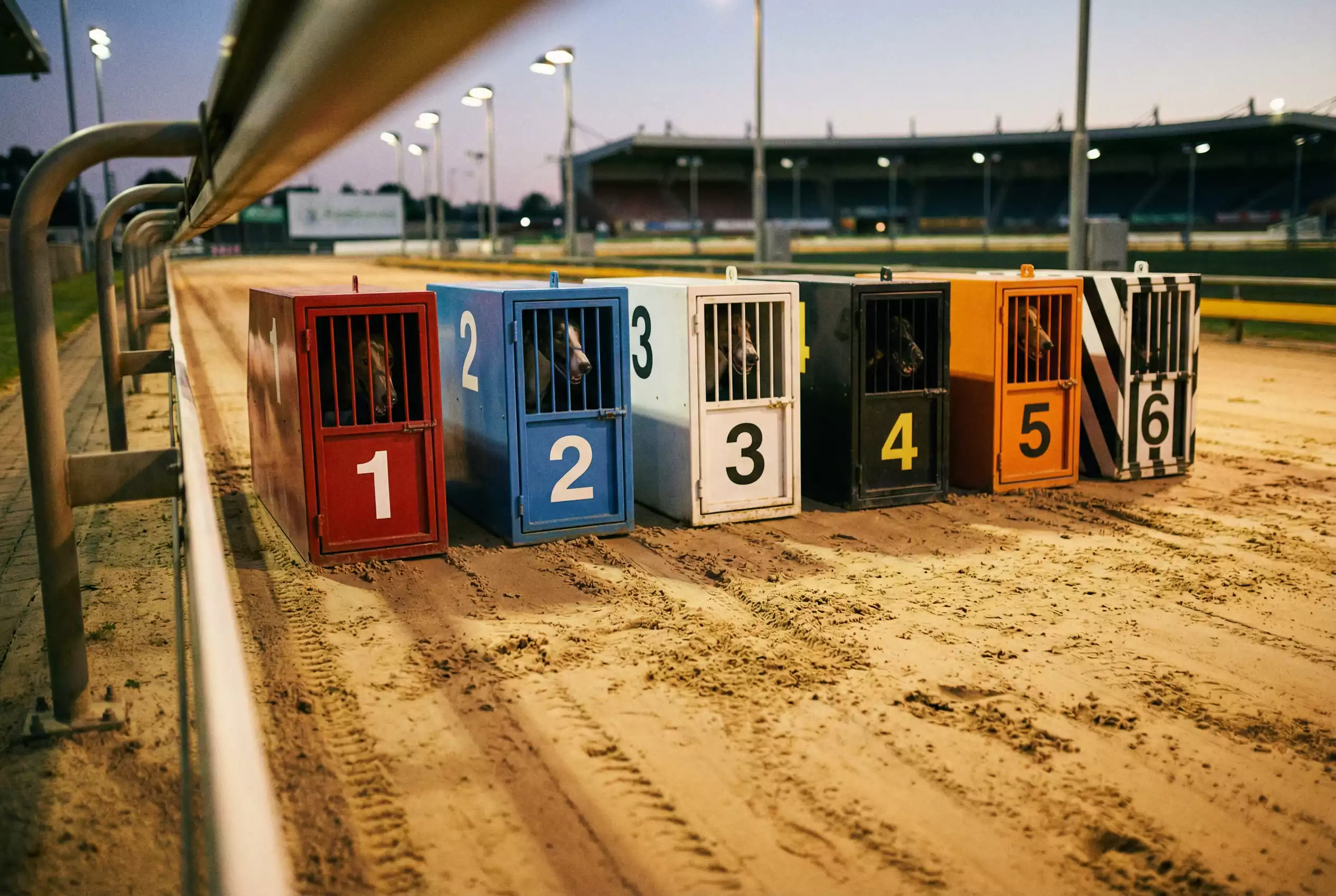
Ask any regular greyhound punter which trap they would rather their selection draw, and the answer is almost always Trap 1. That instinct is correct in aggregate, but applying it uniformly across all tracks, all distances, and all race grades is one of the most persistent errors in greyhound betting. The trap bias in UK racing is real, statistically documented, and worth understanding precisely — but it is not uniform. It varies by track, by distance, by grade, and by the running style of the individual dog. A blanket Trap 1 preference is the starting point, not the finished analysis.
The OLBG annual greyhound statistics, which aggregate favourite and trap win data across all GBGB-licensed UK tracks, provide the most accessible public dataset for trap bias research. The 2024 data showed that in graded racing nationally, the average favourite win rate was 35.67% — but the variance between individual tracks was significant, with some venues posting 42% and others below 32%. Trap win rates display equivalent variance, and understanding that variance rather than relying on a national average is where genuine analytical value emerges.
National Trap 1 Win Percentages by Track
Across the seventeen or so active GBGB-licensed UK tracks, Trap 1 win rates in standard A-grade racing at the principal distance of each venue range from approximately 18% at the widest, most open circuits to above 27% at the tightest. The theoretical expectation for any single trap — given six traps and assumed equal ability across the field — is 16.7%. Every percentage point above that baseline represents a measurable statistical advantage conferred by the draw rather than by the dog’s ability.
The tightest circuits — Crayford (before its 2025 closure), and venues with compact oval designs where the first bend arrives within moments of the trap opening — post the highest Trap 1 win rates. At these venues, the inside draw is effectively a head start that cannot be recovered by a wide-draw dog of equivalent ability unless the railer breaks poorly or checks at the first bend. Crayford’s Trap 1 win rates in sprint racing approach 30% in some grade samples, and even at standard distances the premium sits above 22% in most seasons.
Wide-circuit venues show the softest trap bias. Towcester, by virtue of its large-radius bends and the Derby’s engineering requirement for clean racing, has trap win distributions that are closer to the theoretical equal distribution than any other major UK venue. Trap 1 at Towcester over 500 metres still wins more than 16.7% of the time — the inside draw is never truly neutral on an oval circuit — but the premium is approximately 2–3 percentage points rather than the 8–10 points seen at tight circuits. Nottingham and Yarmouth sit in a middle range: measurable inside bias, softened by bend geometry compared to London circuits.
A practical breakdown by venue type:
| Track Type | Representative Venues | Approx. Trap 1 Win Rate (A-grade, standard distance) |
|---|---|---|
| Tight circuit | Crayford, Harlow | 22–27% |
| Standard oval | Romford, Sunderland, Newcastle | 19–23% |
| Wide circuit | Towcester, Nottingham | 17–20% |
These ranges are indicative rather than precise — they shift year by year as track surfaces are modified, kennel bases change, and the graded field composition evolves. The OLBG annual statistics and the Racing Post’s track statistics section are the best public sources for updated per-track trap data.
Why Trap 1 Railers Have a Statistical Advantage
The mechanical explanation for Trap 1 advantage is straightforward: on a left-hand oval circuit, the inside lane traces a shorter arc through every bend. A dog running close to the inside rail covers demonstrably less ground over the full race distance than a dog running the equivalent race from the outside. Over a standard 500-metre trip at a venue with two full bends, the difference in actual distance covered between the inside and outside line can be two to three metres or more — equivalent to approximately two lengths of dog at racing pace. A Trap 6 railer overcoming that structural distance penalty would need to be running at a materially higher level of ability than a Trap 1 dog of identical quality.
The timing of the disadvantage matters too. The distance penalty falls primarily in the bends, which means it arrives early and sets the positional dynamic for the rest of the race. A wide-draw dog that falls two lengths behind at the first bend through the mechanics of the circuit has to race through or around other dogs to recover that position — which may involve interference, checking, or simply running at an unsustainable pace. The inside draw dog, meanwhile, settles into its position with the rail on its left, expending less energy and experiencing less risk of first-bend contact.
The advantage is largest in sprint races, where the total racing time is shortest and the first bend arrives most quickly relative to the length of the race. At 262 metres, the entire race is essentially decided in the first bend. A Trap 1 railer that reaches the bend first and finds the inside clear will frequently win regardless of the absolute ability differences between it and the wide-draw dogs. At 600 or 700 metres, the same Trap 1 railer has an early advantage but a larger remaining distance over which that advantage can be eroded by a stamina-dominant wide runner who settles into a rhythm in the back straight. Distance neutralises trap bias; the longer the race, the weaker the statistical signal.
Running style compounds the trap effect. Not every dog prefers to race on the inside. Confirmed wide runners — dogs that naturally swing to the outside through bends — can actually perform below their ability when drawn Trap 1, because they are fighting their natural running preference to maintain the inside line. A Trap 1 wide runner who races wide in the bends covers extra ground from the worst possible starting position. These dogs are relatively easy to identify from their form history: look for Trap 1 draws accompanied by times that are slower than their inside-draw times from other entries. The pattern, when present, is consistent and actionable.
Tracks Where Trap 1 Underperforms: The Counterintuitive Data
There are specific contexts within UK greyhound racing where Trap 1 underperforms its theoretical advantage, and identifying them is as analytically valuable as understanding where the advantage is strongest. The most common contexts are wide-circuit venues, long distances, and racing conditions that favour back-end runners.
At Towcester specifically, the combination of wide bends and high-quality competition means that Trap 1 railers face a field where the ability range is narrow and where wide-running dogs have been selected partly for their ability to compete effectively from outside draws. The structural advantage of Trap 1 at Towcester exists but is largely offset by these selection effects, particularly in open race events. During Derby rounds, some historical data suggests Trap 1 does not significantly outperform expectation — the market has priced the draw correctly, and the racing is clean enough that ability rather than position determines outcomes at a higher rate than at typical graded meetings.
Stayers’ events at 680–700 metres at any venue show reduced trap bias compared to standard distances. The physics are simple: over a longer race, positional advantages from the first bend are diluted by the additional ground that follows it. A wide-draw dog with superior long-distance stamina can overtake a railer that has burned its early advantage before the final bend. At these distances, Trap 1 win rates at most UK venues approach or fall close to the 16.7% theoretical expectation.
Sprint racing produces an interesting counter-case at venues with particularly wide starting facilities. If the trap positions are spaced further apart than at a compact circuit, the Trap 1 advantage narrows because Trap 6 runners can find racing room more easily. The extent of this effect varies by venue design and is not always reflected in publicly available track descriptions — it may require watching race replays to identify whether the sprint setup at a specific venue is meaningfully narrowing the usual inside advantage.
Rain and soft going conditions soften trap bias measurably at most venues. Wet surfaces slow all dogs, but they disproportionately affect dogs that rely on the hardest, fastest surfaces to generate their best pace. Inside railers, who tend to run tight and low-energy through the bends, often handle soft going better than wide runners who generate their speed through longer, faster strides. However, very soft going can also cause dogs to check on the inside rail if the footing is treacherous close to the bend board, which introduces a safety variable that reduces the reliability of the inside draw. Under genuinely soft conditions, the trap bias signal weakens — a useful correction to apply in winter evening racing.
How to Use Trap Statistics in Your Greyhound Betting
Trap statistics are a filter, not a strategy. The error that produces most trap-related losses is treating the statistical bias as a standalone selection rationale — backing Trap 1 runners regardless of their ability, their trainer’s current form, their running style, or the specific conditions of the race. Over a large sample, backing every Trap 1 runner in graded races returns a modest profit at some venues. Over a medium sample, the variance is large enough to produce extended losing runs that punters mistake for evidence the strategy has stopped working. Over a realistic betting horizon, the edge from trap bias alone — absent any form filtering — is too thin to sustain a profitable long-term approach.
The correct integration of trap statistics into selection methodology is as a multiplier on form assessment rather than a replacement for it. Begin with the form: which dogs in this field are capable of winning based on their times, grades, recent trajectory, and trainer data? Then apply the trap modifier: of the dogs capable of winning, which is drawn where, and how does the draw affect each dog’s probability of expressing its ability in this specific race? A capable dog drawn Trap 1 is a stronger selection than the same dog drawn Trap 6. A below-form dog drawn Trap 1 is still a below-form dog.
The most actionable version of trap statistics is the detection of mismatch between draw and running style — cases where a confirmed wide runner draws Trap 1, or a confirmed railer draws Trap 6. These mismatches typically create mispriced market outcomes: the Trap 1 wide runner is overpriced because the market reads the inside draw as an advantage, when for this specific dog it represents a disadvantage. The Trap 6 railer is underpriced for the opposite reason. Identifying these mismatches from a form database requires tracking each dog’s best and worst draw performances — a modest research investment that pays consistent dividends.
Beyond Trap 1: Full Trap Bias Statistics for UK Racing
The full trap bias picture across UK racing is more nuanced than the Trap 1 story alone. Trap 2 consistently posts win rates that are second only to Trap 1 at most venues, and at several tracks the Trap 2 premium is nearly as large. Because Trap 2 receives less market attention than Trap 1 in the pre-race discussion, Trap 2 runners are often available at marginally better odds than their equivalent Trap 1 probability would justify. This Trap 2 undervaluation is documented in the OLBG annual statistics and is one of the more robust small edges available to informed greyhound punters.
Traps 3 and 4 are broadly neutral in terms of bias at most UK venues — they occupy the middle ground, neither favouring nor penalising a dog that has no strong preference for inside or outside running. Their win rates at most tracks sit within two or three percentage points of the 16.7% expectation, and the market tends to price them accordingly. There is no systematic edge in either backing or opposing middle-draw dogs on the basis of the draw alone.
Traps 5 and 6 are underperformers in aggregate, consistent with the geometry of oval circuits. But the degree of underperformance varies by venue, distance, and grade, and there are consistent exceptions: wide runners specifically suited to outside draws, wide-circuit venues where the penalty is minimal, and long-distance stayers’ events where the first-bend advantage has dissolved by the final straight. Understanding these exceptions is what separates a sophisticated trap analyst from a punter who simply avoids Traps 5 and 6 reflexively and misses the genuine value opportunities they occasionally provide.
The most useful habit a greyhound punter can develop around trap statistics is simple record-keeping. After each card, note the trap and result alongside the finishing time. Over a month of following a single venue, a clear pattern emerges: which traps at which distances at this track produce the strongest statistical overperformance, and which dogs in the current active field match or resist that pattern based on their running style. That combination of venue-level trap data and dog-level running style data is the complete picture, and it is available to anyone willing to build it from publicly accessible results.